

When I went to the monkey puzzle tree (Araucaria araucana) forests of Chile in March and April of this year I had a specific list of target species I was hoping to photograph, to complete the images for my book project about the Ancient Araucaria Forests of the Andes. I referred to this book in my previous blog, and my visit this year was the last of five I’ve made since early 2015 to document the forest in all the seasons of the year. This time I was going in late summer and early autumn, hoping to catch some of the features and phenomena of both seasons.
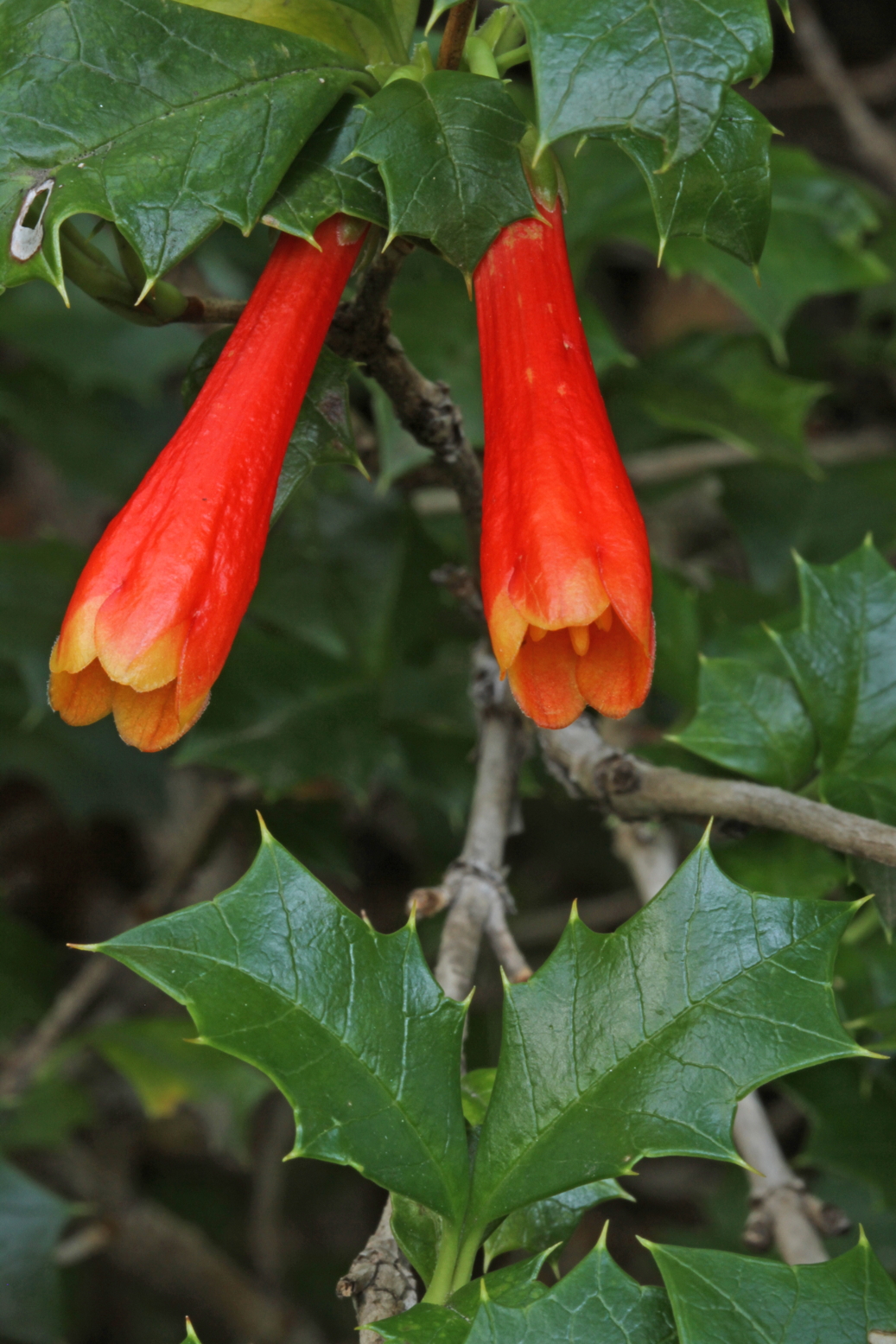
One of my top priorities was to get some photographs of the most southerly occurring species of hummingbird in the world, the green-backed firecrown (Sephanoides sephaniodes) – an agile aerial acrobat which plays a key role in the pollination of many of the understorey flowering plants in the Araucaria forests. In fact, this beautifully-coloured bird, together with the flowers it is intimately associated with, is often quoted as a text-book example of the phenomenon of coevolution.
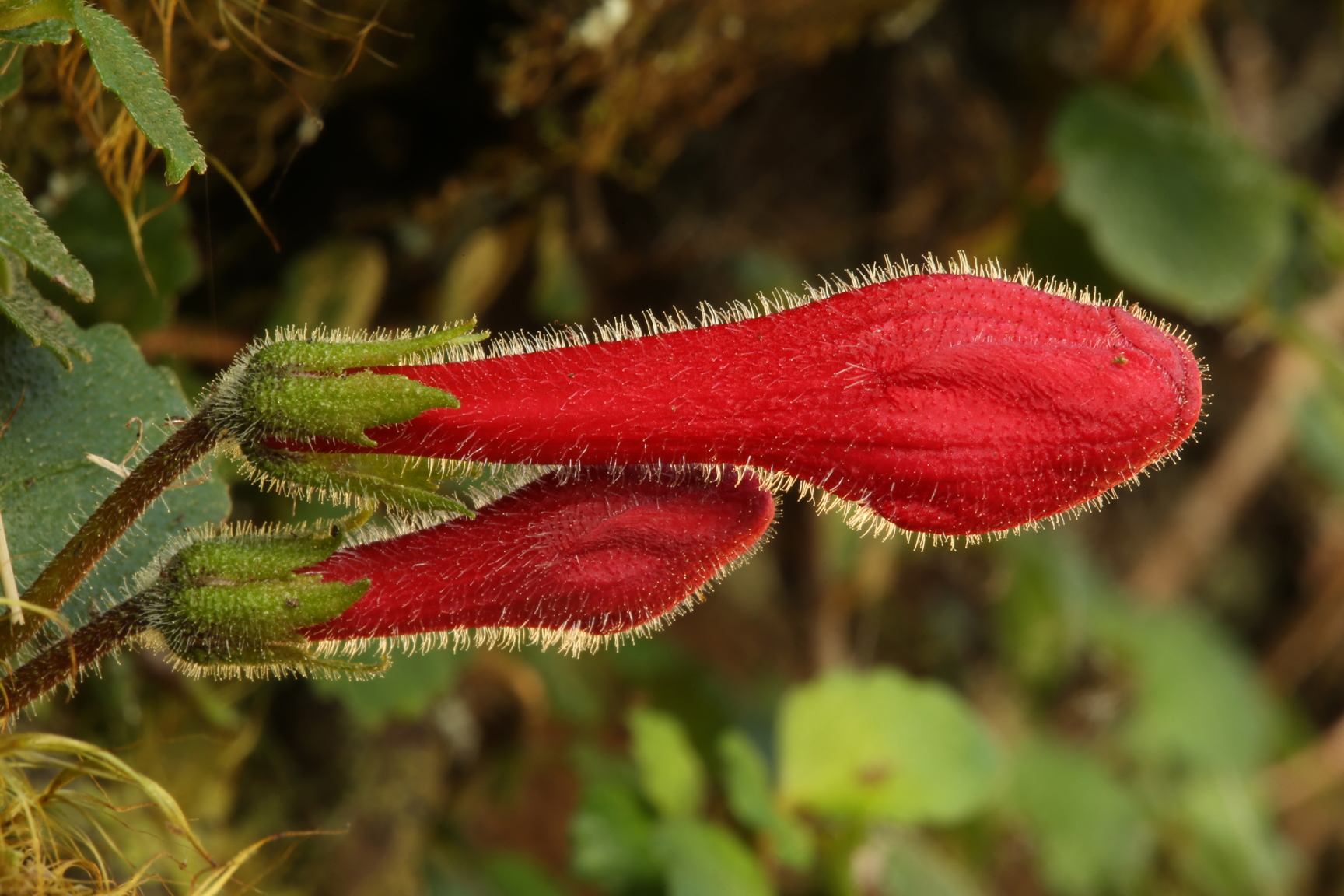

That is the term for the evolutionary process in which two (or more) species have developed features or characteristics that serve the other species, thereby drawing them together in an intimate and often mutualistic relationship, in which both benefit from the presence and actions of the other. In this case the red colour of the flowers attracts the hummingbird, and the tubular shape of the blossoms matches the bird’s long narrow bill. The hummingbird uses this to sip nectar that the flowers provide, and in return it transfers pollen from one flower to another as it feeds, thereby enabling fertilisation and seed production to take place for the plants. One of the interesting features of the Araucaria forests is the number of different plant species in them that have red tubular flowers. These blossom at different times, from early spring in the case of species such as the flor de la cascada, or cascade flower (Ourisia ruelloides), through the summer and well into autumn for plants such as taique (Desfontainia spinosa).
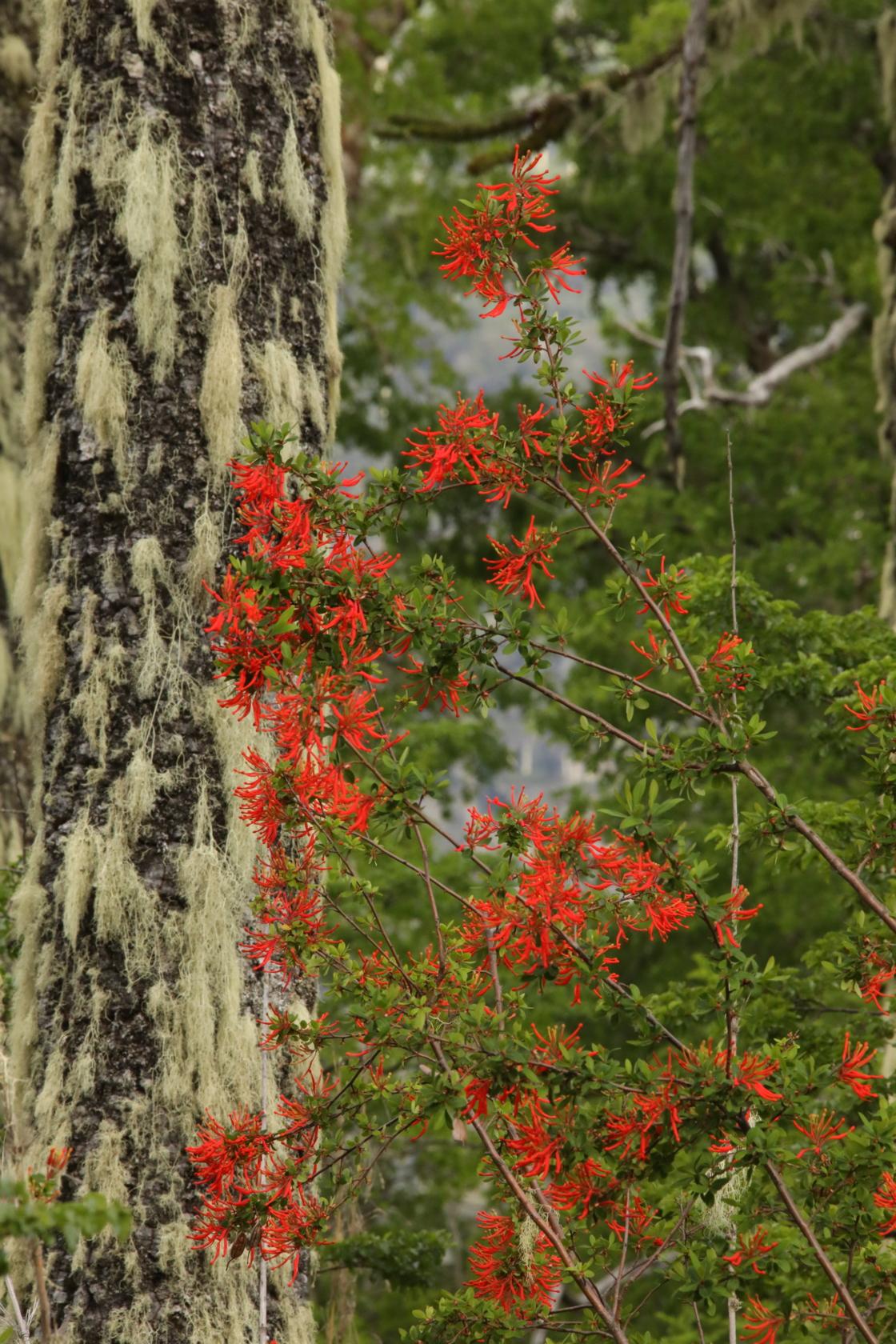
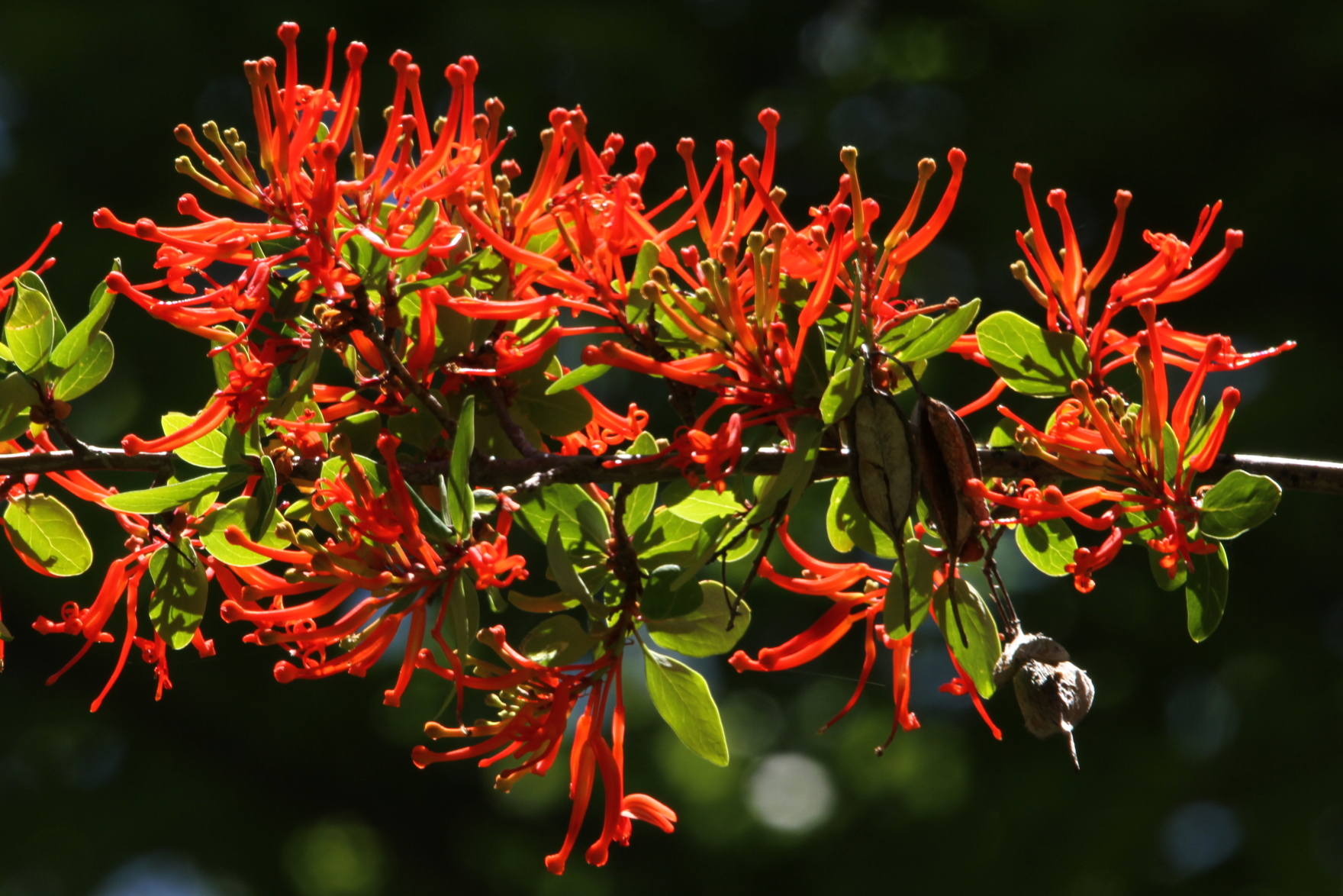
The Chilean firebush or notro, as it is known in Spanish (Embothrium coccineum), is another species that blossoms with dense clusters of red tubular flowers in the spring, making it very visible in the forest.
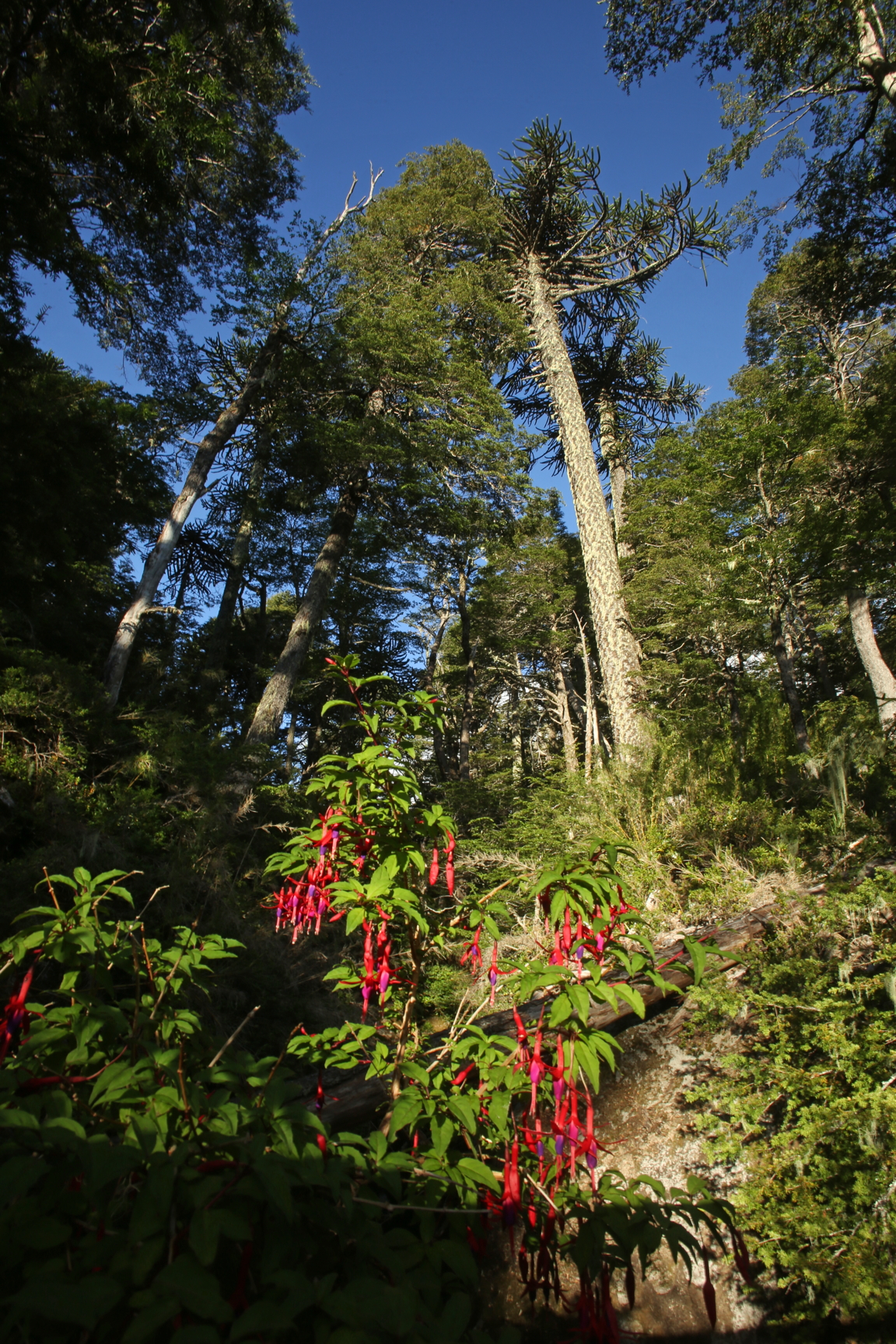
Many of these are relatively small plants in the forest understorey, but the chilco (Fuchsia magellanica) can grow to be a substantial shrub, up to three metres in height, and spreading, in open conditions with lots of light, to almost three metres in width. Large bushes can be covered in hundreds of blossoms, making it one of the most significant food plants for the green-backed firecrown. (Incidentally, the profuse flowering of this species has also led to its widespread planting as an ornamental species in gardens in Europe, North America and Australia, far from its native habitat in southern Chile and Argentina.) When I’d seen the green-backed firecrown very fleetingly during my previous trips to the Araucaria forest, it had been when they were feeding at chilco bushes, so I knew that my best opportunity to get some photographs of them would be to find one of the bushes in full flower.
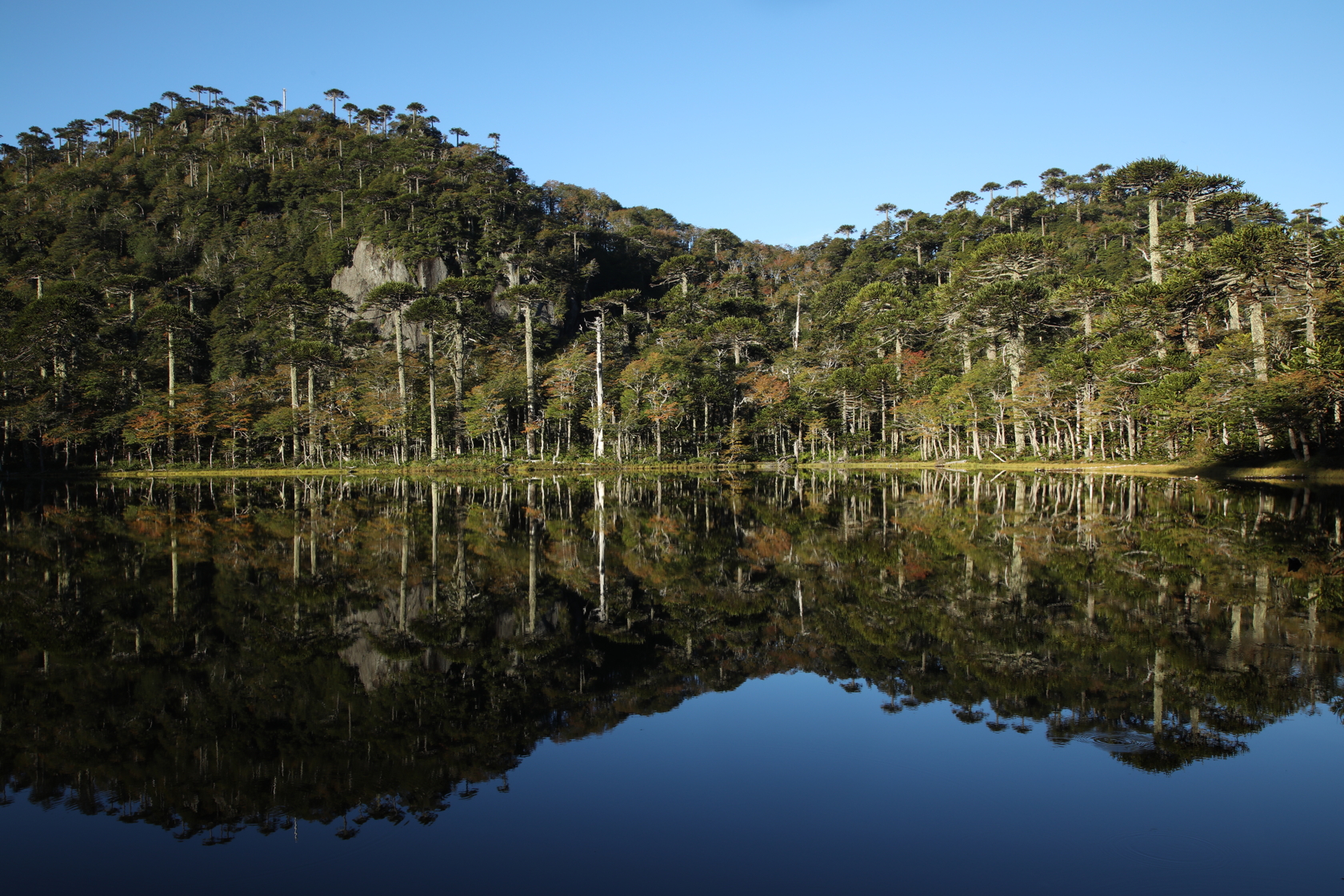
At the end of March, a week into this latest journey to Chile, I had planned a 5 day trip up into the Cañi Sanctuary, a 500 hectare area of land owned by a Chilean conservation organisation near the town of Pucon. It protects a beautiful site with numerous lagoons in an old volcanic caldera, surrounded by an undisturbed Araucaria forest. It’s a 7 km. hike to get to the Sanctuary’s campsite at Laguna Negra, and the first 4 km. are consistently steep, which makes it very difficult to do with two backpacks, as I have – one for all my camera gear and the other containing my tent and other camping equipment. Fortunately, a young Canadian man who wanted to visit the site offered to join me and carry my camping backpack, which made the trip possible for me.
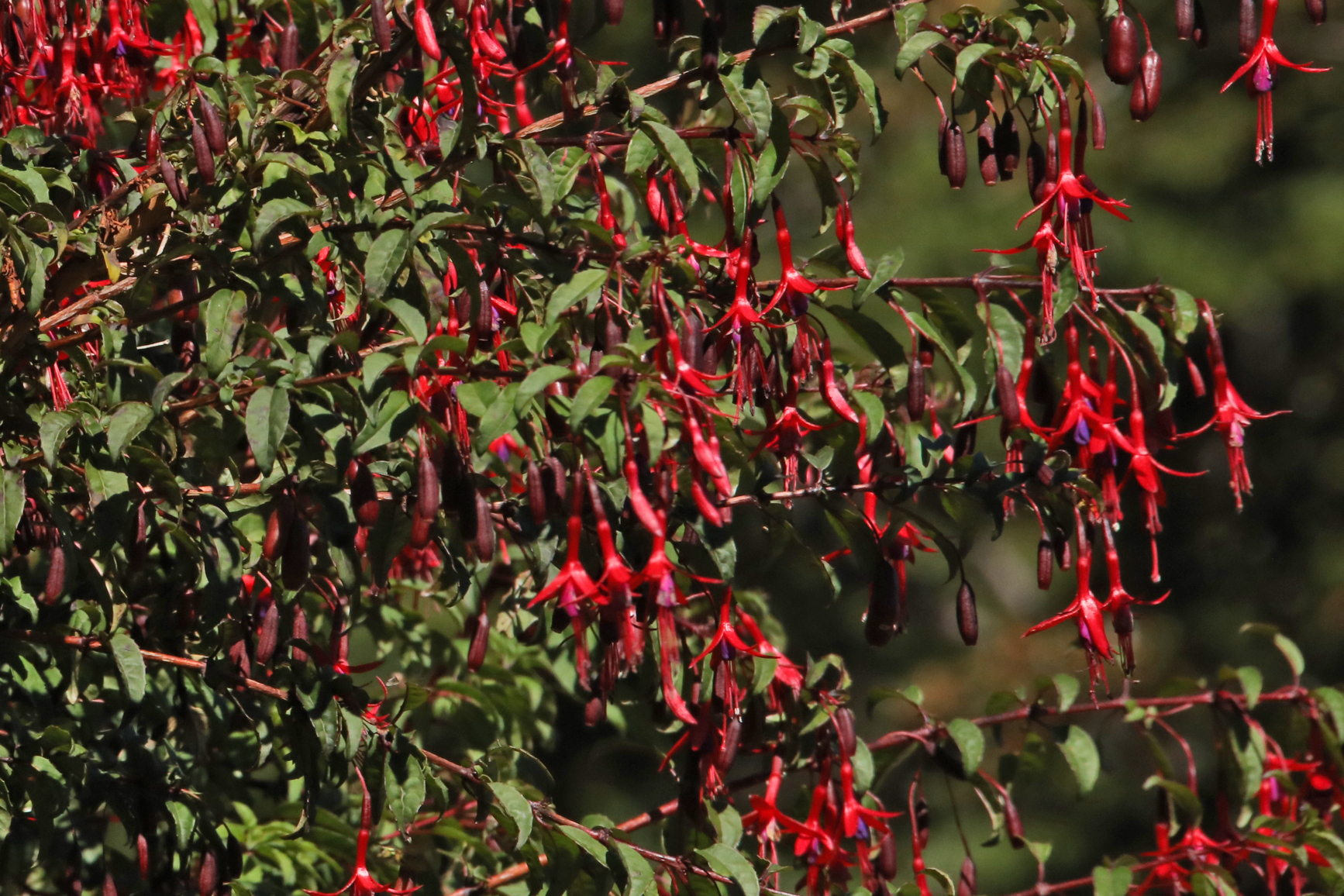
Although we set off together, my young companion soon outpaced me on the steep trail, and when I reached the entrance to the Sanctuary, after 4 km., I hadn’t seen him for over an hour. There’s a small refugio, or mountain hut, at the entrance and I stopped there to have a rest and a drink of water, as it was a sunny day and I was hot and sweaty from the climb. Almost immediately, my eye was drawn to a large chilco bush, which was in full bloom in front of the refugio. This seemed like a good possibility to see the green-backed firecrown, and indeed after a few minutes one duly appeared.blossom

Pulling out my camera, I attached my 120-400 mm lens and attempted to take some photos of the hummingbird as it fed on the flowers. It proved to be a futile venture though, as the bird was very fast indeed, flitting rapidly from flower to flower, and only staying at each blossom for a second or two before moving. This meant there was no time to turn the camera, find the bird in the viewfinder, focus and take a shot before it had moved on again. However, it did rest for a few moments perched on a branch above the chilco’s flowers, and I was able to get one or two shots of it there.
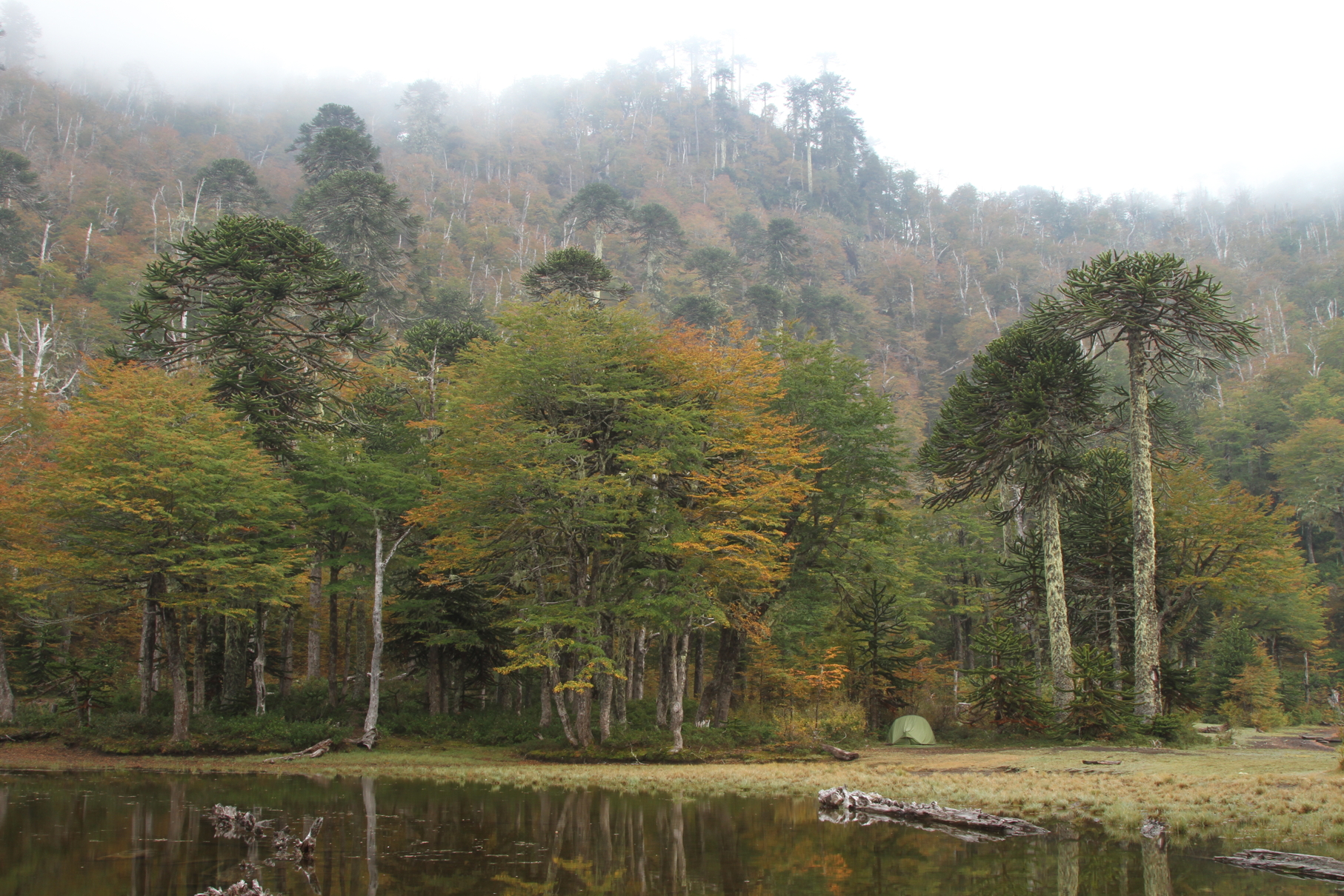
I would have liked to spend more time then, to see if I could get some photographs of the green-backed firecrown feeding at the chilco’s flowers, but I knew I needed to keep going on the trail, to meet up with my companion ahead. Reluctantly I set off from the refugio, but I was already planning for a return to this chilco bush during the next four days that I’d be in the Sanctuary, to see if I could get the shots I was after. From the hut it was another 3 km. to the campsite, but the trail was much easier, being flat for considerable sections, and the steep parts were relatively short.
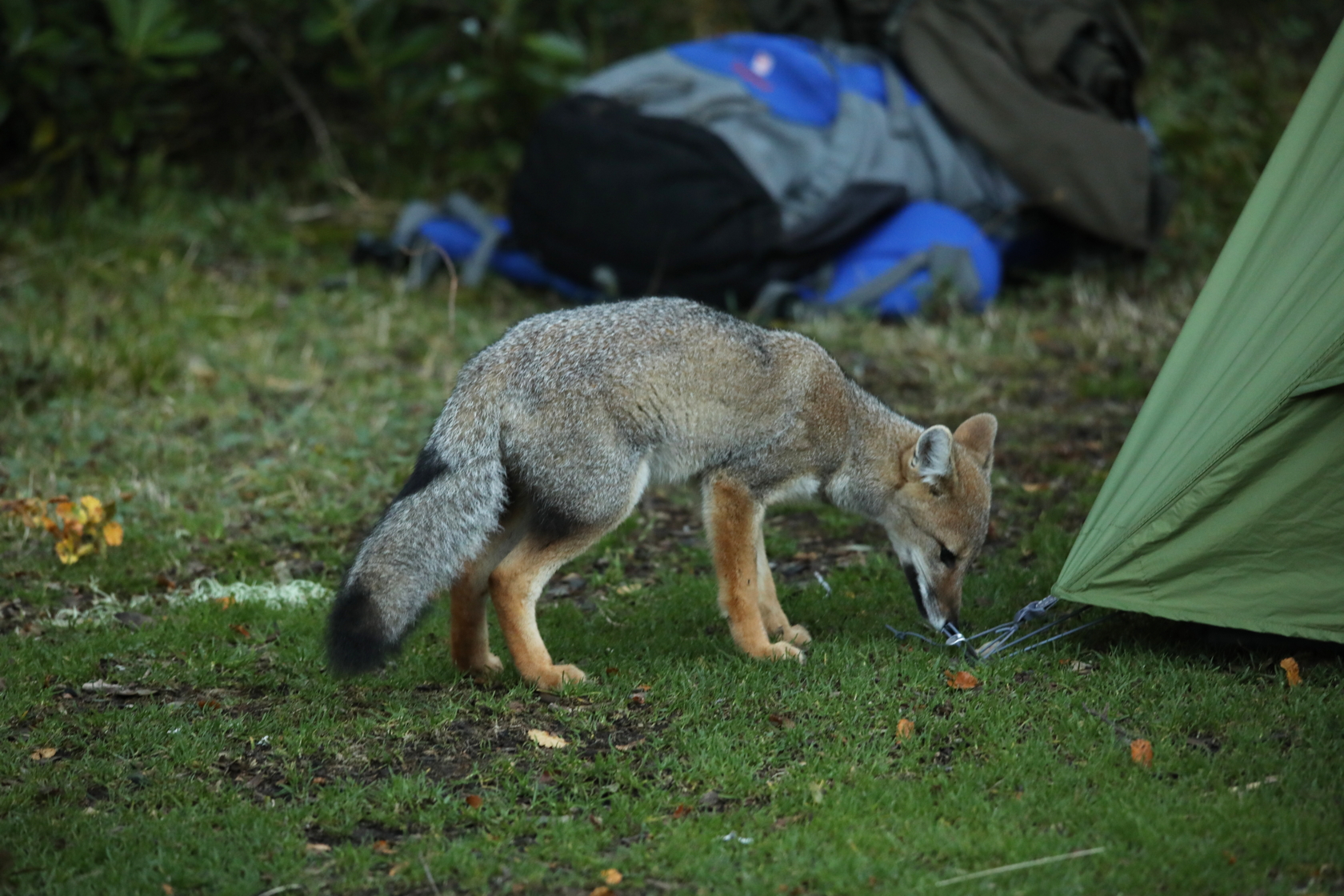
However, just as I approached Laguna Negra, where I’d be camping for the next four nights, I met my young Canadian friend, already on his way down, as he had to be back in Pucon that evening. He’d already made the steep climb from Laguna Negra up to the spectacular summit viewpoint of the Sanctuary, so I thanked him profusely for his help and he set off down the trail. I continued on to the campsite by the lagoon, and as I was setting up my tent an unexpected visitor appeared…
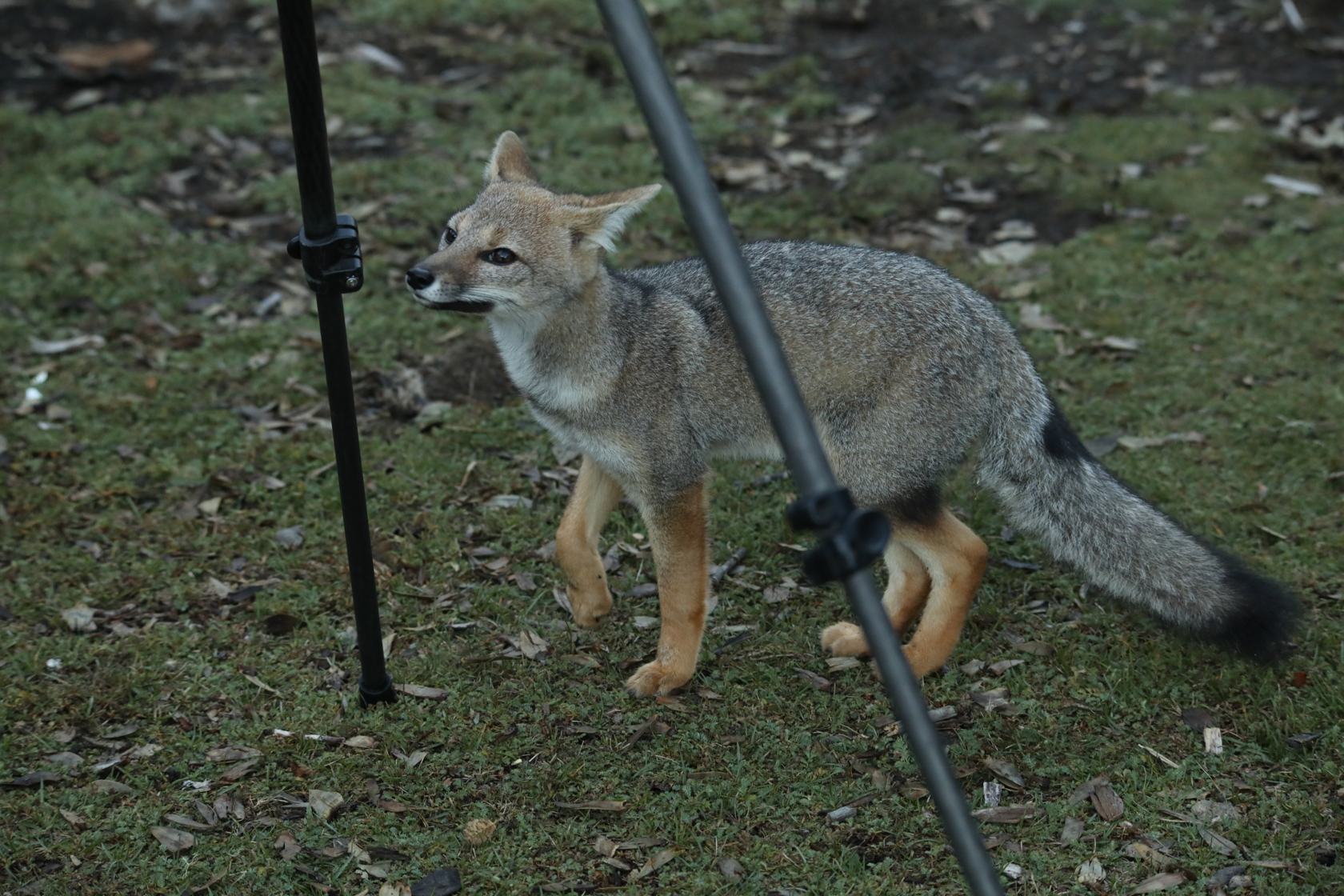
It was one of the foxes native to southern Chile – the zorro chilla, or grey fox (Lycalopex griseus). When I first saw it, out of the corner of my eye, I thought it was a cat, as it was about the size of a large domestic feline, and it moved gracefully in complete silence. As soon as I turned to look at it though, I realised it was a small fox, and I suspect this was a young individual as it was completely fearless.
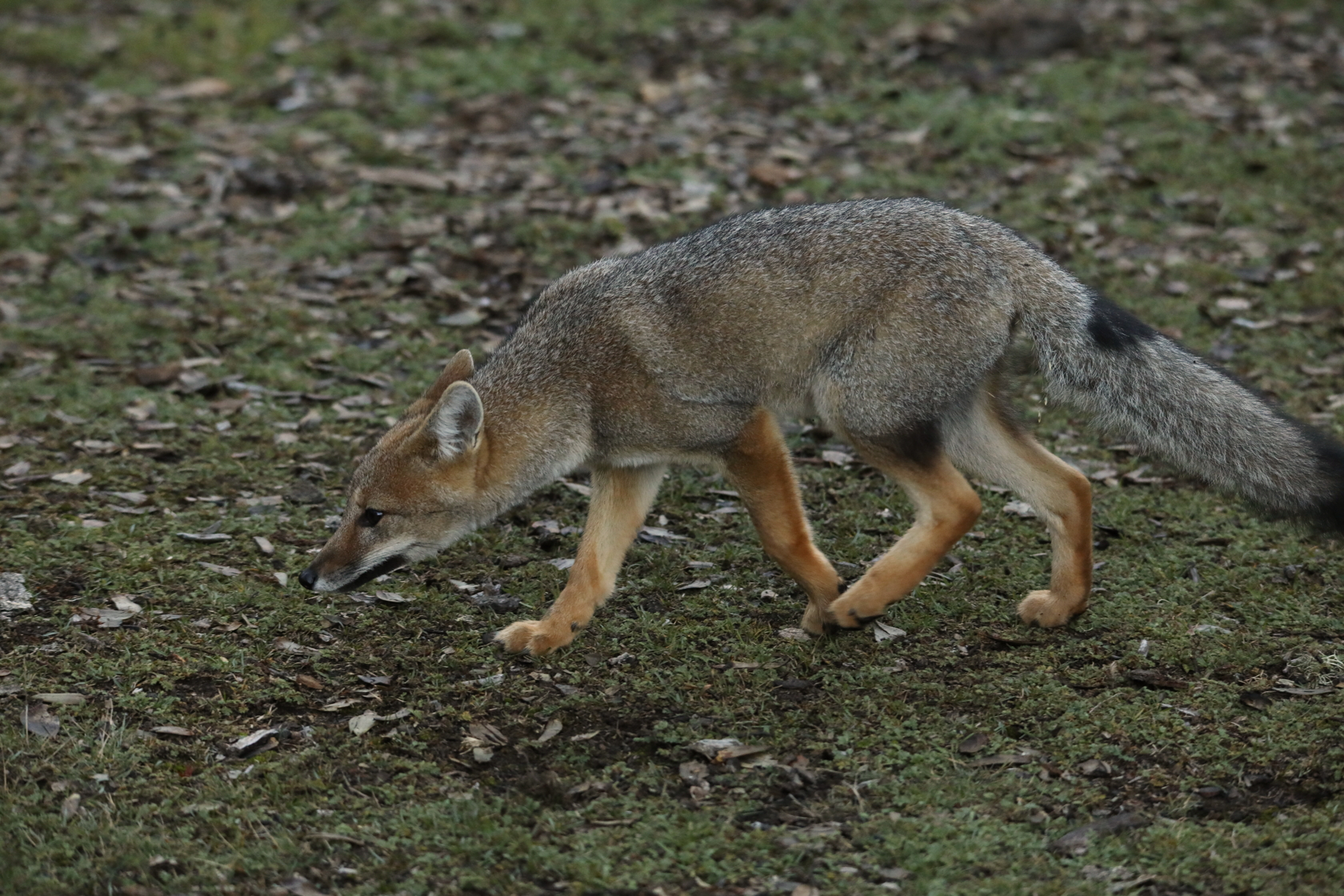
It wandered nonchalantly about the campsite, sniffing out my tent and another nearby tent, and also investigating my tripod. I watched it for quite a while, as it went around the campsite, looking for food scraps in a methodical way that indicated this was regular behaviour on its part. My food was all safely stored inside my backpack, so the fox had no joy at my campsite that day. However, the next morning when I was preparing a sandwich for my lunch that day, I went to my tent to get something and when I returned a few seconds later, the slice of bread was gone. I hadn’t seen the fox yet that morning, but when I quickly looked around now, I saw it running away through the vegetation, having snaffled my slice of bread! After that I was very careful, and in fact I only observed the fox one more time, in the distance, a couple of days later.
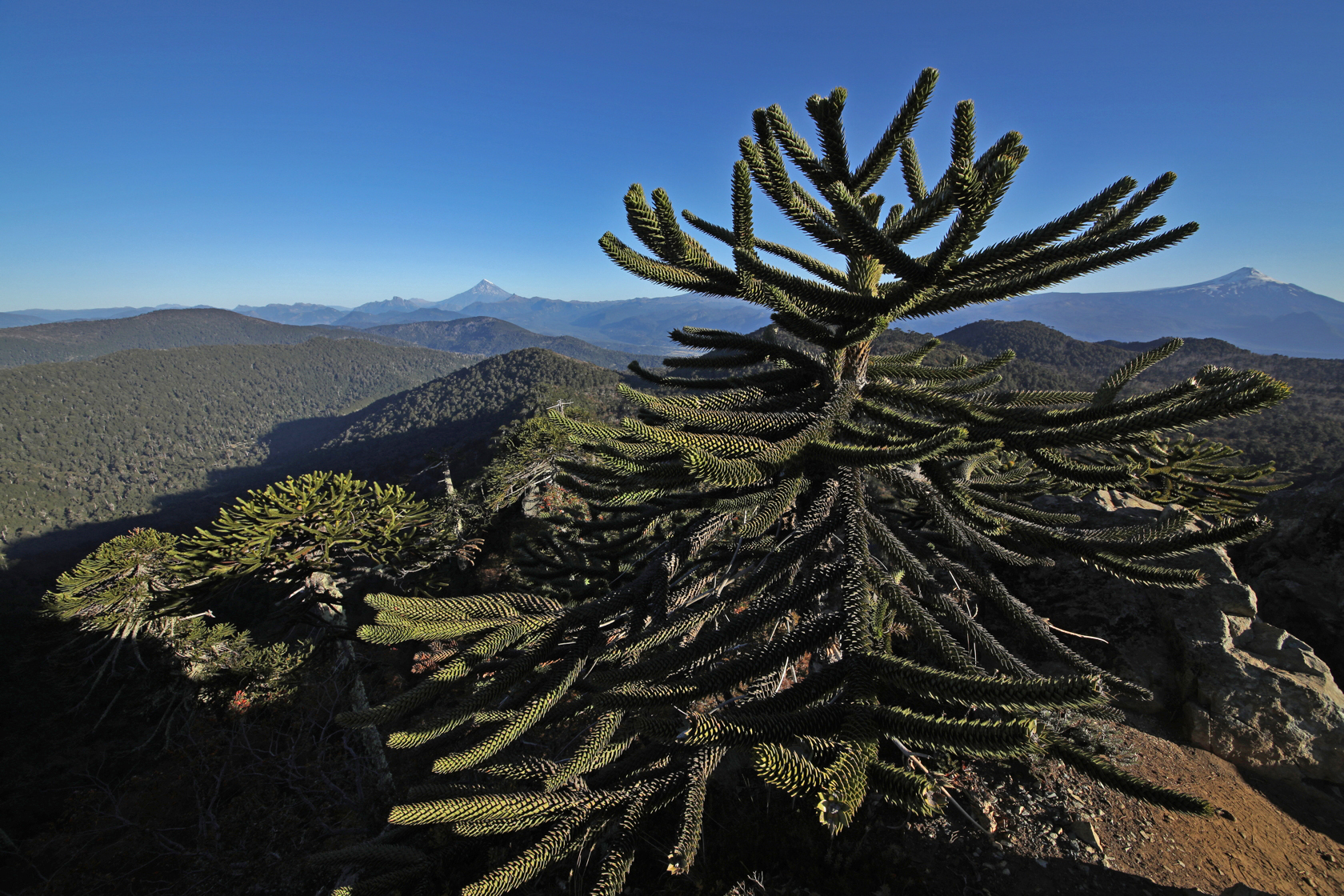
I had visited the Cañi Sanctuary twice before, once in 1998, and then again more recently in November 2017, so I knew the area from those trips. This helped me plan out how to use my time, and I spent the next two days taking photographs around the series of lagoons, and also climbing to the viewpoint, or mirador, from where there are spectacular vistas out over the canopy of the Araucaria forest towards some of the region’s snow-capped volcanoes.
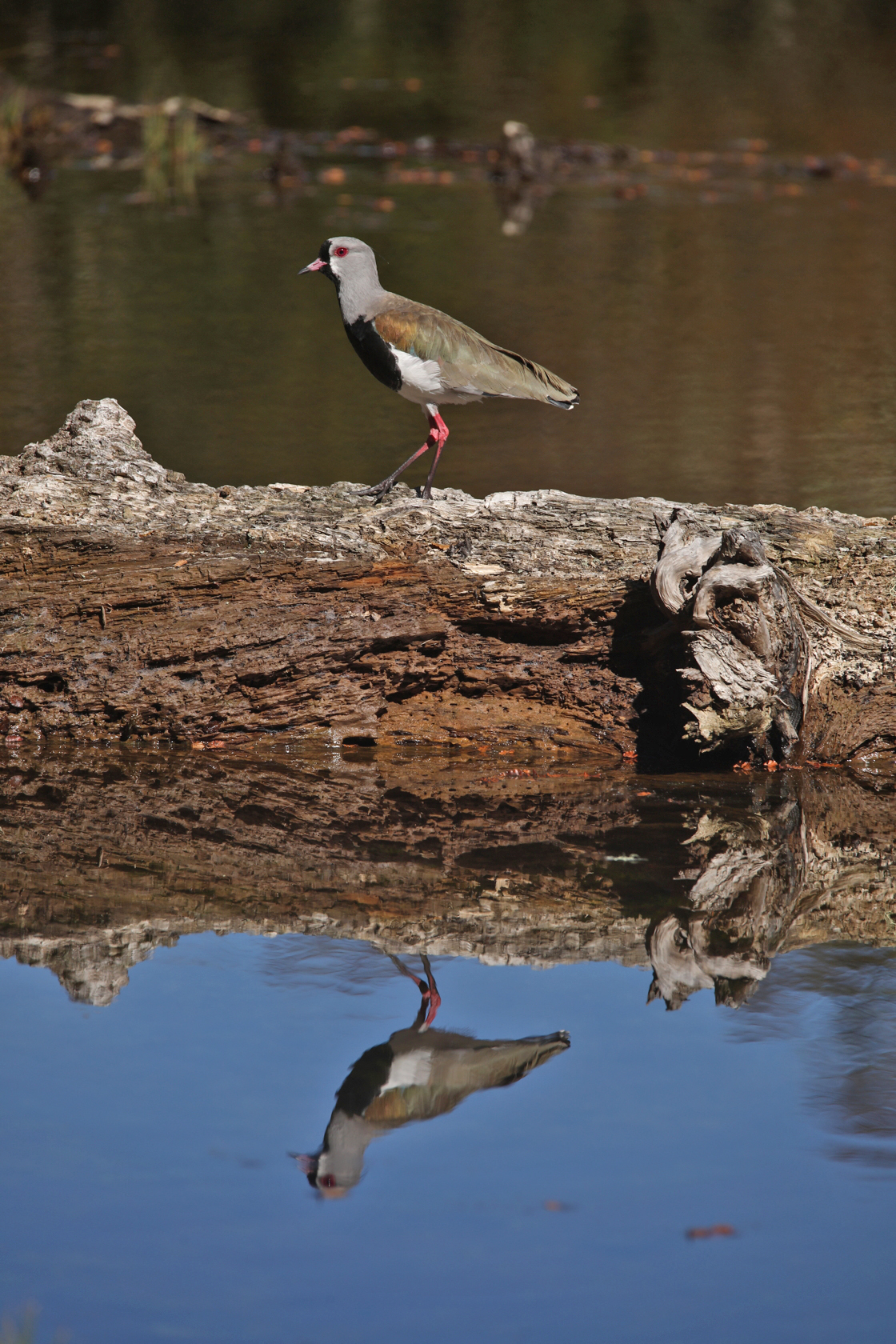
The next day was going to be my last full day in the Sanctuary, and with the morning arriving sunny and cloudless, I knew it would be my best opportunity to get some photographs of the green-backed firecrown. While I got ready for the hike back down to the refugio at the entrance, a southern lapwing, or treile (Vanellus chilensis) as it is known in Spanish, began calling nearby. This is quite a beautifully-coloured bird, with a piercing repetitive alarm call, and it had obviously seen me already. Looking around, I spotted it on the trunk of a dead Araucaria tree that had fallen into Laguna Negra, where it was perfectly reflected in the still water. Grabbing my camera, I quickly took some photographs, and I also managed to shoot a brief video clip of the bird calling. This seemed like a good omen for my mission for the day. As I walked down the trail though, the thought came into my mind that I was potentially going to have to stake out the large chilco bush for an extended period of time, if I was to have any hope of success with photographing the hummingbird.
Here’s a brief video clip of the southern lapwing making its alarm call:
https://www.youtube.com/watch?v=P4StO4xrBqY;vq=hd720&rel=0&showinfo=0
Reaching the refugio, I took a minute or two to have a drink of water and then began watching the chilco bush. Sure enough, a hummingbird soon appeared, flitting rapidly from flower to flower and then speeding away again. I knew I had the chance to get some good images, but the question was how to achieve this? I very quickly discovered that using my tripod was hopeless. When a bird appeared, by the time I had turned the camera on the tripod’s head to where the hummingbird had been, it had already gone.
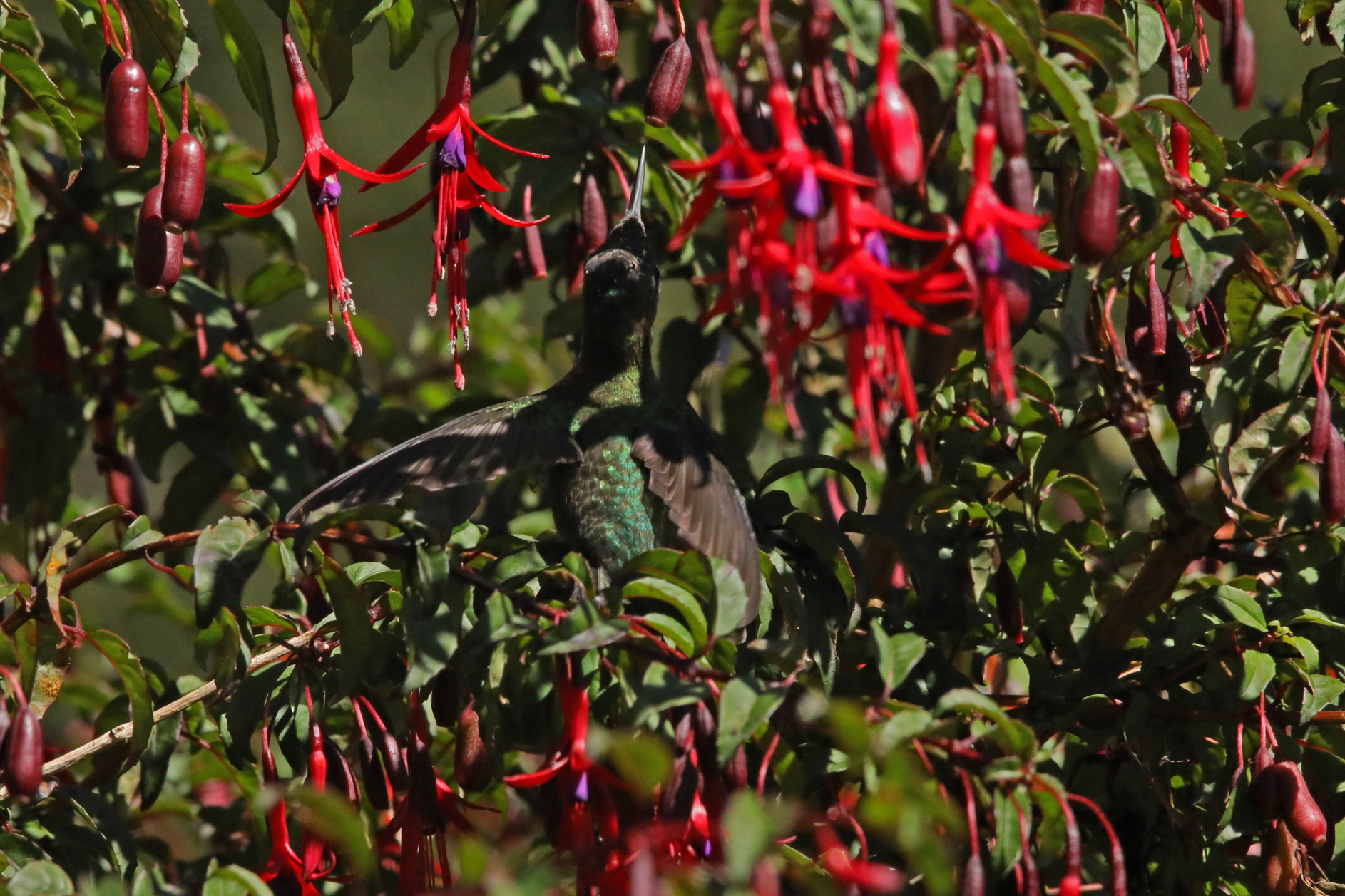
The challenges of photographing the birds were compounded by the sheer size of the chilco bush and the position of its numerous blossoms. It was unpredictable where any of the birds would appear, so I couldn’t just set the camera up to focus on a fixed part of the bush and wait for one – that might have taken hours before a bird would be in the frame of the shot. Sometimes I was able to get the camera focused on where a hummingbird was, only to have it be partially hidden by the flowers and/or the deep shade being cast on this sunny, cloudless day. I did manage to get one or two images, such as this one here, but they didn’t show the green-backed firecrown, or its feeding on the chilco blossoms, as clearly as I wanted.
I was also using the camera at the upper limit of its capabilities. Because the hummingbirds are so fast, with wingbeats of up to 80 times per second, very high shutter speeds, in excess of 1/2000 of a second, are required to get sharp images of the wings, without any blurring from their movement. I also had the lens stopped down to f/11 or f/13, in order to get a reasonable depth of field at the 400 mm focal length setting I was using on my zoom lens. This in turn necessitated a high ISO setting, in this case ISO 3200, for there to be enough light reaching the camera’s sensor to make a correct exposure. Fortunately, because of the bright, sunny conditions I was able to achieve this.
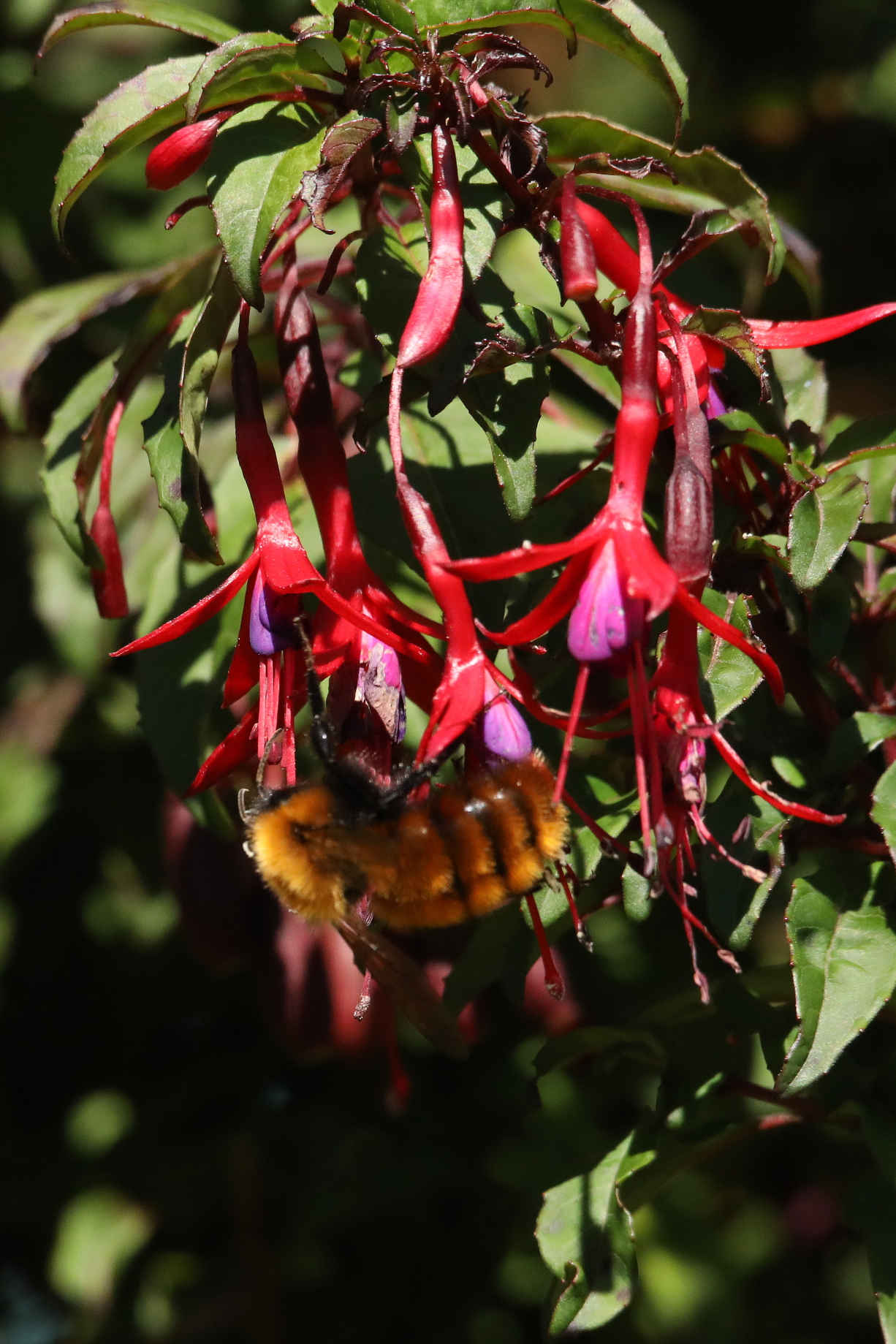
Having mastered the technical requirements of being able to get a shot of a hummingbird sharp and in focus while it was hovering in mid-air, I still had the much tougher challenge of getting a good composition that showed how they feed on the chilco’s blossoms. I continued to have the same problem, of not being able to move the camera quickly enough to get a bird in the frame and fire off a shot before it had moved on to another part of the chilco bush. This was in due in part to the combined weight of my camera body and large zoom lens – I simply couldn’t keep it up at eye level for any length of time, and so had to lower it regularly to give my muscles a rest. Then when a green-backed firecrown appeared, the delay while I raised the camera to my eye was usually enough for me to miss it, as it had already moved on to another part of the bush. As a result, I spent quite a while trying unsuccessfully to get any decent photographs.
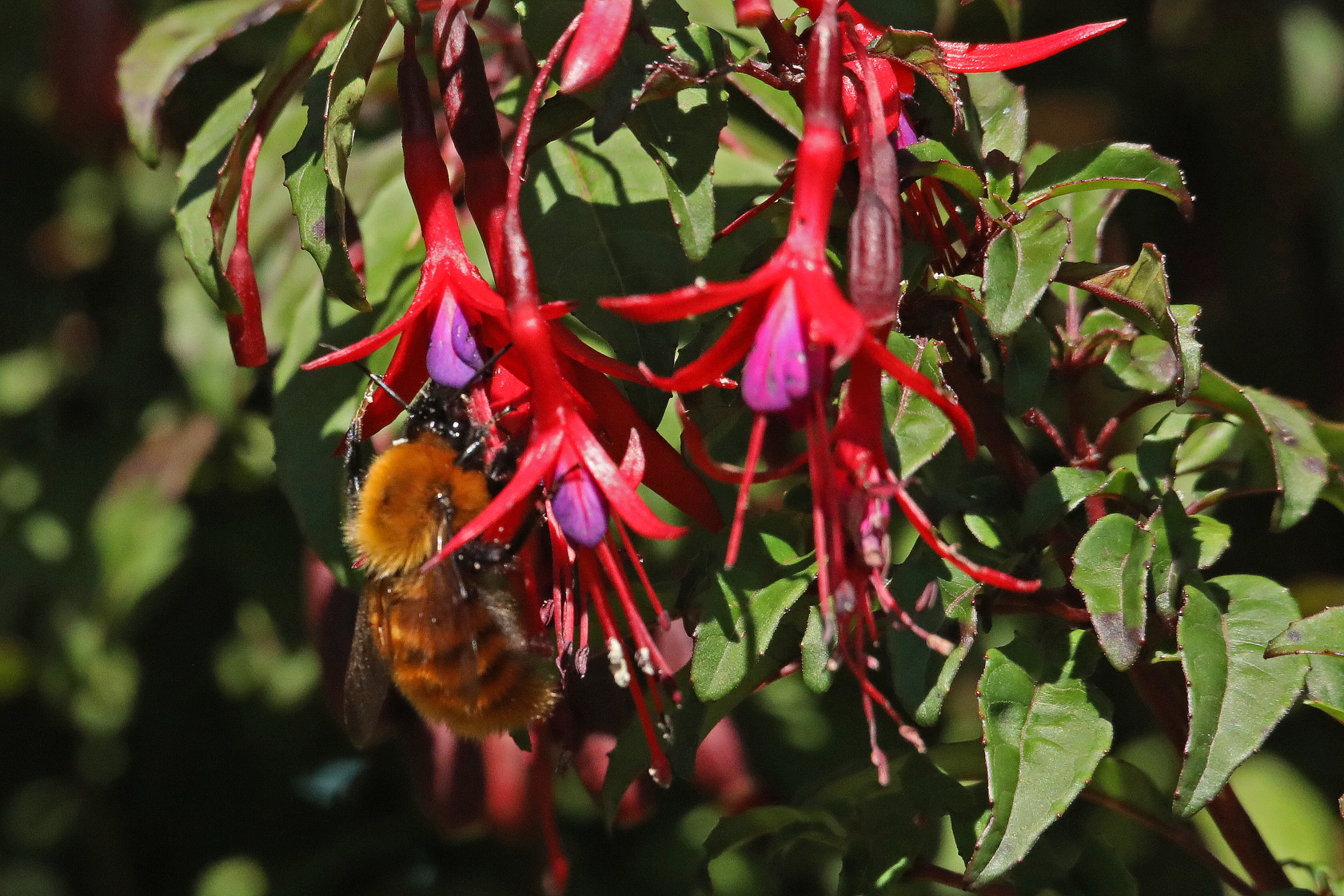
However, at a certain point, my attention was diverted by another visitor to the chilco’s blossoms. This was a large orange bumblebee that I recognised immediately as being the endemic Patagonian bumblebee (Bombus dahlbomii) – an endangered species that was also on my target list to photograph on this trip. I had never seen this bumblebee during my other 4 visits to Chile in the previous 3 years, as it has been displaced from most areas by the invasive non-native buff-tailed bumblebee (Bombus terrestris) that has been introduced from Europe.
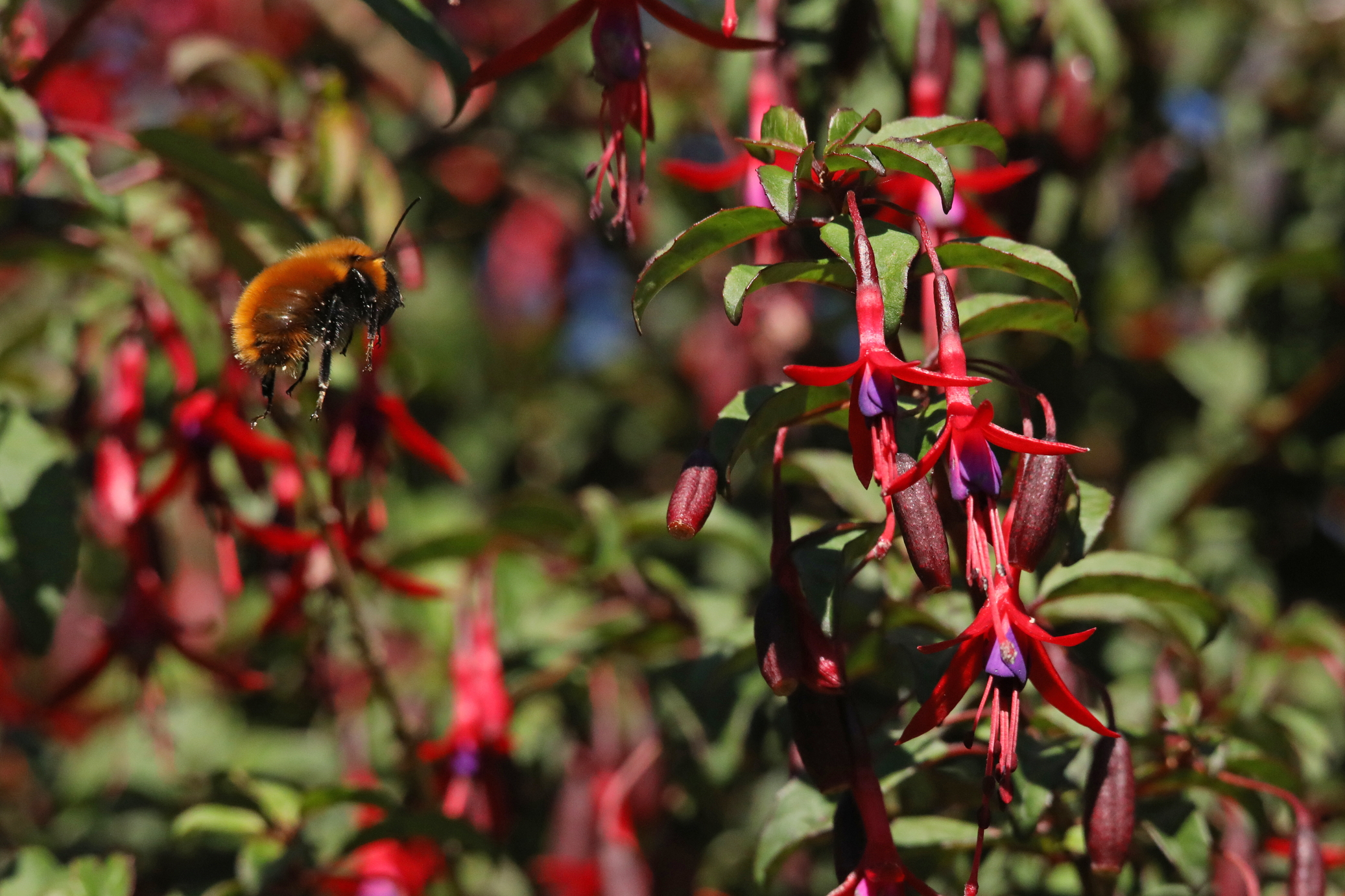
That bumblebee has been imported in large numbers to pollinate commercial crops, with almost 200,000 queens introduced in 2015 alone. They have given rise to colonies that have spread rapidly, and their range expansion, plus to a lesser extent that of another introduced species (Bombus ruderatus), has been paralleled by a dramatic reduction in both the range and numbers of the Patagonian bumblebee. This has resulted in Bombus dahlbomii being classified as Endangered on the IUCN Red List of Threatened Species, meaning that it is now considered to be at serious risk of extinction.
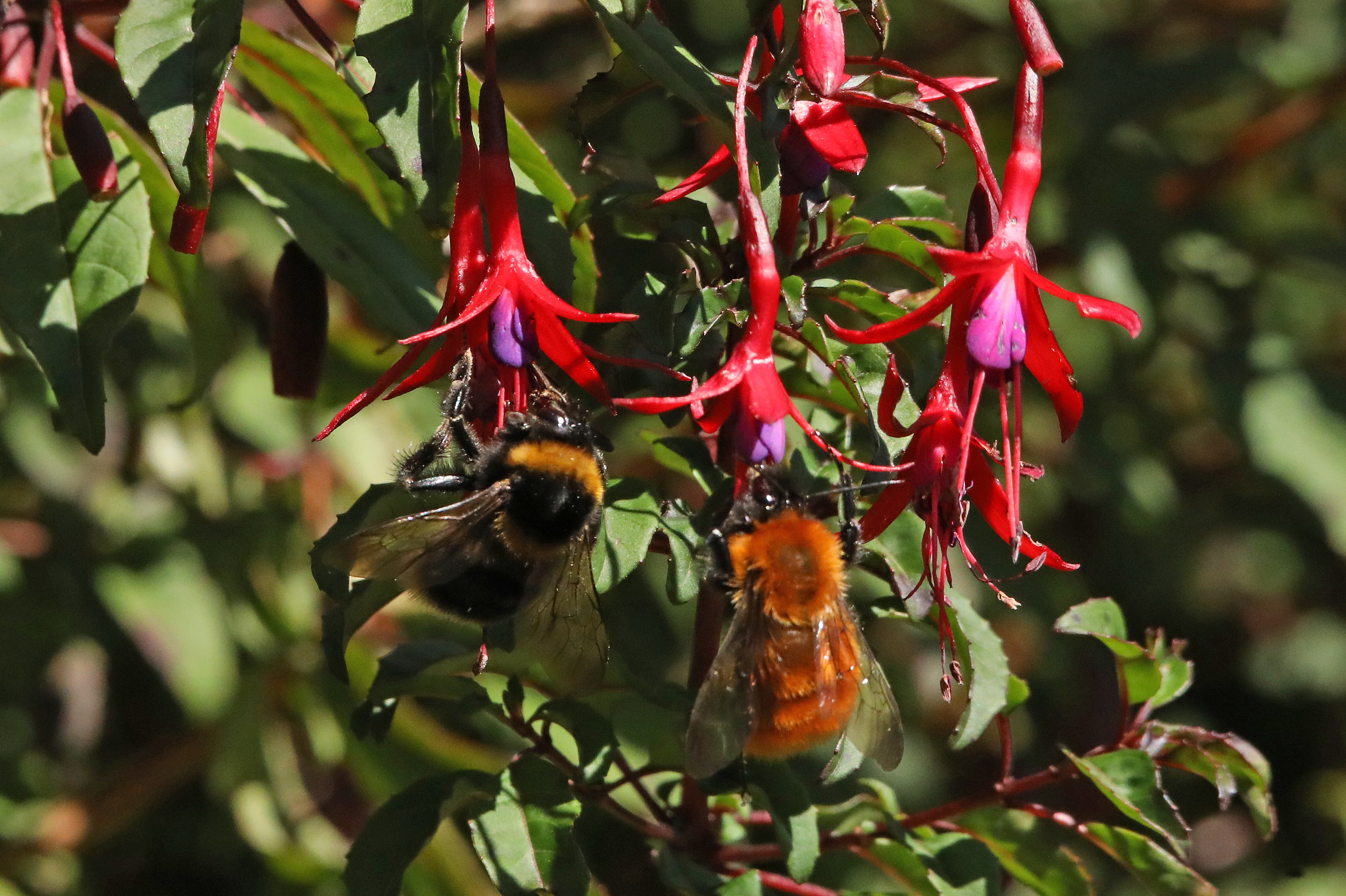
I was very pleased therefore to find it here at the Cañi Sanctuary. Only occurring in the temperate forests of southern Chile and Argentina, it is one of the largest bees in the world, and the only bumblebee native to Patagonia. However, as I watched the chilco bush, I saw some buff-tailed bumblebees (Bombus terrestris) also visiting the flowers, and was able to take a photograph of the two species side by side. To me, this dramatically symbolised the displacement of the native bumblebee by this introduced invasive species. While the possible loss of the Patagonian bumblebee is of serious concern in and of itself, it also has potentially very damaging effects on the ecosystem. Whereas the native bumblebee, like the green-backed firecrown, provides the vital service of pollination for the plants, the non-native buff-tailed bumblebee often acts as a nectar robber. It feeds on the plants’ nectar, but doesn’t pollinate them, thereby reducing their ability to reproduce and thrive as part of the forest ecosystem. Over time this could lead to a significant change in the balance of plants in the forest.
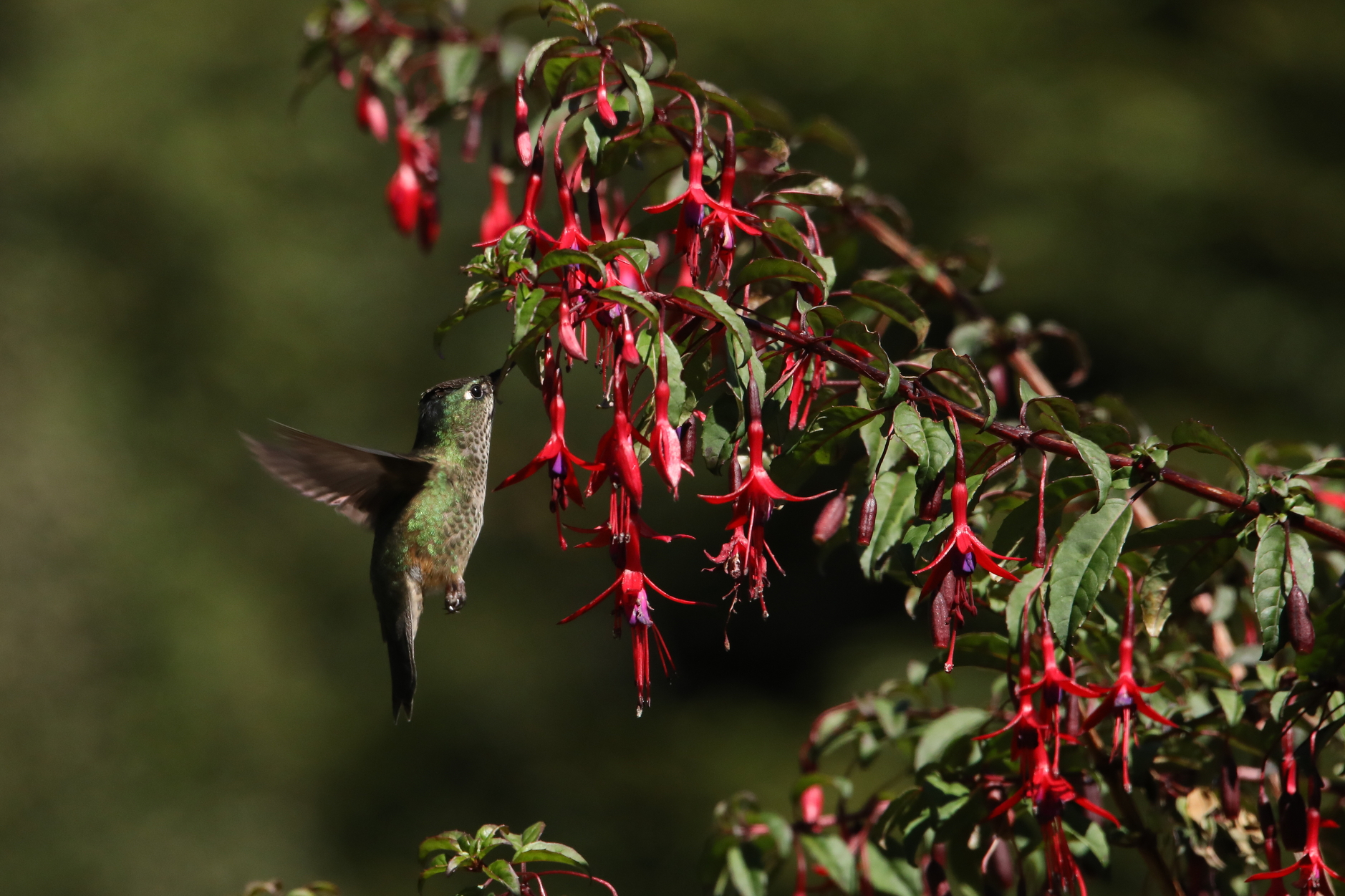
While it seemed like a great gift in itself to see and photograph this very special and endangered bumblebee at the chilco bush, its presence also enabled me to finally get some good photographs of the green-backed firecrown. This came about because while I was photographing the bumblebee, a hummingbird flew into view and started feeding on some of the chilco’s flowers, very close to ones where the bee was. It meant that I could just turn the camera slightly to the left and fire off a couple of frames before the green-backed firecrown moved away.

This made all the difference, as it took just a fraction of a second to shift the viewpoint from the bumblebee to the hummingbird, instead of lifting the camera up to my eye and then having to find the bird in the viewfinder, thereby losing a couple of crucial seconds – the very time in which the green-backed firecrown had previously been flying away in. With this experience, I began actively tracking the bumblebees as they came to feed, even when they weren’t in a suitable position to be photographed themselves, but instead using them as the sighting line, so to speak, for a hummingbird when it appeared.
As a result, I began to get the type of photograph I’d been hoping for – side-on views of the green-backed firecrown feeding on the flowers of the chilco bush. I was also able to take some photographs that illustrate why the species has ‘firecrown’ as part of its common name. This is due to the patch of iridescent red feathers on the top of the head of male birds – it’s relatively inconspicuous in one of the photographs below, but becomes larger and more intensely-coloured in the hummingbird’s breeding season.

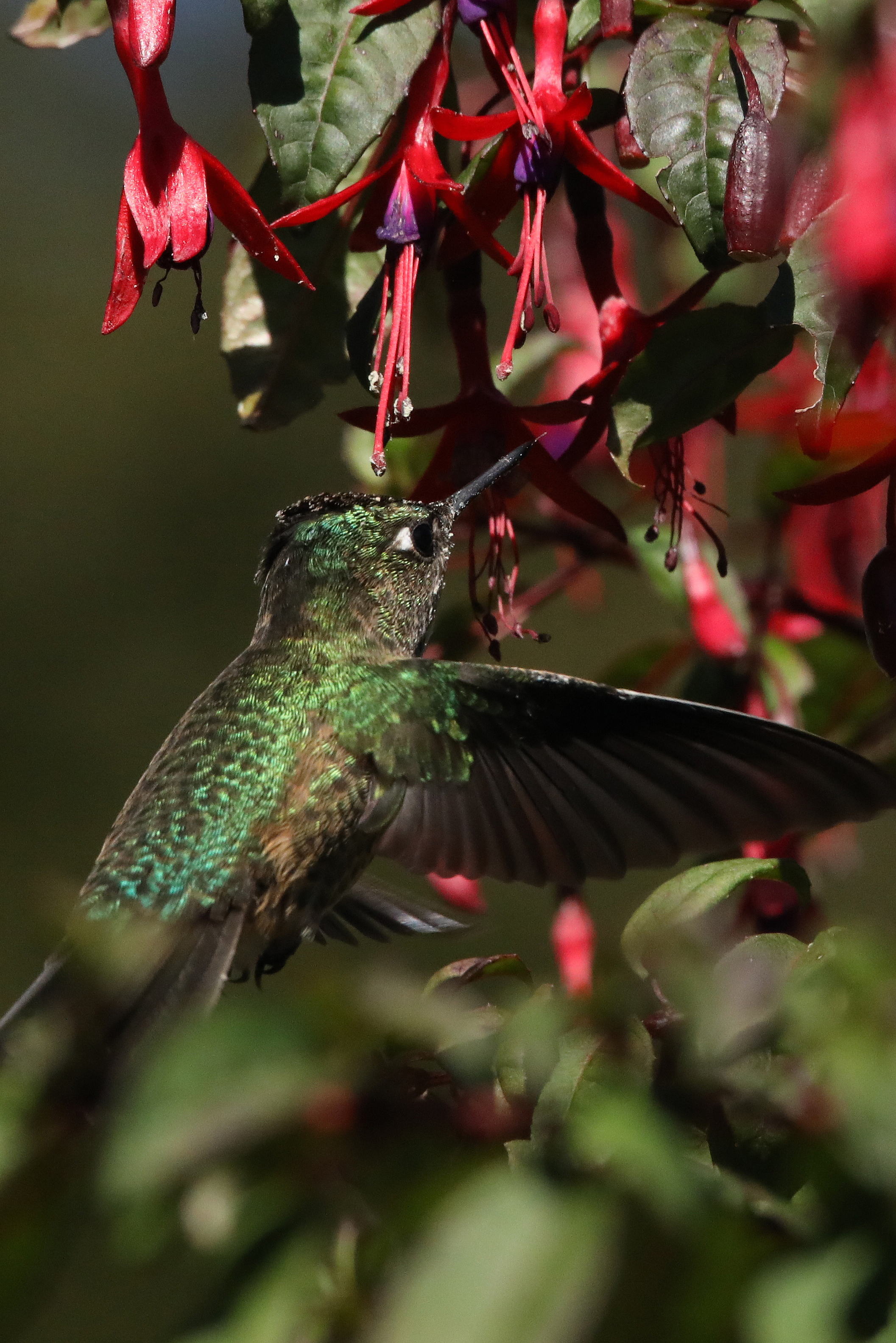
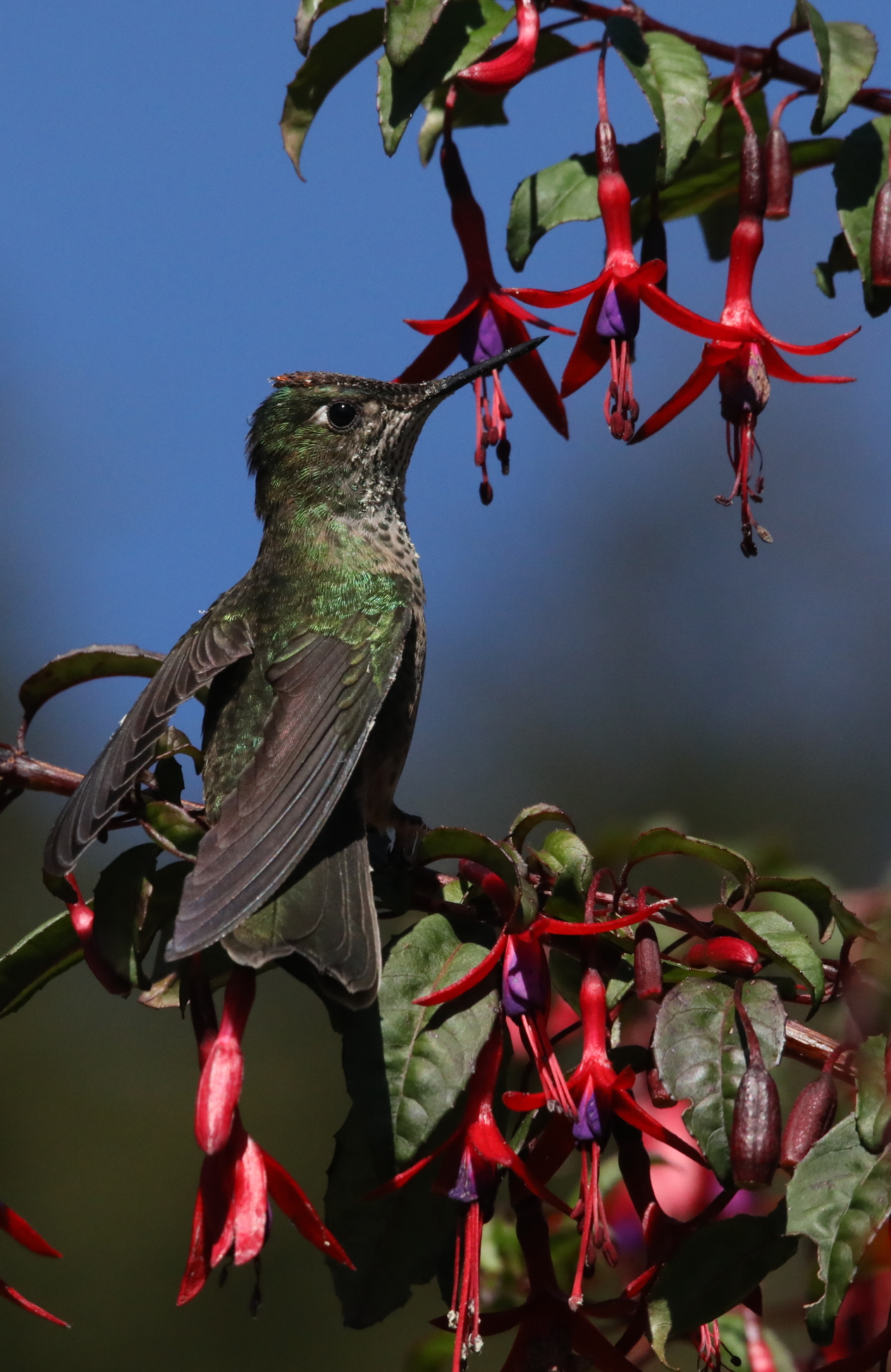
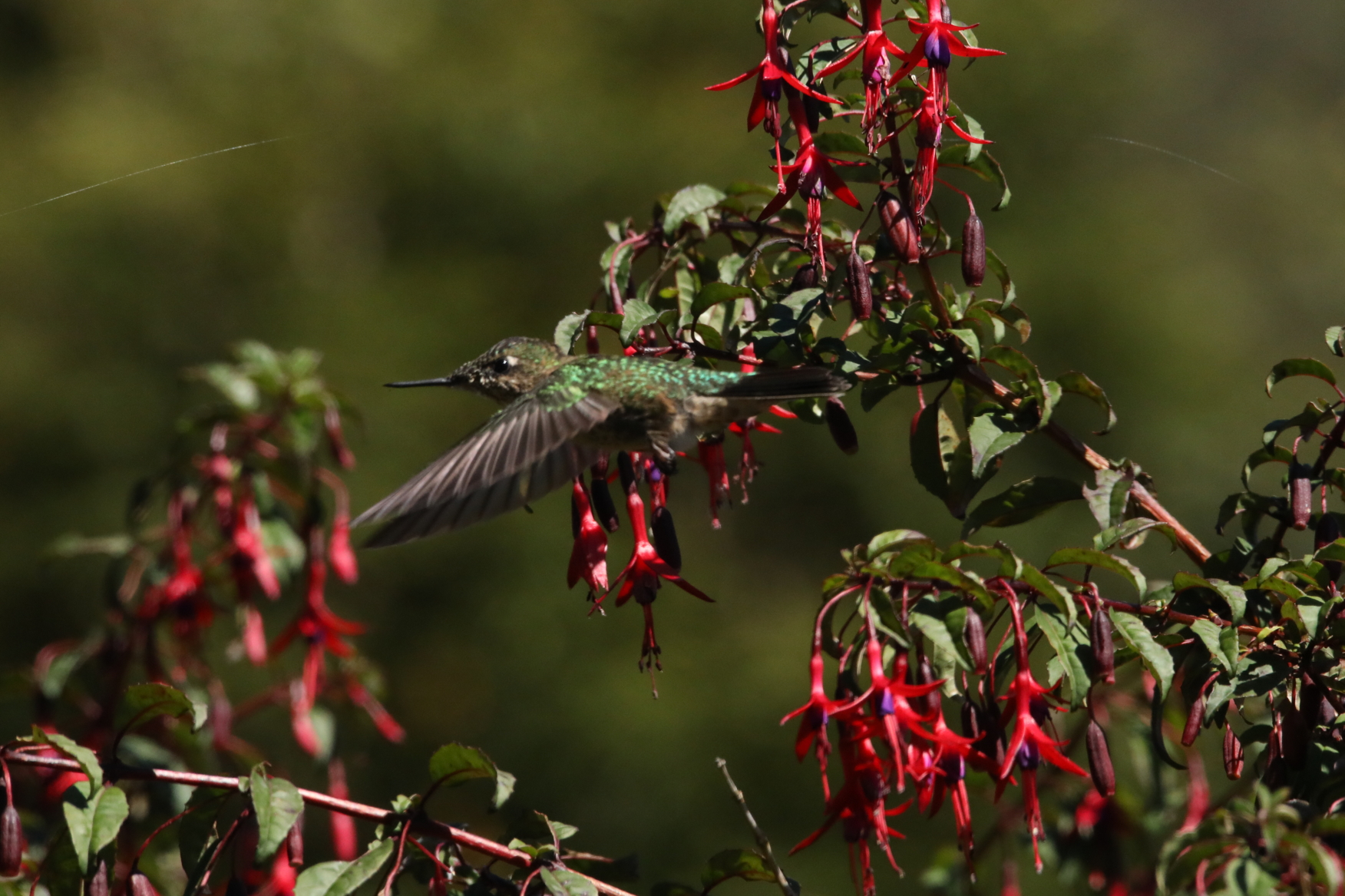
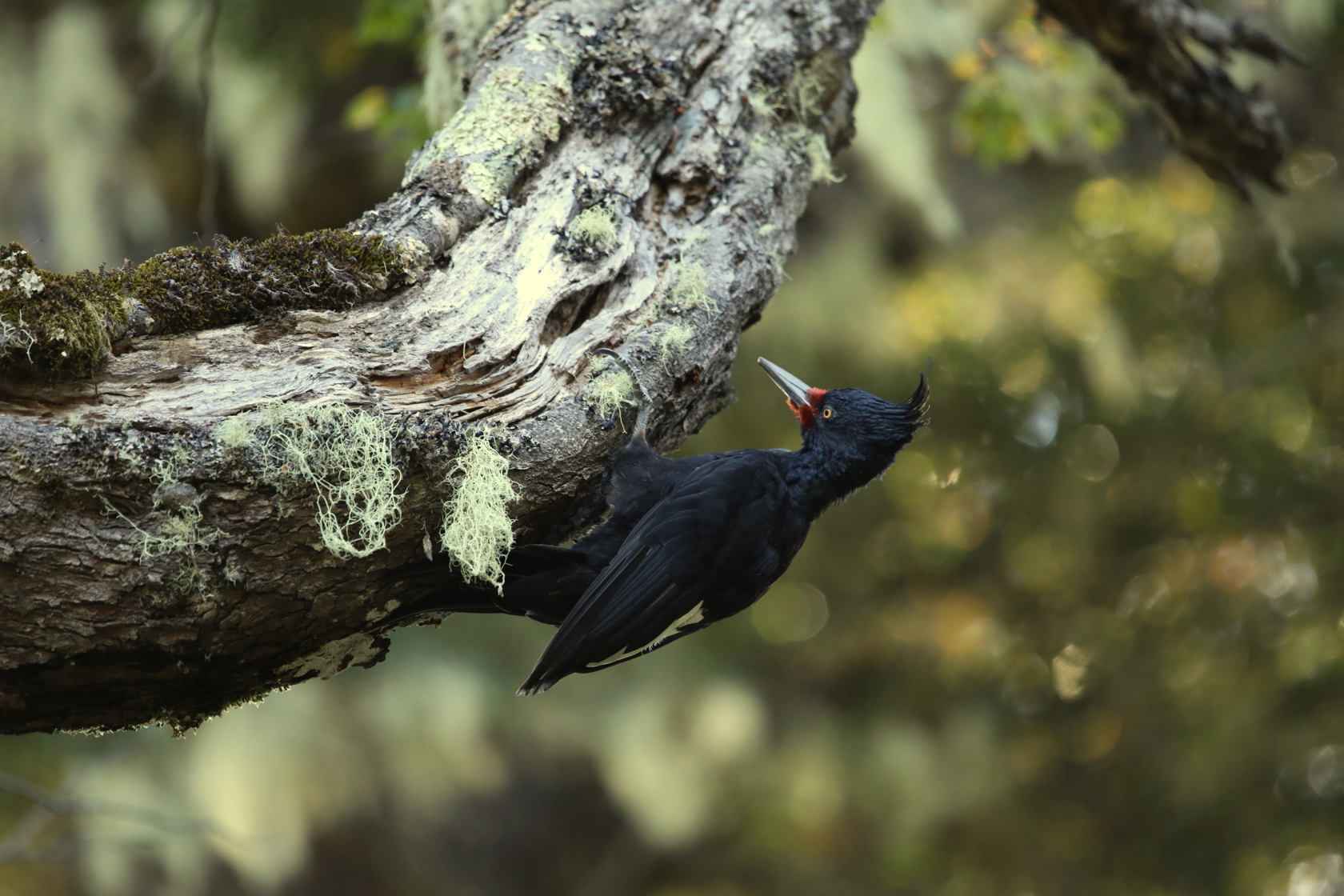
I spent over two hours in my stake-out of the chilco bush altogether, which seemed very long at the time. However, I was successful in my mission to get some good photographs of the green-backed firecrown, and it was in fact a relatively short period compared to the time (many days in some cases!) that is required to photograph some species of wildlife. As I headed back up the trail towards my campsite at Laguna Negra, I did so with a lot of joy in my heart, and this was reinforced when I came across a pair of Magellanic woodpeckers (Campephilus magellanicus) along the way. These are common birds in the forests in this part of Chile, but they are more often heard than seen, because of the distinctive hammering sound they make as they search for insect larvae on the trunks of the Nothofagus trees.
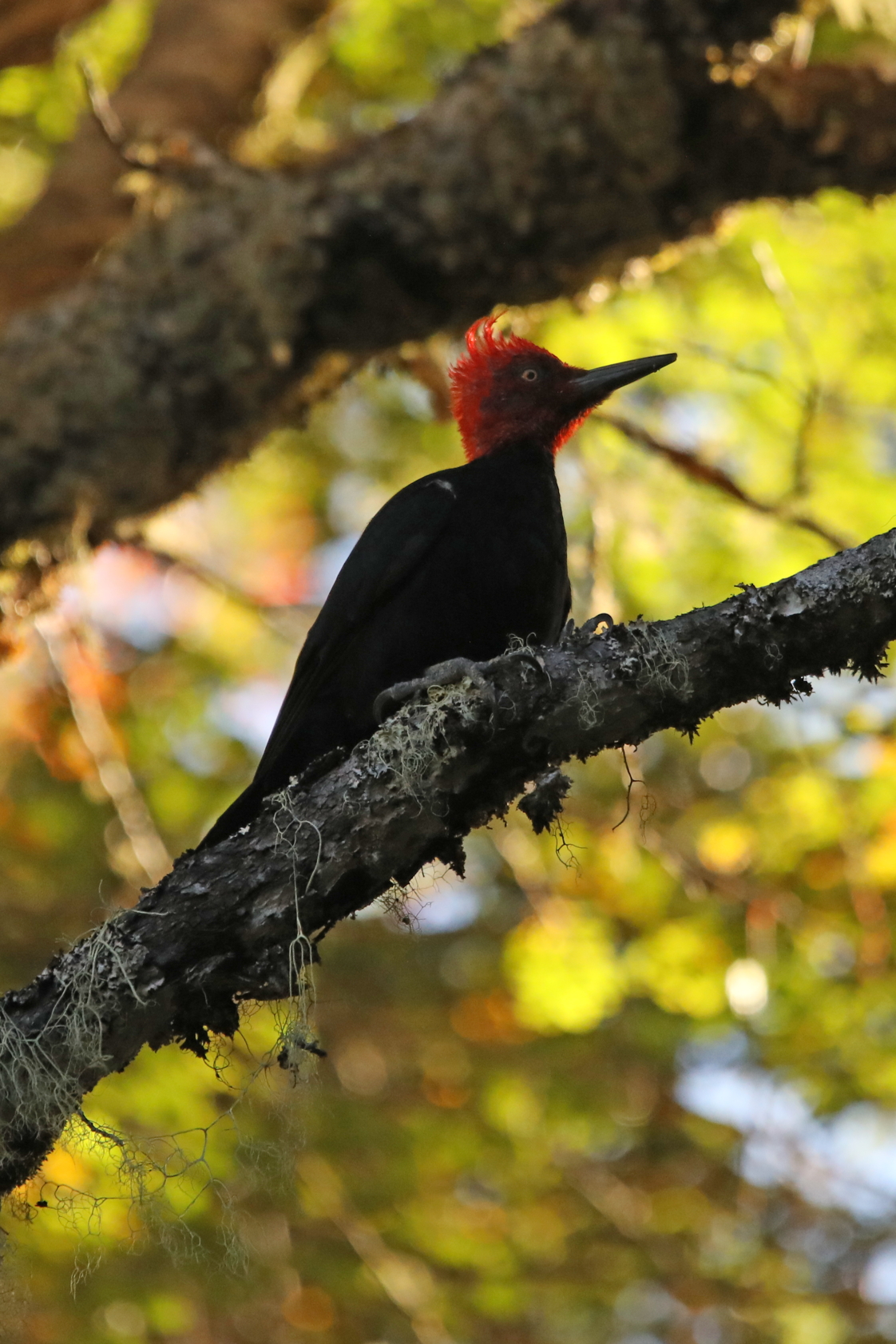
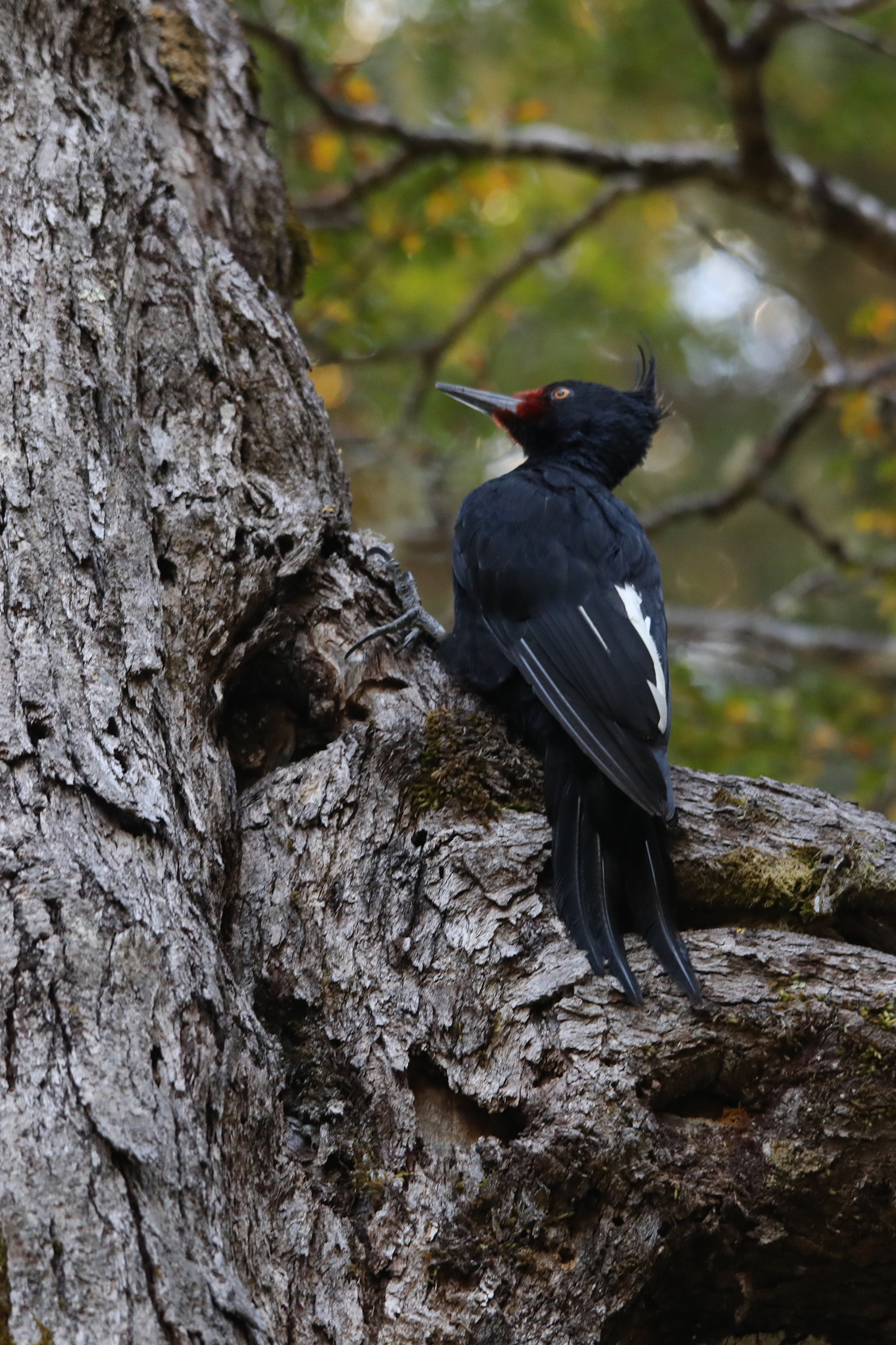
At up to 45 cm. in body length, they are one of the largest species of woodpecker in the world. The male has a bright red head and crest, far outdoing the green-backed firecrown in its colourful cranial flamboyance. In contrast, the female has a mostly black head, with just a small area of red at the base of its bill.
This pair were working their way up adjacent trees, searching for grubs and beetle larvae on the trunks of a lenga tree (Nothofagus pumilio) and a coigüe tree (Nothofagus dombeyi). I’ve seen and photographed these woodpeckers on several occasions during my trips to the Araucaria forests (and will feature them more in a future blog), but their appearance here was particularly auspicious, as they completed a ‘bird theme’ to my day, after the morning experience with the treile, and my two hour stake-out to photograph the green-backed firecrown. It also seemed like a fitting end to my last full day in the Cañi Sanctuary on this particular trip.
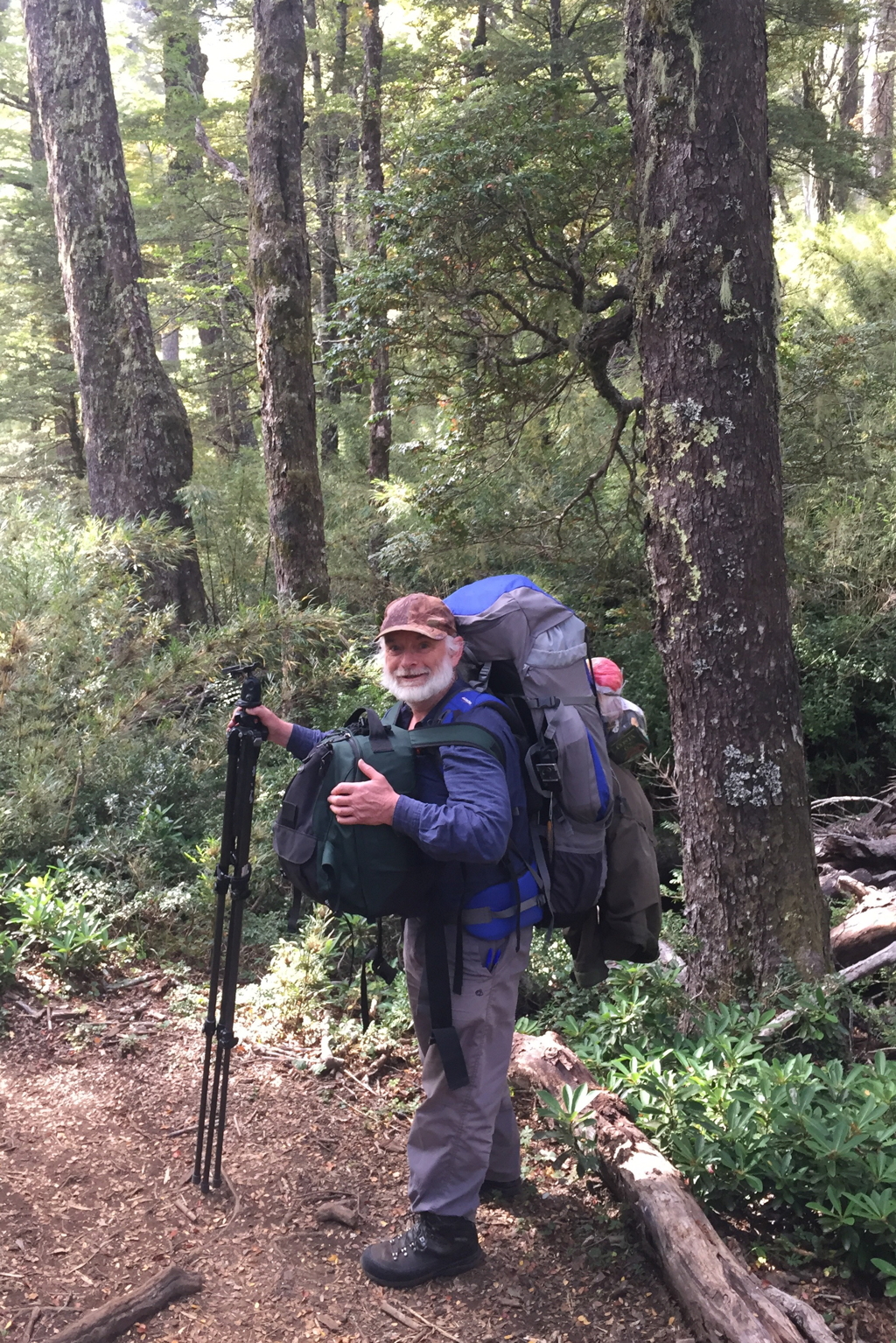
I spent a few hours the next morning photographing the forest around the lagoons and then headed down the trail, to go back to Pucon. I had planned the return journey knowing that I’d be hiking with my two packs – the backpack with my camping equipment on my back, and my camera backpack on the front – reckoning that the load would be lighter because I would have eaten all my food, and that the trail was all downhill and therefore the weight would not be such a problem. It was still a very strenuous effort to carry such a load, and I was very glad when, about three quarters of the way down the trail, a young Dutch hiker offered to help me by carrying the camping equipment backpack for the rest of the way. When I got back down to the road and my car I was rather exhausted, my shoulders were aching from the packs and my knees had received a very thorough work-out from the steep descent. However, I had a deep sense of fulfilment and satisfaction, having had a great wilderness experience up in the Araucaria forest and returning with some of the priority photographs I’d set myself the target of obtaining during this trip to Chile.
Great pictures and interesting narrative — thanks for sharing your experiences — what an interesting forest, look forward to your future blogs
Many thanks John – I’ll be posting some more blogs about the Araucaria forest in the coming weeks.
With best wishes,
Alan
Wonderful reading, Alan ~ and fabulous photographs and video. Truly a joy. Thank you!
Many thanks for the great feedback Stephanie!
With best wishes,
Alan