On Sunday it was a clear, cold and sunny morning when I headed out to Dundreggan, with the first rays of sunshine turning the snow-covered peak of Ben Wyvis (to the northwest) pink, as I left Forres on the road to Inverness. It was going to be my first day out in the forest after the Christmas and New Year break, and the low temperature (-4 degrees C at Findhorn) and abundant frost seemed like Nature’s heralds for what promised to be a beautiful day.
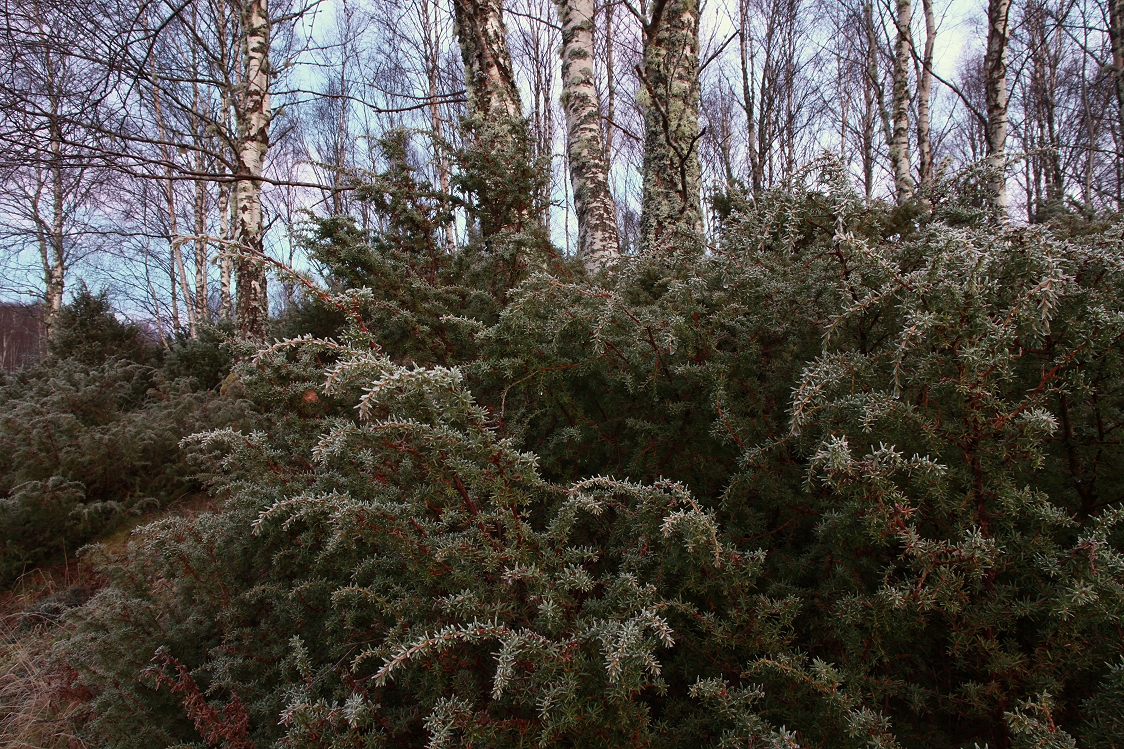
When I arrived at Dundreggan, the sun had just come up over the hills to the south, and there was a white coating of hoar frost on all the grass and juniper bushes around the car park at the estate. Hazy clouds obscured the sun, so I knew the frost would be there for a while and I took advantage of the opportunity to photograph some of the juniper branches in close up.
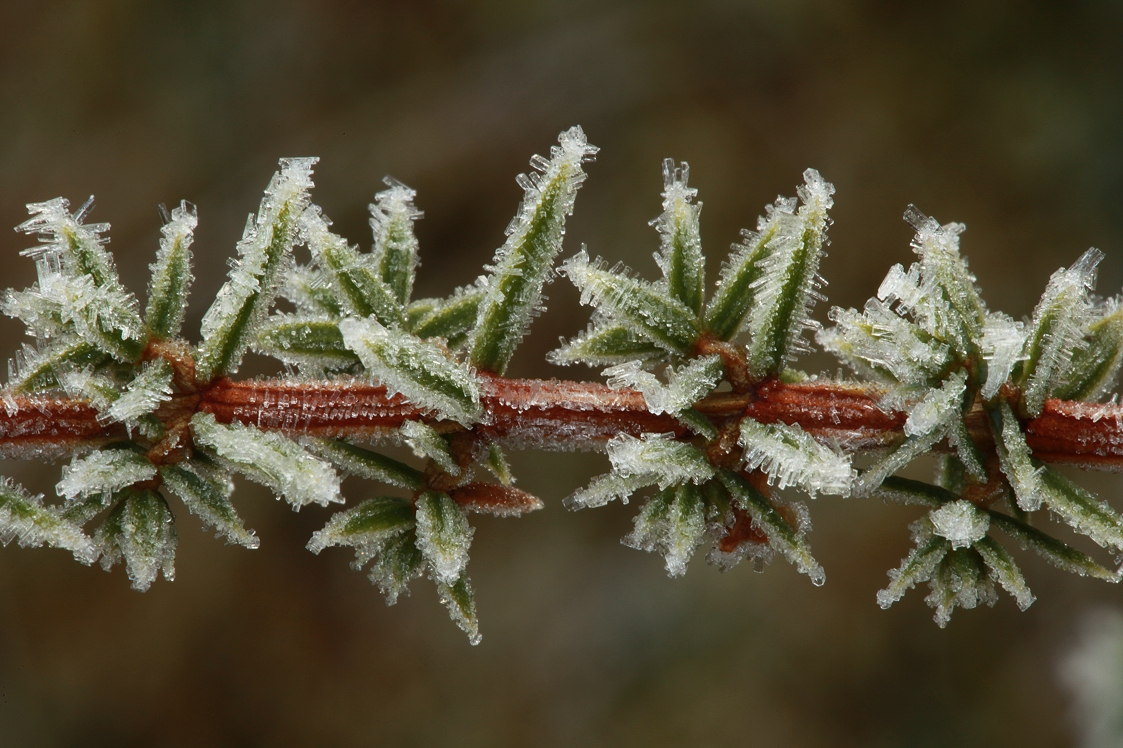
Every juniper needle was fringed with a delicate filigree of crystalline hoar frost. As I looked closely, it seemed to me as though the frost crystals had the same characteristic as snowflakes, in that each one was unique and different from all the others. Of course there’s no way of knowing if that’s actually true (without checking each crystal individually against all the others!), but every crystal certainly seemed to vary from its immediate neighbours, and the patterns that groups of crystals formed together also seemed not to repeat themselves.
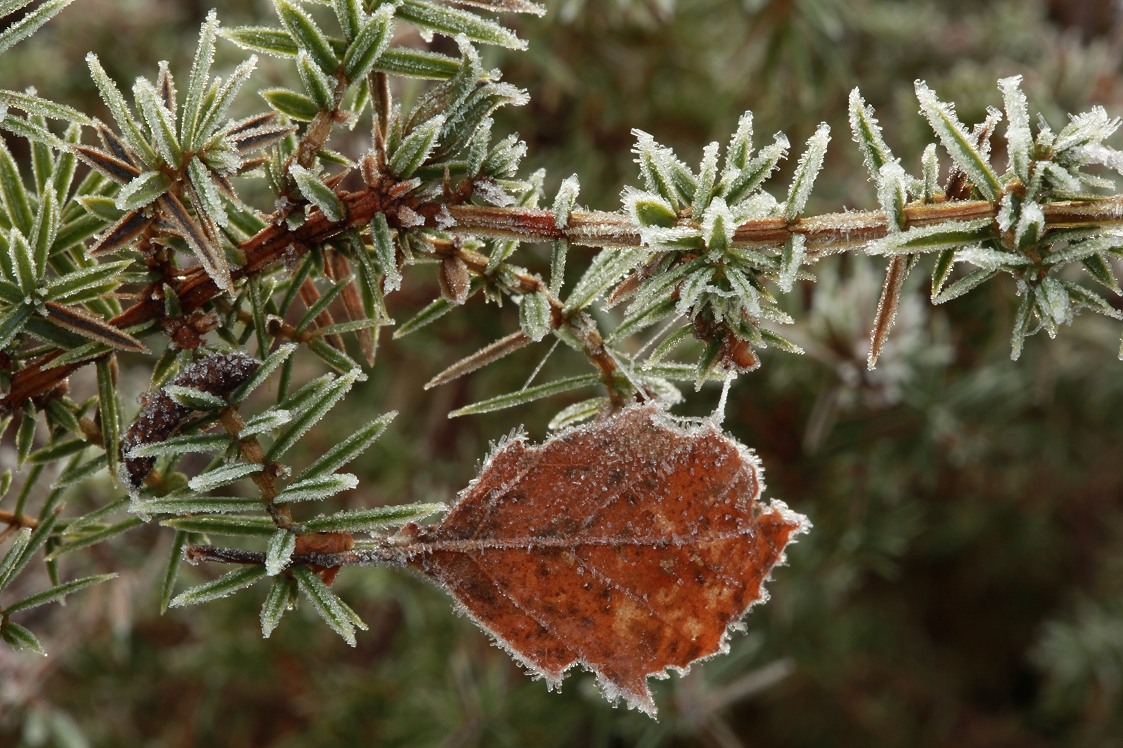
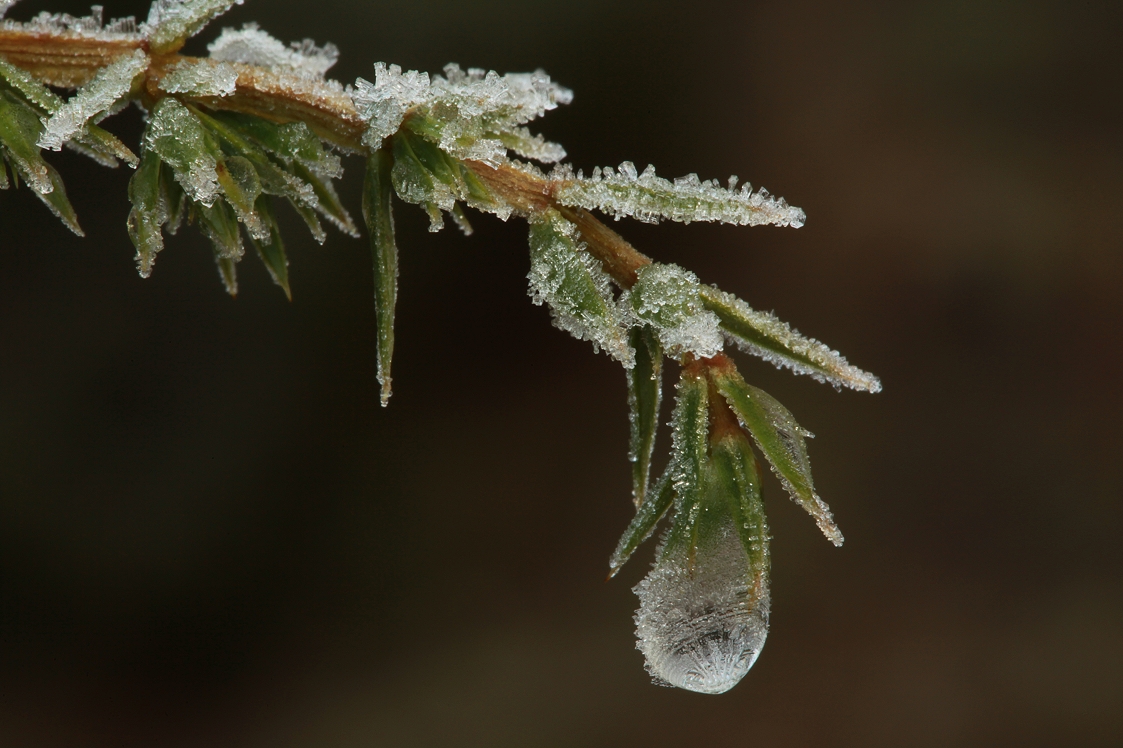
Some of the juniper twigs had water droplets frozen on their tips – a sign that the frost from a previous night had melted during the day and then frozen again in place the next night. Other twigs had birch leaves frozen in place amongst their needles, with the veins on the leaves highlighted by the pattern of frost crystals that had formed along them. These hanging leaves were a visual reminder of last autumn, which now seems like a long time ago!
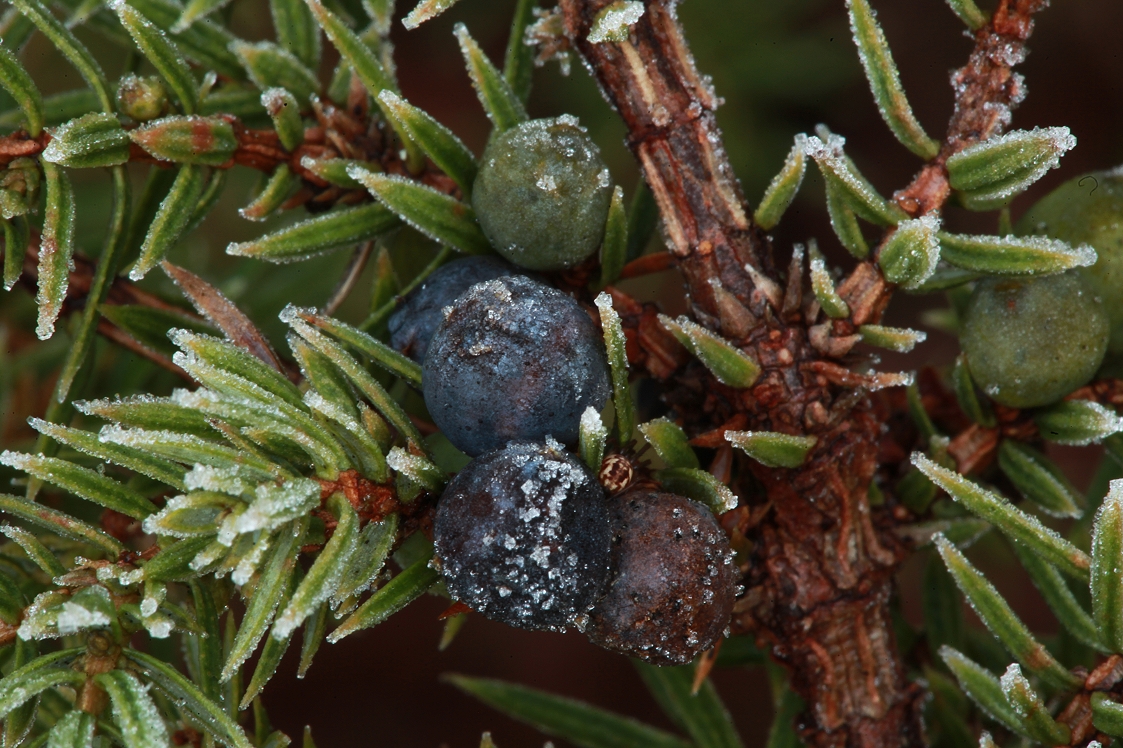
With their abundance of densely-needled branches growing close to the ground, the junipers had a more prominent and obvious coverage of frost than the birch trees, for example, where the twigs were generally higher up and therefore harder to get a close look at. Thus, I spent quite a while with the junipers, and I was keen to find some with berries covered in frost, which it took a surprisingly long time to do.
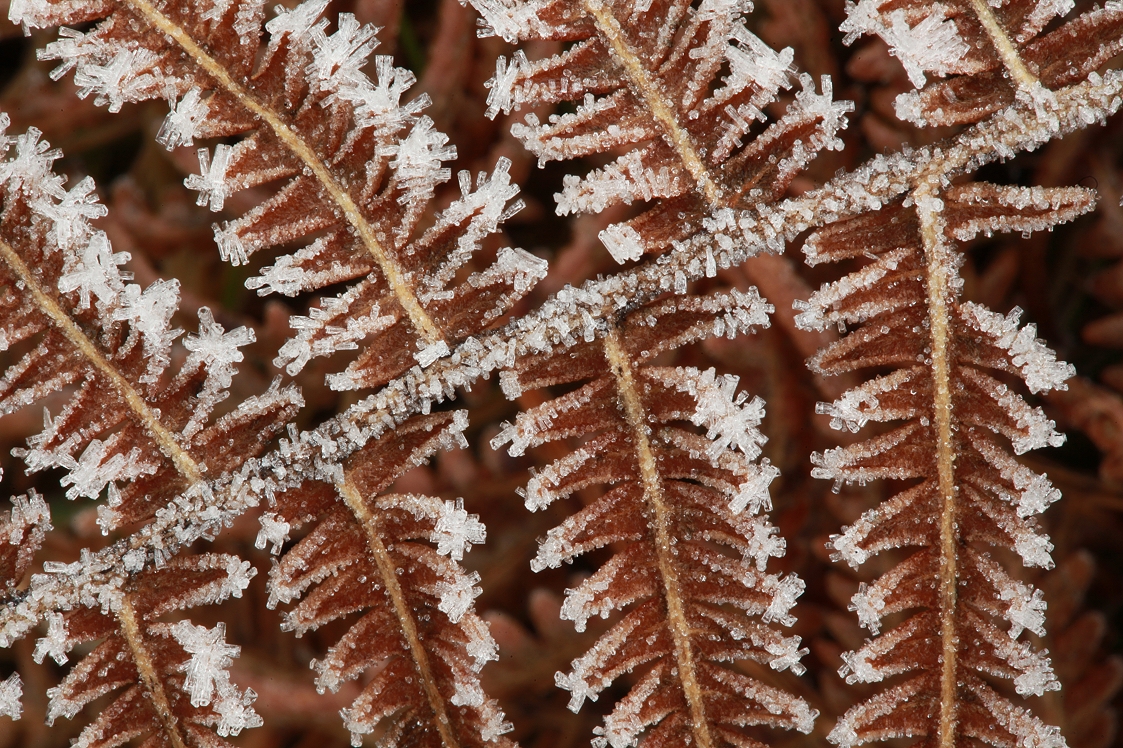
Moving on from the junipers, my attention was drawn to some bracken fronds, where the frost highlighted the growth pattern of the small leaflets or pinnules on each frond. Because of the repeating shape of the leaflets on the fronds, bracken shows the effects of the frost more clearly than most other plants, and I usually find myself taking photographs of it whenever there’s a hard frost.

On this occasion, I also used my high magnification 5 times life size macro lens to get some detailed close-up images of the frost on the bracken. Normally in photographs like that, the depth of field is very limited, meaning that only a small plane of the subject is in focus. This is one of the problems of macro photography, but on this day I was trying out a new technique called focus stacking. Basically, this involves taking a series of photographs of the
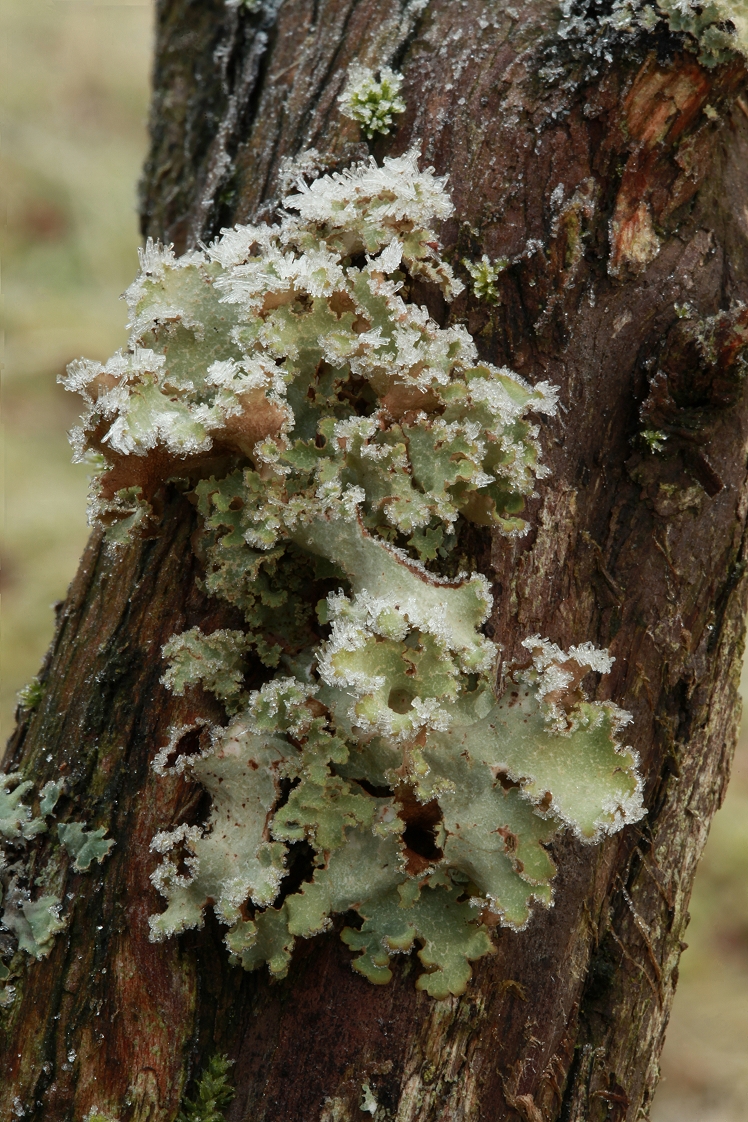
same image, but changing the focus slightly between each one, so that a different section of the subject is in focus. Some clever software then combines the in-focus sections of each image to create a composite image, or focus stack, which is in sharp focus throughout. This close-up image here of the frost crystals on the bracken is the result of one of these focus stacks. I also used the same technique to produce a photograph of a common lichen (Platismatia glauca) that was growing on the branch of a juniper bush nearby.
My first impressions of this software are quite positive, as the results are sharper than any individual photograph of the same subject would be, so I’ll be continuing to experiment with it in the coming weeks – I’ve got the software (Helicon Focus) on a 30 day free trial.
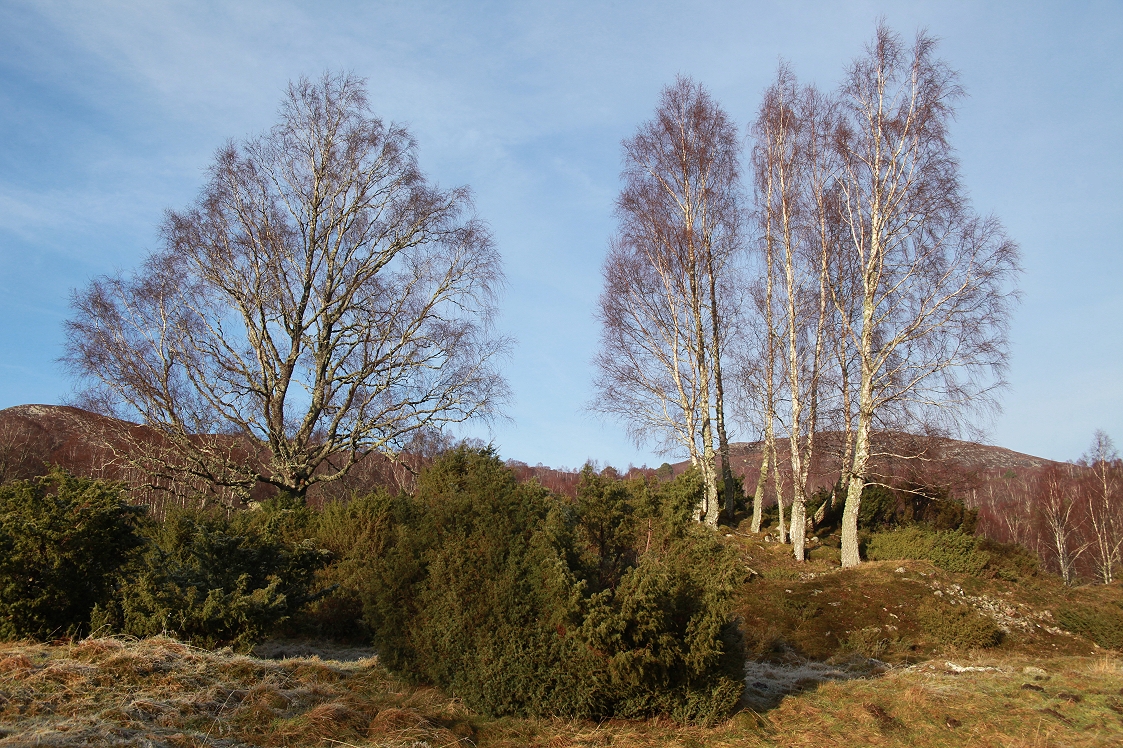
By this time it was early afternoon, and the sun had come out, so that the frost was rapidly disappearing from all the areas that were catching the sunshine. However, although Dundreggan is generally on a south-facing aspect, there are a number of morainic mounds and eskers on the low ground, and the north-facing sides of those don’t get the sun at all in winter. The frost therefore remained there all day, so I spent the rest of my time in those places, to make the most of the ephemeral beauty they provided.
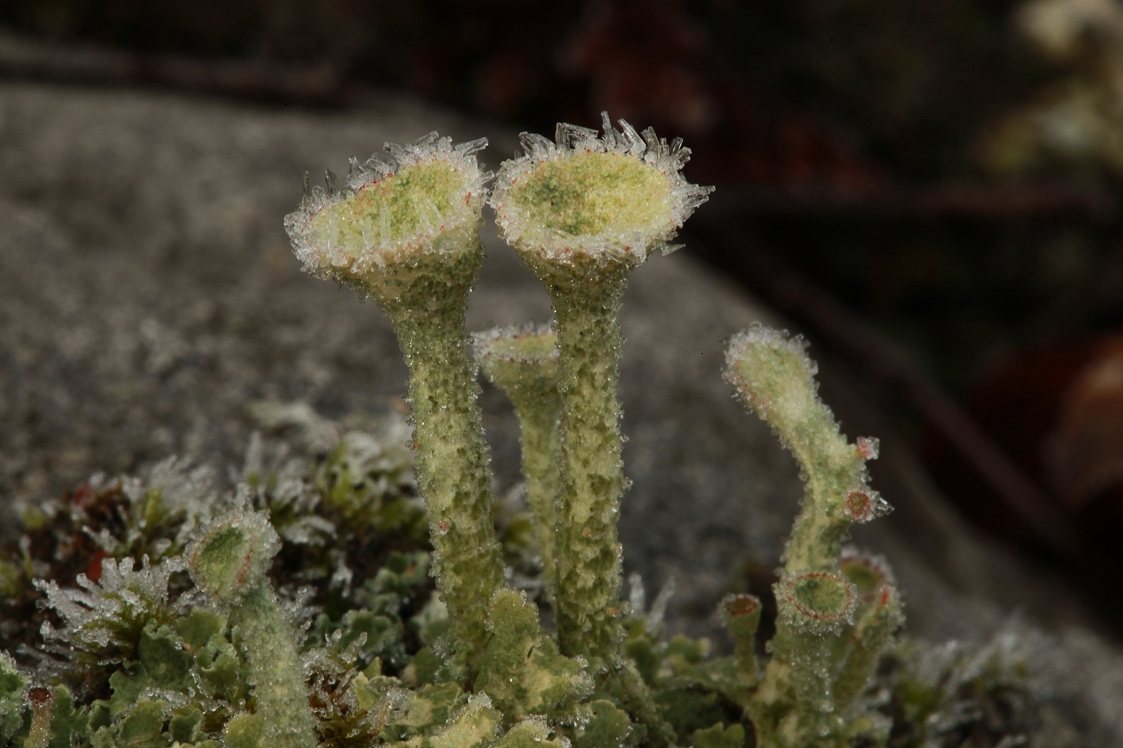
The eskers formed by the glaciers that filled much of Glen Moriston in the last Ice Age have numerous rounded rocks on them, sometimes clustered in groups, and these have been colonised by various species of moss and lichen. Those included various different types of Cladonia lichens, which are amongst my favourites, because of the propensity of many species in the genus for producing stalked cups, known as podetia, which are often tipped with red apothecia – the part that releases the spores of the lichen’s fungal component.
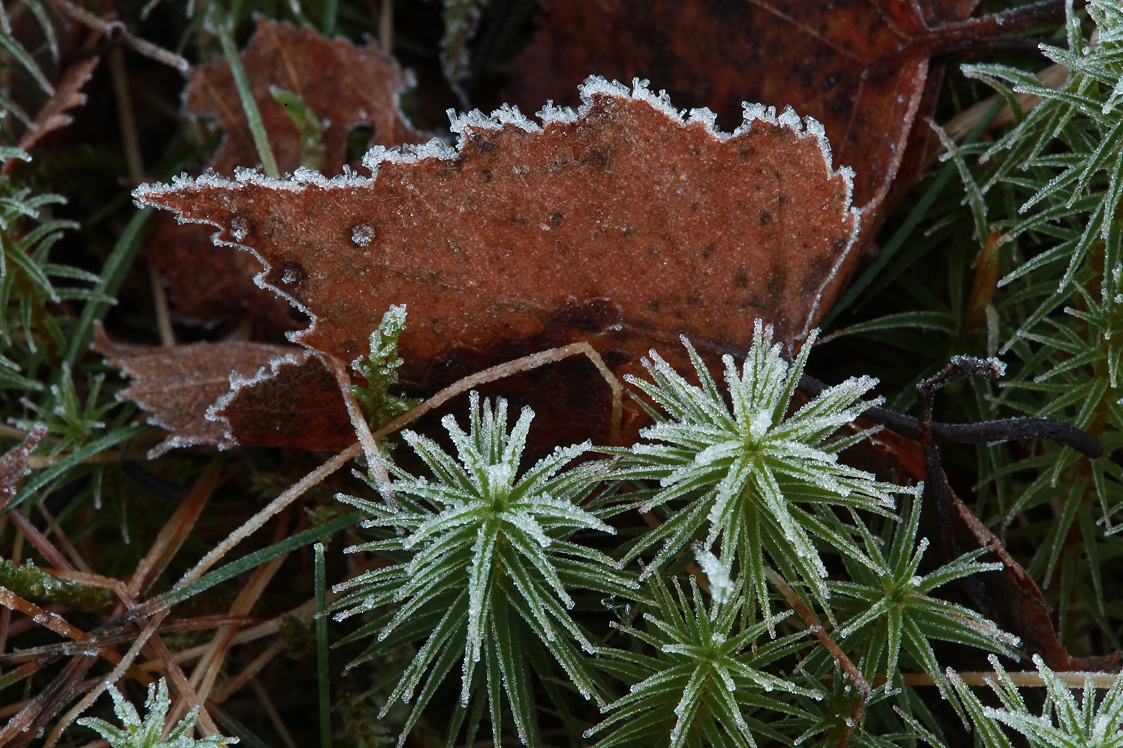
There were plenty of mosses covered in hoar frost as well, and the common haircap moss (Polytrichum commune), with its tiered, star-like leaf formation, was particularly beautiful, with the white crystals of the frost outlining each leaf. I think they look like miniature Scots pine seedlings sometimes, and when there’s a large patch of them growing together on the forest floor the pattern they make is very attractive visually.
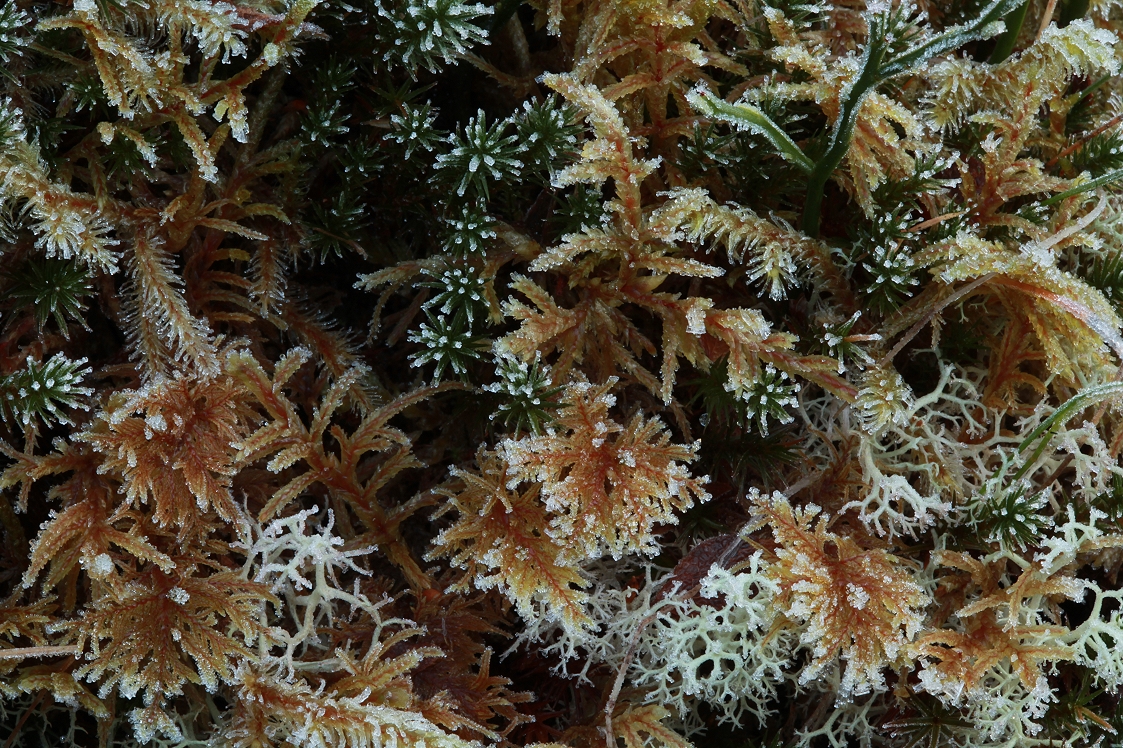
In other places, there were several different species of moss growing together, and the frost seemed to highlight the differences between them, and the unique growth pattern of each one. When viewed close up, these clusters of mosses, with fringes of crystalline frost on their leaves, appeared like a miniature world of exotic chandeliers, covering the forest floor.
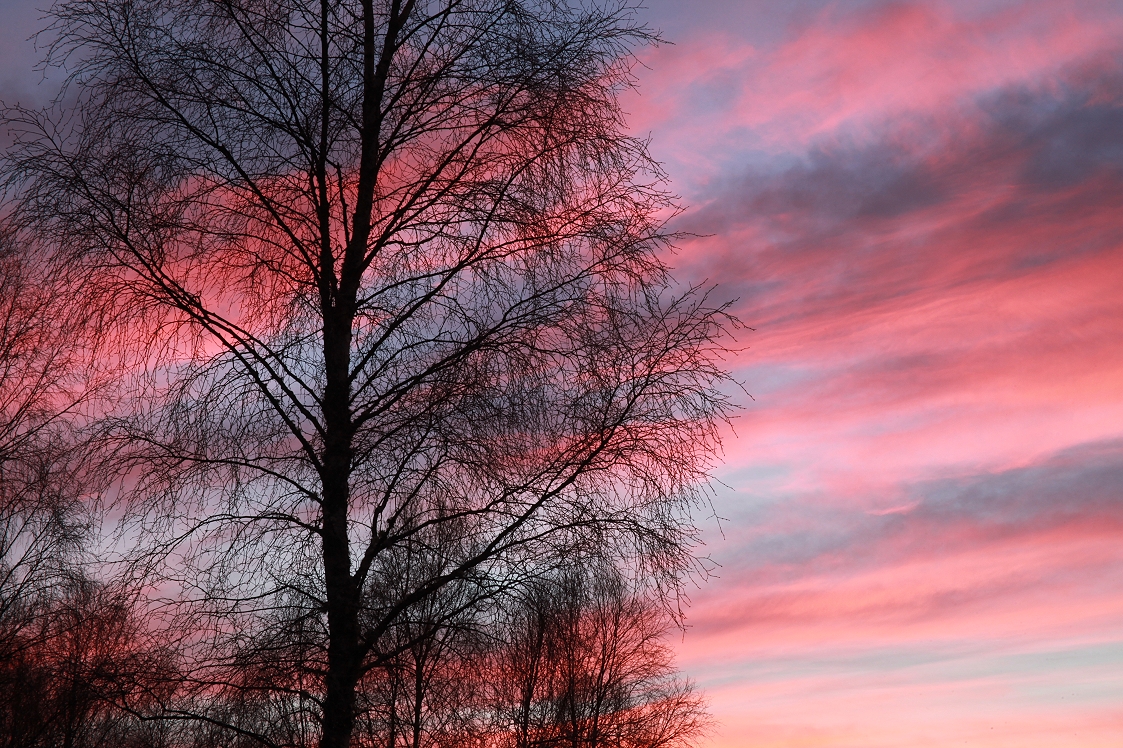
By this time it was late in the afternoon, and the sun was going down. A few clouds had appeared in the sky to the west, so there was a beautiful sunset, with scarlet colours illuminating the undersides of the clouds. This provided the perfect end to another great day, and was also a fitting counterpoint to the pink sunrise colours I had seen on the snow-covered peak of Ben Wyvis, when I was on my way out to Dundreggan in the morning.
Leave a Reply