(Edited on 11th October to add video footage at the end of the blog)
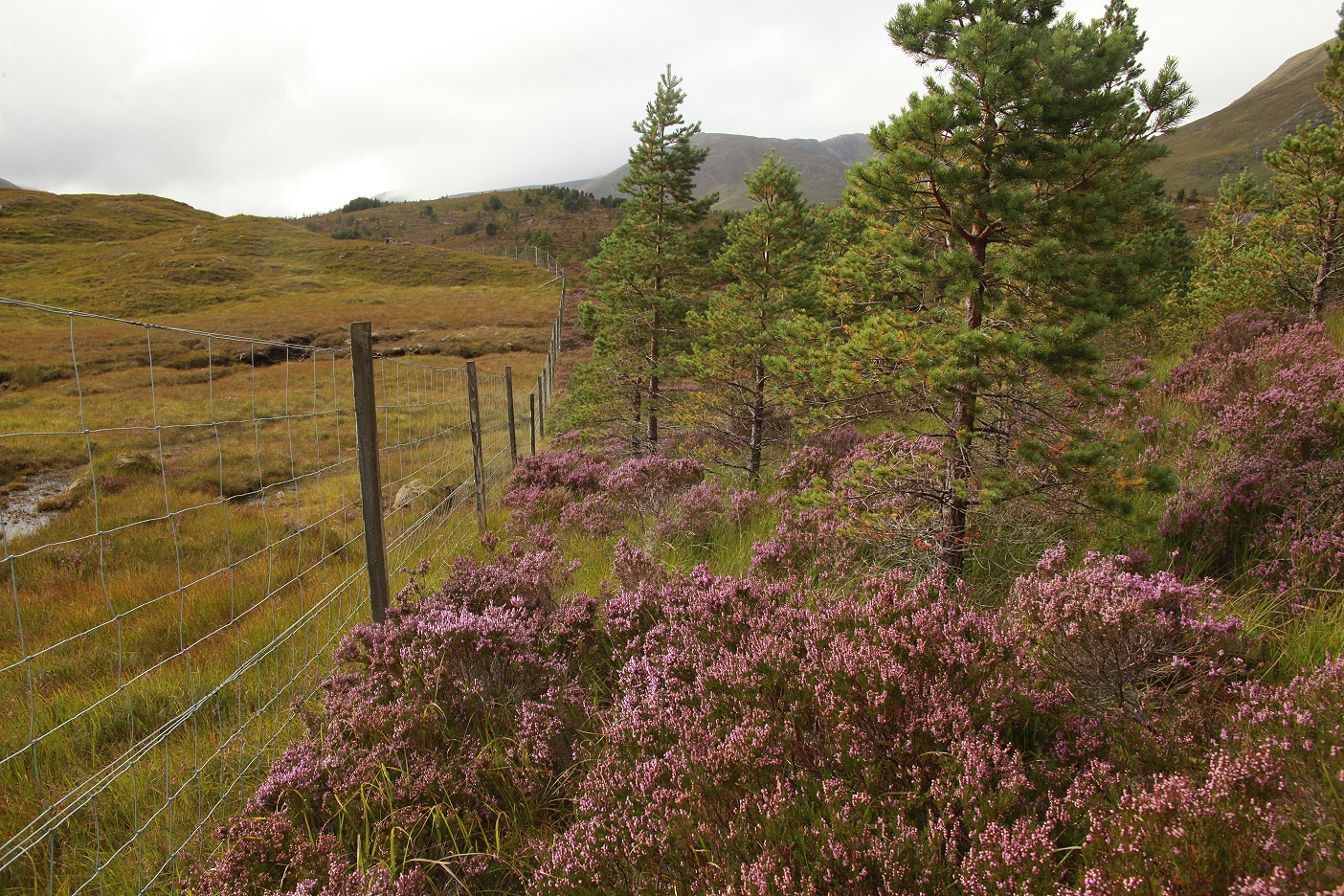
In early September I spent a couple of days out at Athnamulloch, in the western part of Glen Affric, which is the site of Trees for Life’s first tree planting, in 1991-92. In the spring of each of those two years, our first volunteer groups planted 21,400 Scots pines (Pinus sylvestris) inside a 60 hectare fenced exclosure that had been erected by Forestry Commission Scotland (FCS) in 1990. In subsequent years we returned to plant smaller numbers of broadleaved trees such as aspen (Populus tremula) and some junipers (Juniperus communis).

I go out to Athnamulloch most years, to see and photograph the growth of the trees there, and in 2011, the 20th anniversary of the first plantings, I wrote a special feature about the area for our members’ magazine, Caledonia Wild! However, it had been 5 years since I was last there in late August/early September, when the heather (Calluna vulgaris) is in bloom, and the contrast between inside and outside the fence is at its most dramatic. It was to see this difference therefore that I made these two trips this year.

The Athnamulloch exclosure is approached from the direction of the bothy of the same name just to the east, where vehicle access ends, across a flat area of wet grassland. Reaching the fence, there’s a stile to cross in the southeast corner, and just inside is a flat area where there used to be prominent peat hags. That is the name given to areas where the vegetation has been broken up, allowing the underlying peat to become exposed, and to erode through the action of the elements. Peat hags can be seen in many of the glens in the Highlands, and they often contain the stumps of old pine trees, sometimes thousands of years old, indicating the former extent of the forest. These peat hags are effectively gaping wounds or running sores in the landscape, as the pressure of overgrazing prevents the growth of any new vegetation, and they continue to erode and expand, which makes walking in these landscapes difficult.
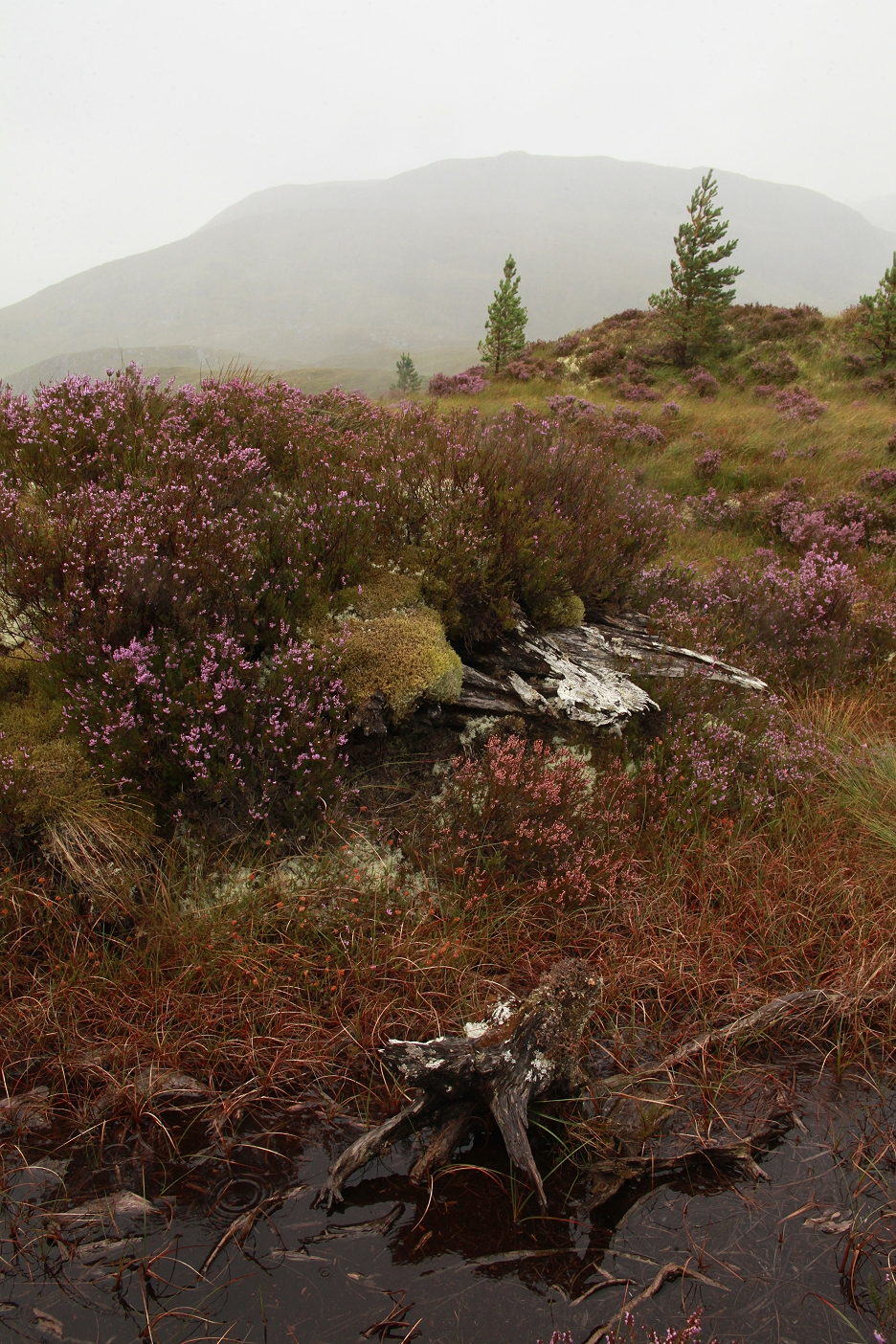
At Athnamulloch though, the peat hags inside the exclosure have revegetated considerably in the 22 years since the fence was erected – a real healing of the wounds has taken place. In the absence of overgrazing, sphagnum mosses, heather, reindeer lichens and other plants have grown over what had been the bare surface of the peat.


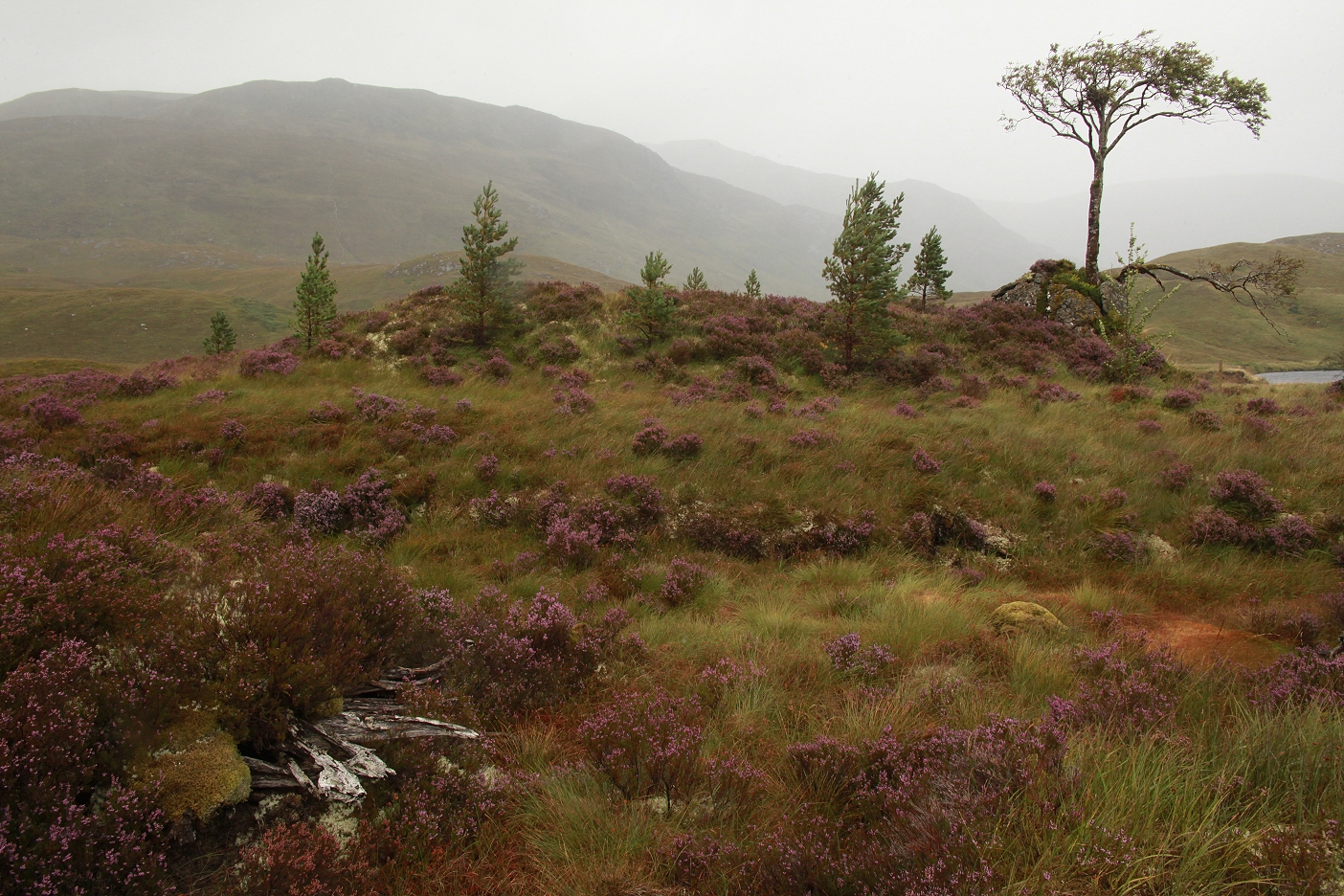

I wish everyone who cares about the Highlands could see the transformation that has taken place at Athnamulloch and in other similar exclosures elsewhere. In my view, there’s no excuse for the continued existence of peat hags anywhere in the Highlands – they are an embarrassing and shameful statement about the depletion of the land, and our present day culture’s prevention of the healing process that would naturally occur for such wounds.
The weather was quite wild on the first of these two days I spent at Athnamulloch, with fierce westerly winds and intermittent driving rain. The conditions made photography very difficult, as it was virtually impossible to keep my camera dry and to have the lens free of raindrops. Only by working in the more sheltered locations, and taking photographs exclusively facing out of the wind, was I able to get any images at all.

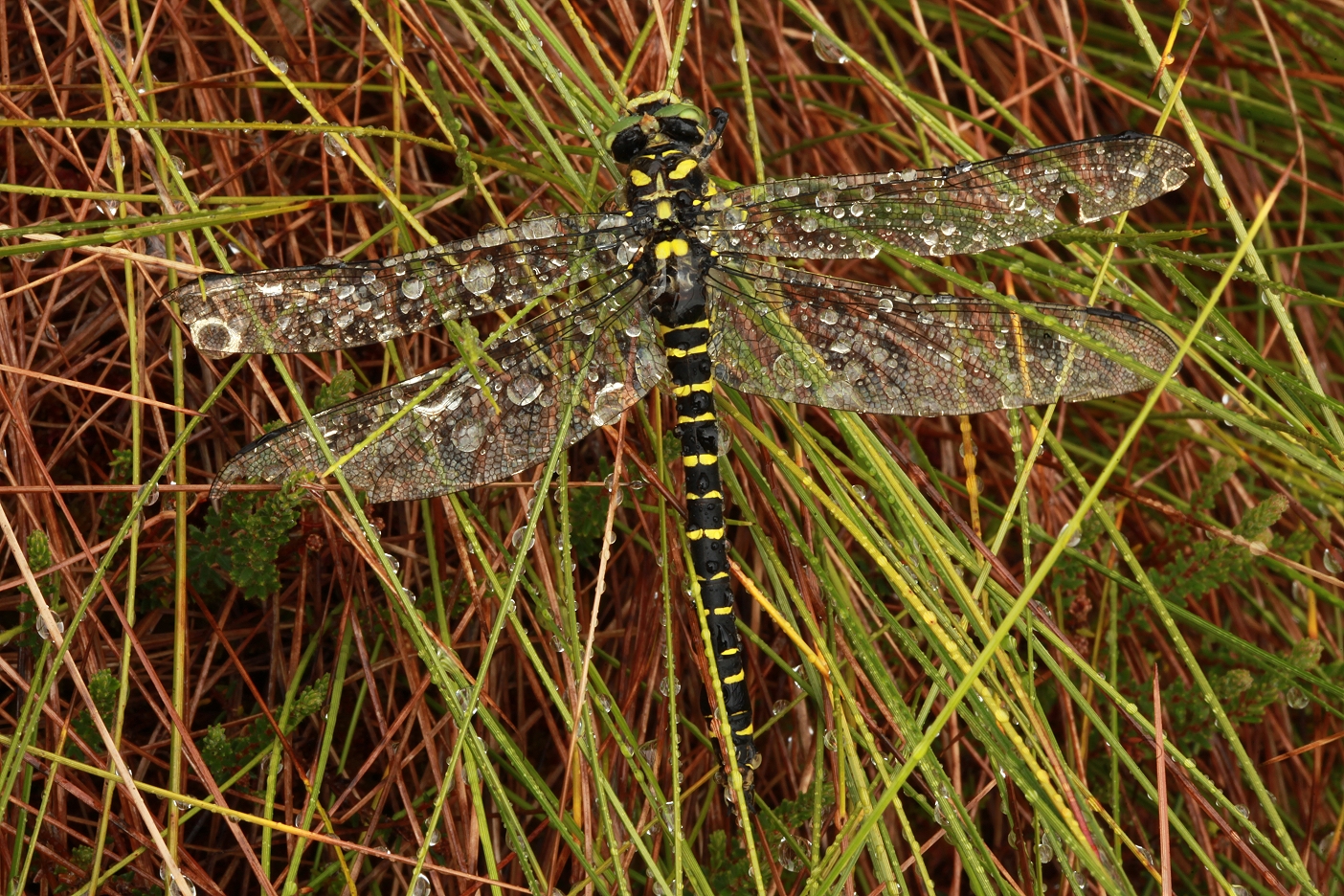
However, the effects of the wild, elemental conditions had a greater impact on some of the other creatures at Athnamulloch that day. No insects were able to fly at all, and I came across a golden-ringed dragonfly (Cordulegaster boltonii) that was on the ground, with its wings tattered and completely soaked in raindrops. Fortunately, no predators were about either in these conditions, so the dragonfly was relatively safe, despite its enforced immobility. When I returned to the same spot about 2 hours later, on my way out of the exclosure, it was still there, in exactly the same place.
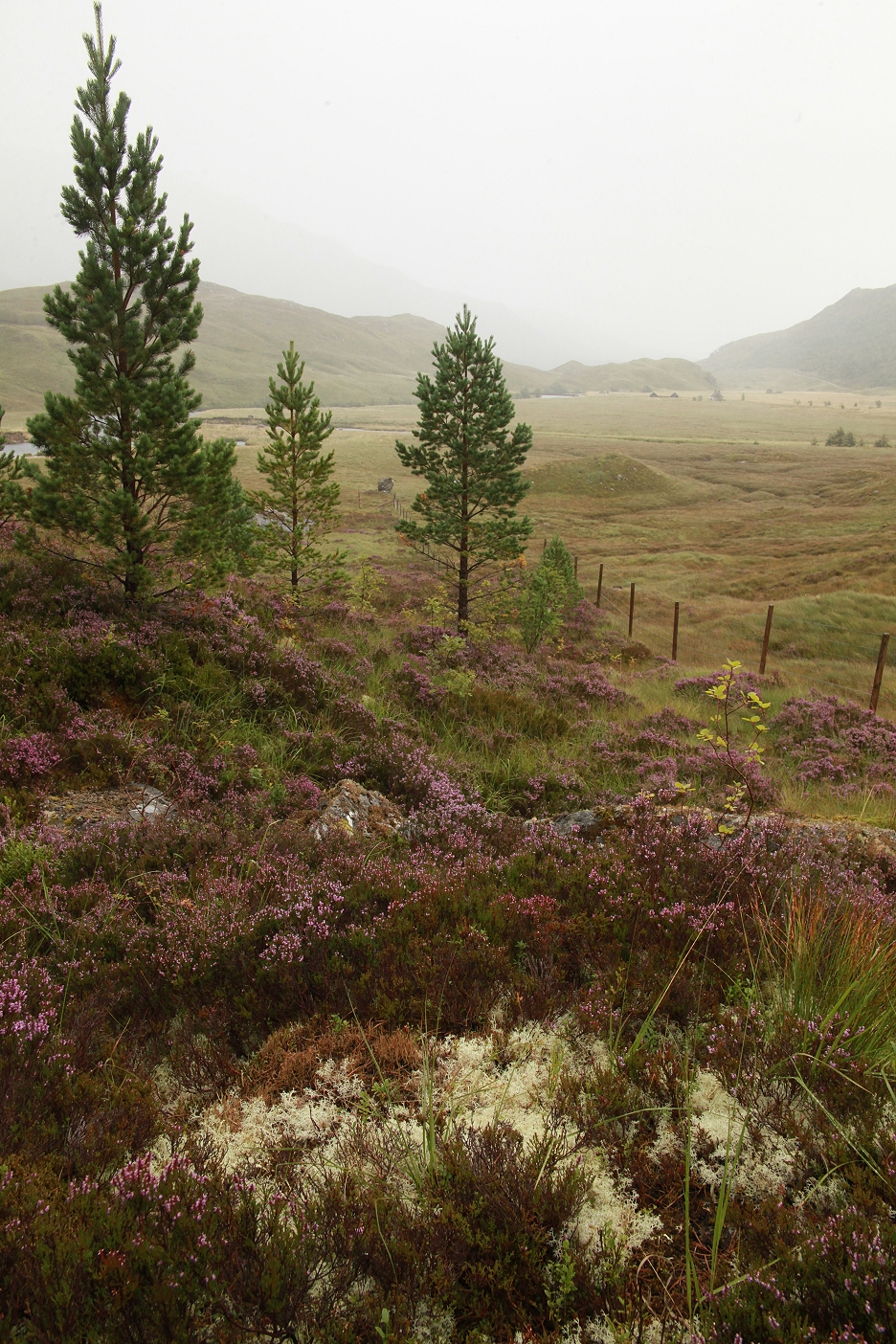
Moving further into the exclosure, and climbing a small rise where the ground conditions are drier, I walked amongst the pines which are now forming a young forest there. Some of them are over 20 feet (6 metres) tall, and have begun to form a closed canopy, providing the shady conditions that favour understorey plants such as blaeberry (Vaccinium myrtillus).


There was a particular area I was keen to see, as it has a lot of very conspicuous peat hags outside the fence, and I hoped to get a visually-powerful image of the contrast between that and the vigorous and healthy growth of trees and heather, out of reach of the deer, in the exclosure. The conditions made it a challenge, as great sheets of rain were blowing eastwards down the glen in the near gale force winds, and the leader shoots of the trees were getting whipped violently back and forth by the gusts.

I wandered around in the exclosure for a while longer, unable to take any more photographs because of the weather, but enjoying the richness of the recovering vegetation and the intense purple of the heather, which was intensified by the rain. After a couple of hours I headed back east, down the glen, as I had to meet the sawfly surveyors from Liverpool Museums (who’ve done a lot of survey work at Dundreggan in the past couple of years) – I’d helped arrange for them to do some surveying for FCS in Affric as well this year.

I caught up with them near the Allt Beithe Garbh burn, which flows through an area of old pinewood on the south side of the glen into Loch Affric. This was more sheltered, in amongst the trees, and the combination of mature pines and flowering heather was particularly photogenic, especially with the mist-like quality of the drifting rain in the background. The surveyors weren’t having much success though, as there there no insects of the wing at all, and very few to be swept with nets off the vegetation.

I spent about an hour with them looking at the alder trees (Alnus glutinosa) that grow beside the burn there. In the end, I did find an unusual-looking and colourful larva on a bracken frond (Pteridium aquilinum) beside one of the alders. One of the surveyors thought it was the larva of a hoverfly and took it for rearing to adulthood, so that it could be identified – I’ve yet to hear if they’ve been successful in that though. Eventually, we all decided to leave the glen, rather wet from the day, but nonetheless exhilarated by the elemental experience of being out in those conditions.

I felt I hadn’t done justice to the wild garden of Athnamulloch, though, so two days later, on the week-end, I returned for another visit, this time with my good friend and colleague, Jennie Martin. Jennie is a former Trees for Life staff member, and current board member of the charity, and is also the founder and Executive Director of Wild things!, an environmental education charity that has grown out of Trees for Life. We hadn’t spent a day together out in the forest for some years, so this was a good opportunity to share the specialness of Athnamulloch, where we’d both worked in the 1990s. On the way towards the exclosure, we stopped to have a look at the Allt Gleann na Ciche burn, which flows northwards from the side glen of the same name in the Affric River, between the Athnamulloch bothy and the exclosure. There’s a straggle of mainly alder trees alongside the burn there, and those are only ones in the area, except for the young ones we’ve planted in the exclosure itself.

On our way to the exclosure, my eye was caught by some scat on the ground, which we stopped to have a look at. Jennie recognised it immediately as being from a badger (Meles meles), and indeed, when volunteers were staying in the Athnamulloch bothy, badgers were occasionally seen at dusk in the area. I’ve never seen one there myself, but it was exciting to imagine that a badger was walking the same route as us, just a few hours previously.

It was a drier day than the previous one, and although it was still quite windy, the sun shone intermittently, and there were more signs of life around. Inside the exclosure, we stopped to look at a naturally regenerating eared willow (Salix aurita), that was flourishing amongst the planted pines. Willows support many species of insects, and I’d previously seen quite a few on that particular bush, indicating that the young forest was supporting increasing numbers of invertebrates, so I hoped there would be some visible this day as well.

Almost immediately I spotted a brightly-coloured fly, which I thought might be a dung fly, but when I sent the photograph to an expert he replied it was a species in a family whose larvae feed on decaying plant and animal matter. It was in the genus Suillia, and was possibly Suillia variegata, although an absolute identification was not possible from the photograph alone.

On the willow bush, there were several unusual growths on the tips of some of the shoots. These are galls that are induced by the actions of a midge, known as the European rosette gall midge (Rhabdophaga rosaria), which causes the willow to produce this distorted growth. A single larva of the midge lives inside each rosette, feeding there and pupating inside the gall, which persists on the bush throughout the winter, eventually being displaced by the new growth of the willow the following spring, by which time the adult midge has left.
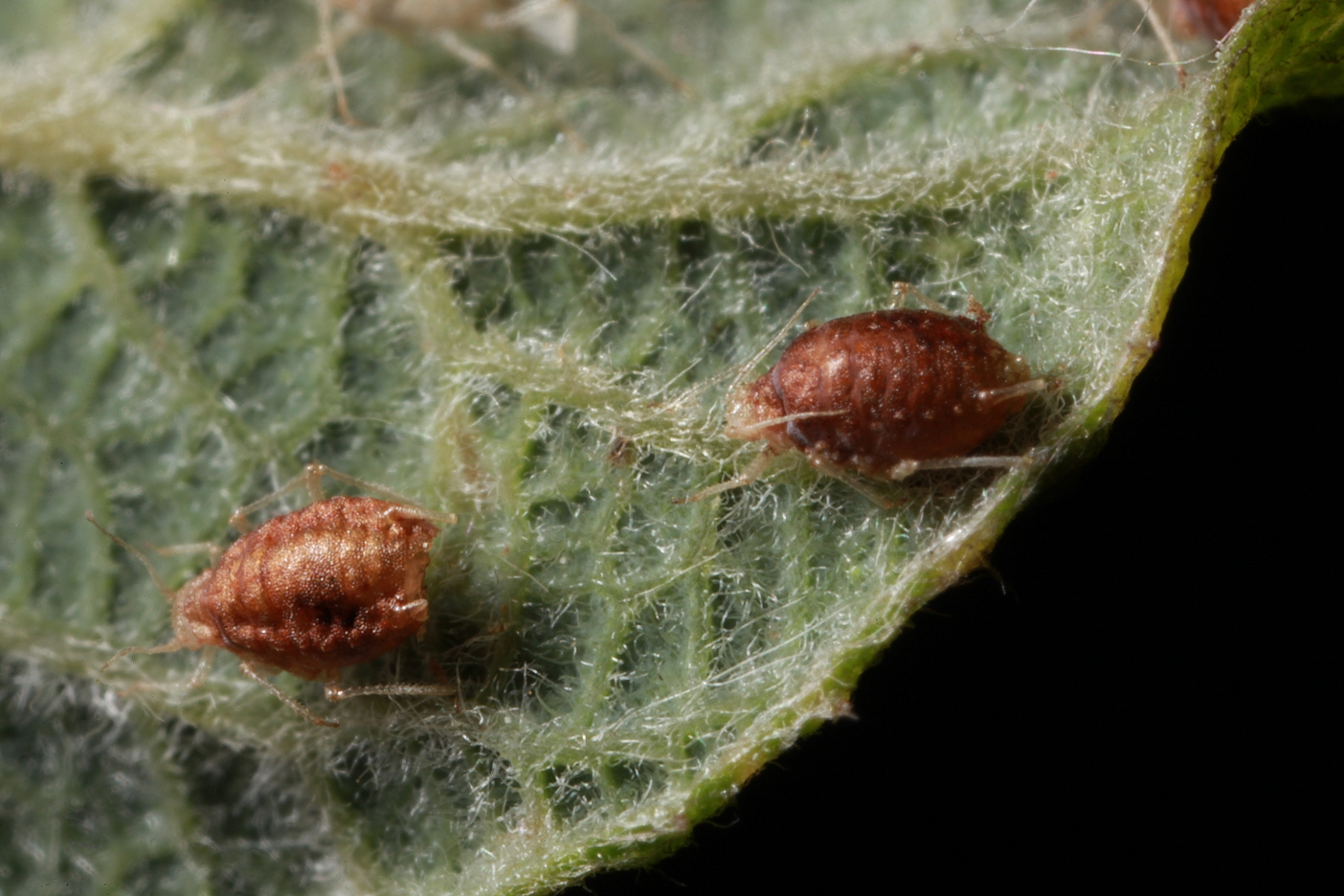
Turning over some leaves on the eared willow revealed the mummified bodies of some aphids on their undersides. I suspect these were a species (Cavariella theobaldi) that I’d photographed on Dundreggan, but I’ll have to wait for confirmation of that from Ed Baker, the aphid specialist who did a survey for us there in June this year. These aphids have been parasitised by a wasp, the larvae of which grow inside each aphid, killing their host.

Moving on to the area of the largest Scots pines in the exclosure, I was able to take some photographs facing west, without the camera lens getting soaked by rain.


Spending time amongst this veritable wild garden at Athnamulloch, I imagined what the Highlands would be like if similar measures, of protection from overgrazing and planting trees, were implemented in all the areas where peat hags occur at present. It would be a fundamental, profound transformation and healing of some of the most depleted landscapes in the country today … and there’s no practical reason why that shouldn’t take place – it just takes commitment on the part of landowners and managers to make it happen.

In addition to the pines that we’ve planted in the Athnamulloch exclosure, there are plenty of broadleaved trees regenerating their naturally, including downy birches (Betula pubescens), rowans (Sorbus aucuparia) and eared willows. One particularly large rowan was heavily-laden with berries, its branches bent down almost to the ground. In the coming weeks birds will eat those berries and distribute their seeds in their droppings, thereby helping the further recovery of the forest. By protecting this area and enabling the growth of new trees, the whole web of life is being re-woven at Athnamulloch …


I spent most of the day in the area near the fence, to document the contrasting life on each side of it. However, in the afternoon I also wandered around in the centre of the area for a while, where the new trees are growing at varying rates, depending on the soil conditions and exposure to wind etc. This variation, combined with the clumped and irregular spacing at which the trees were planted, means that it’s hard to imagine, without knowing otherwise, that this new forest didn’t regenerate naturally.

That, of course, is the goal of all our work – to mimic Nature so well that in 50 years time it will not be possible to tell the difference between areas that have regenerated of their own accord, such as at Coille Ruigh in Glen Affric (our first major project there, in 1990), and those where we have planted trees, like here at Athnamulloch. In my view that will be the measure of the success of our efforts. I won’t be around then to appreciate the results of our work – it will be future generations who benefit from that. For now, though, I’m very happy to enjoy the wild garden that is already flourishing at Athnamulloch …
[jwplayer config=”alan29may” file=”http://www.alansblog.org.uk/alan-oct-10.mov” html5_file=”http://www.alansblog.org.uk/alan-oct-10.mov” image=”http://www.alansblog.org.uk/oct10preview.jpg”]
Hi Alan,
I came upon your blog, while searching for photos of flies from the genus Suillia. However, I suggest that your fly expert should give the fly another look, as I don’t think it is a Suillia sp. Suillia flies (as most species from the family Heleomyzidae) have strong, visible bristles/spines on the front margins (costa) of their wings, which are missing from this individual. Judging by the hairy look of the fly and the numerous bristles on its legs, I’d say it’s a fly from the family Scathophagidae; most likely a Scathophaga suilla (note the similar species name compared to the previously suggested genus).
Nevertheless, I like your article!
Cheers,
-Harry
Finland
Hi Harry,
Many thanks for your comment, and also for drawing my attention to the questionable ID of the fly – I’ll contact another Diptera expert to get a second opinion from the one who IDed it before.
I’m glad you enjoyed the blog article.
With best wishes,
Alan
Hi I am a pensioner who recently spent 2 months in hospital. You’re regeneration notes have inspired me. How can I get there? I have doddery mobility. Thanks
Hi John, Thanks for your comment on my blog. Glen Affric is accessible by public road, and instructions for how to get there are on our website at: http://www.treesforlife.org.uk/ilovepine/find_remnants.html#affric . To reach the Athnamulloch area depicted in my blog is probably beyond you, when you state you’ve got doddery mobility – it’s a 5 mile walk along a rough forestry track to get there from the end of the public road! However, there are lots of other beautiful parts of Glen Affric readily accessible from the car parks in the glen. I hope this is helpful!
With best wishes,
Alan
wonderful post, Alan – I absolutely love to read about (and see) the wonder of restoration like this – fuel for the soul!
Hi Martin, Many thanks for the feedback – Athnamulloch is a very inspiring place for me. With best wishes, Alan.