When I headed out to Glen Affric on 2nd February, it was for my first day out in the Caledonian Forest in a month, as I’d been away for 3 weeks in January. Two of those weeks were in Thailand, a very different environment and climate entirely to the Highlands in winter, but I’d returned from that trip refreshed, revitalised and renewed, and I was looking forward to reconnecting with one of my favourite places again.
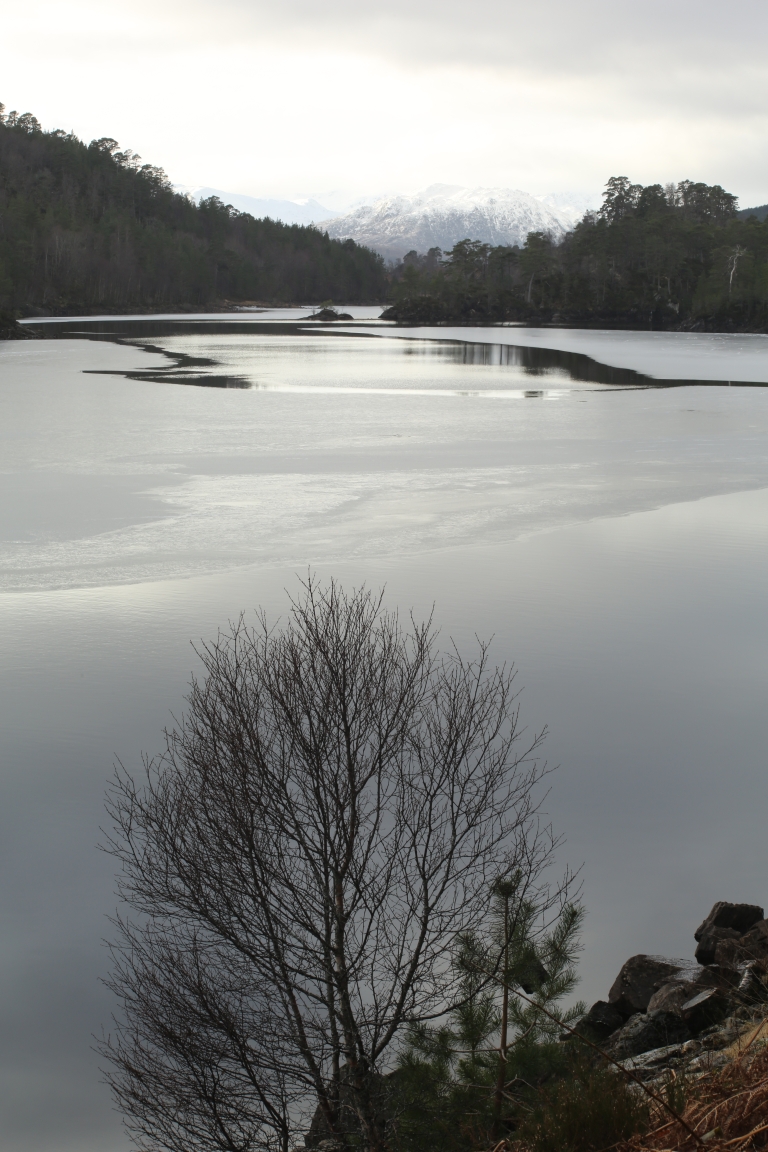
This winter overall has been fairly mild (so far!) in the north of Scotland, although there had been quite a lot of snow on the day I returned to the UK. It had also been quite cold and snowy a few days before I went to Glen Affric, but on the day itself, the snow had gone from all the lower ground and it felt quite spring-like when I left home. Arriving in Glen Affric, as I drove along the north shore of Loch Beinn a’Mheadhoin, I noticed that there was some ice on sheltered sections of the loch. It looked like that was all that remained of what must have been a much larger expanse of frozen water a few days earlier, during the colder spell.
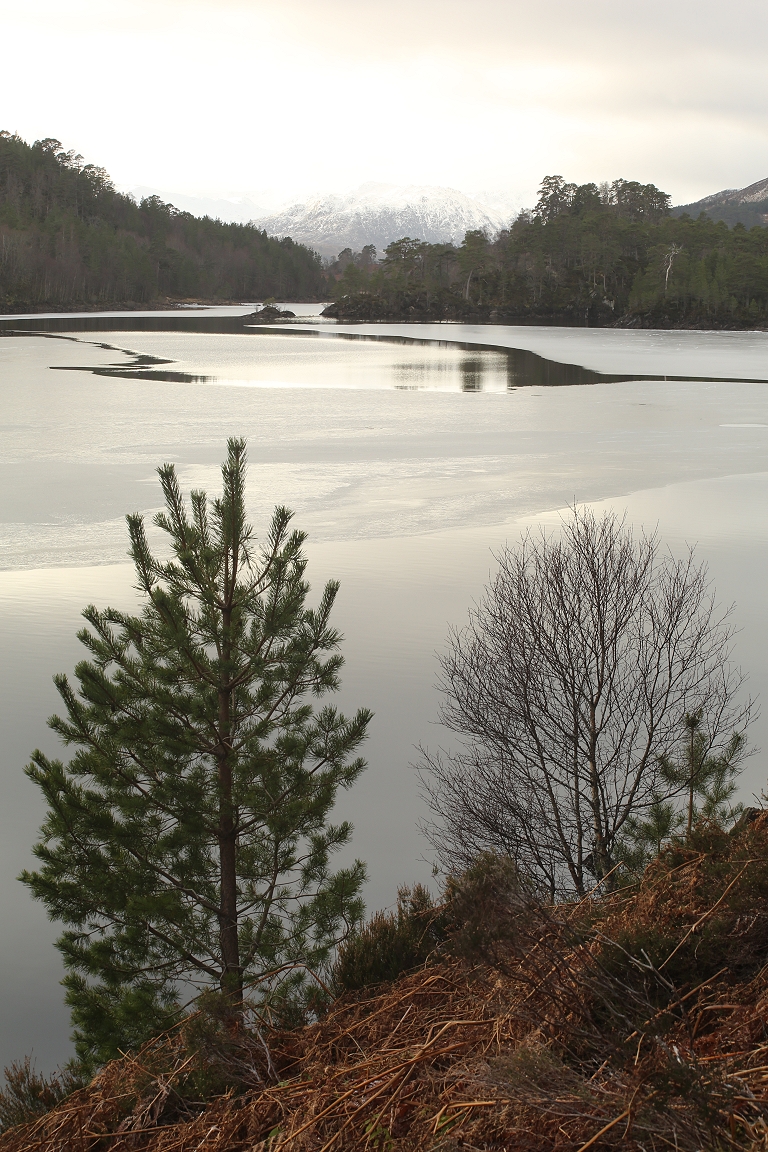
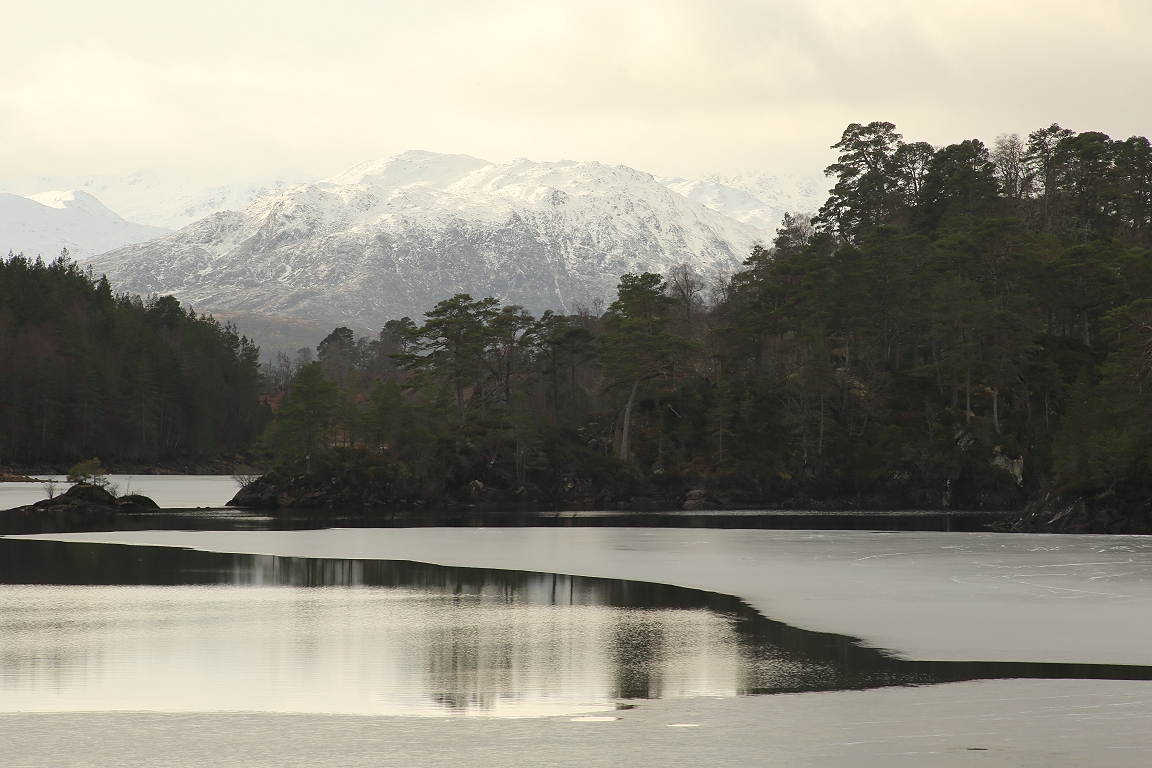
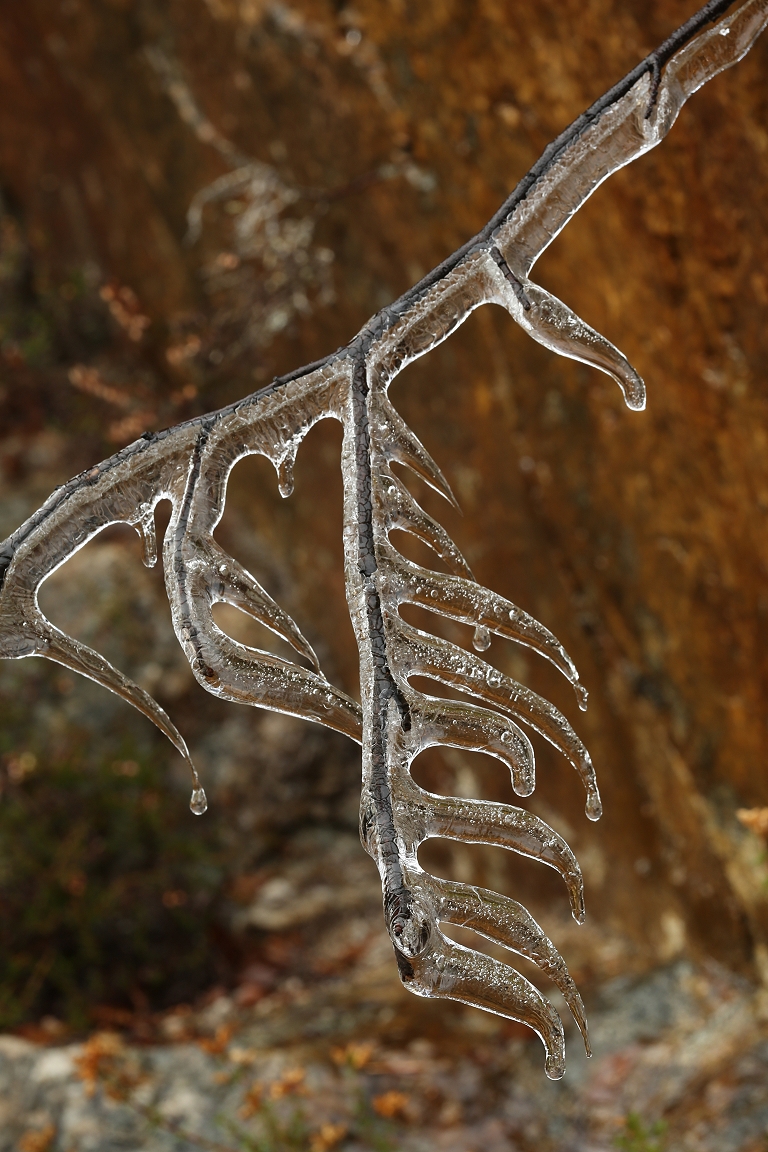
After stopping to enjoy the view westwards along the loch, and the evocative, wintry scene that it provided, I continued west along the road on the north side of the loch. Near the highest point on the road there are some cliffs rising directly from the road edge, and as I came to them my attention was drawn by clusters of ice at their base. These stood out as there was no other ice or snow anywhere nearby, so I stopped my car to have a closer look.
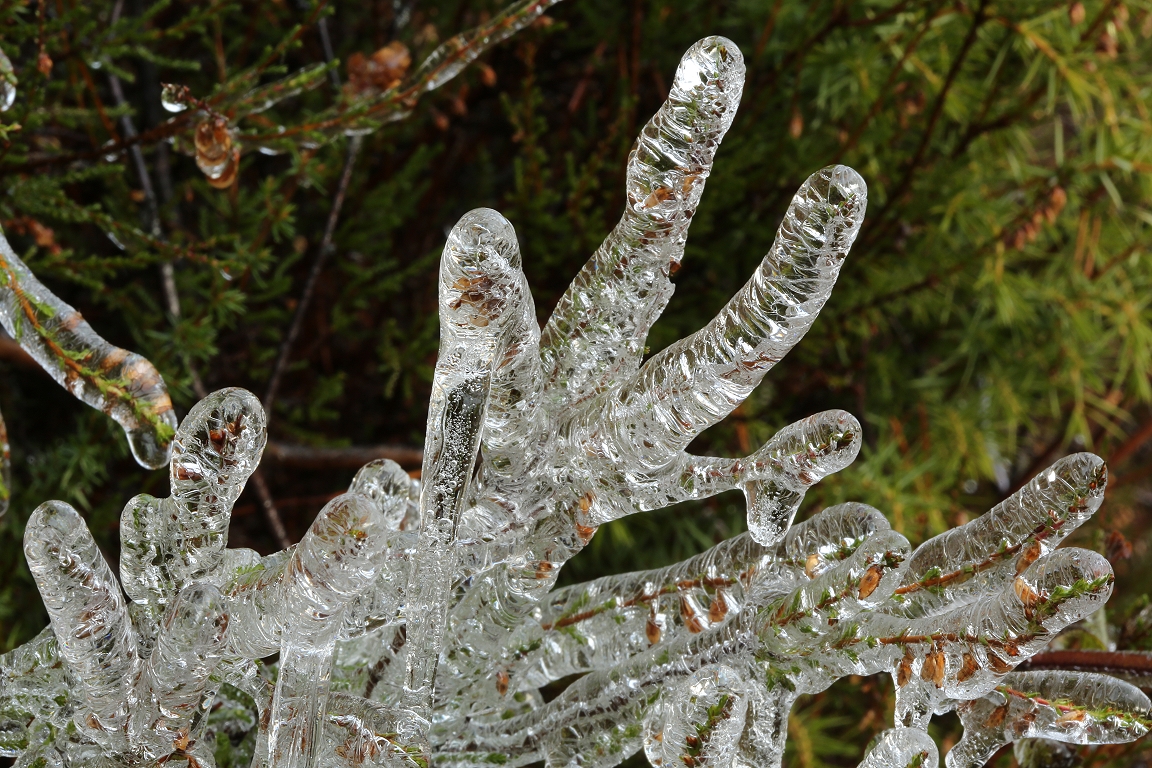
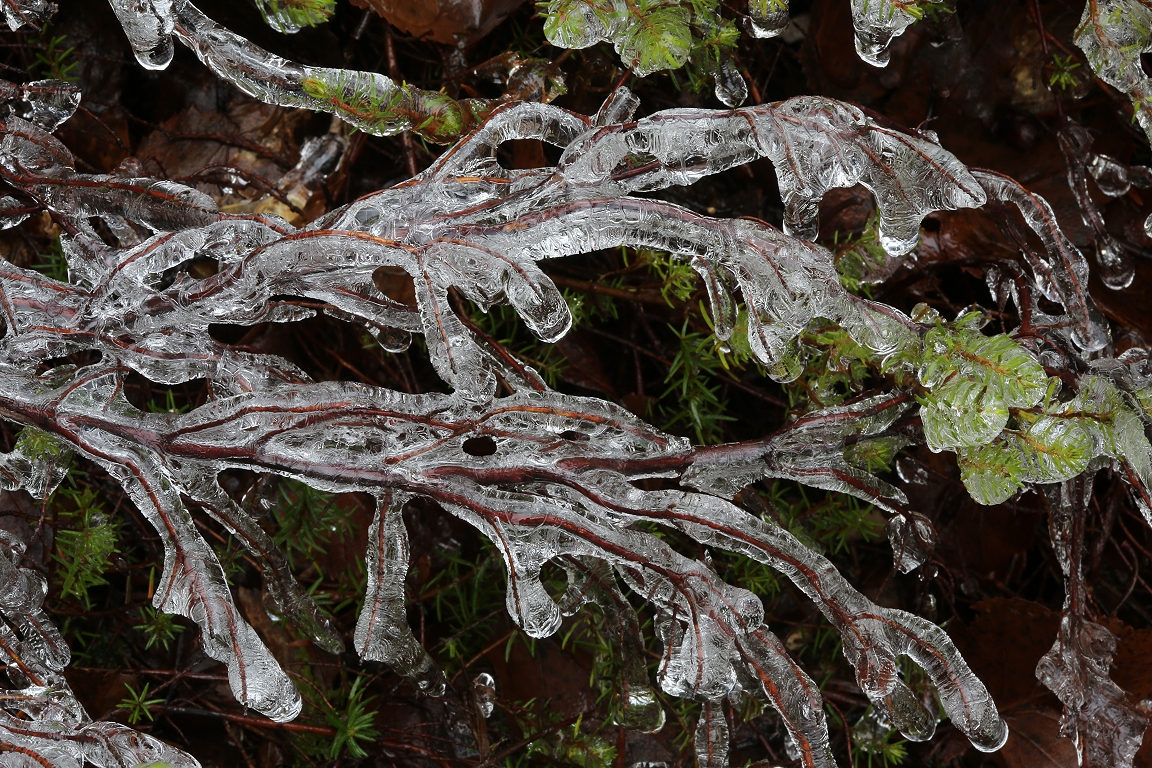
Approaching them, I was astonished to discover a fantastic filigree sculpture of ice coating the stems and foliage of heather plants (Calluna vulgaris), young birches (Betula spp.) and Scots pine seedlings (Pinus sylvestris). The ice had created a delicate tracery on each individual stem, needle or leaf, forming a miniature frozen wonderland of crystalline beauty. Each ice sculpture was unique and different in its shape and complexity of form, and all of them were breathtaking in their exquisite detail.
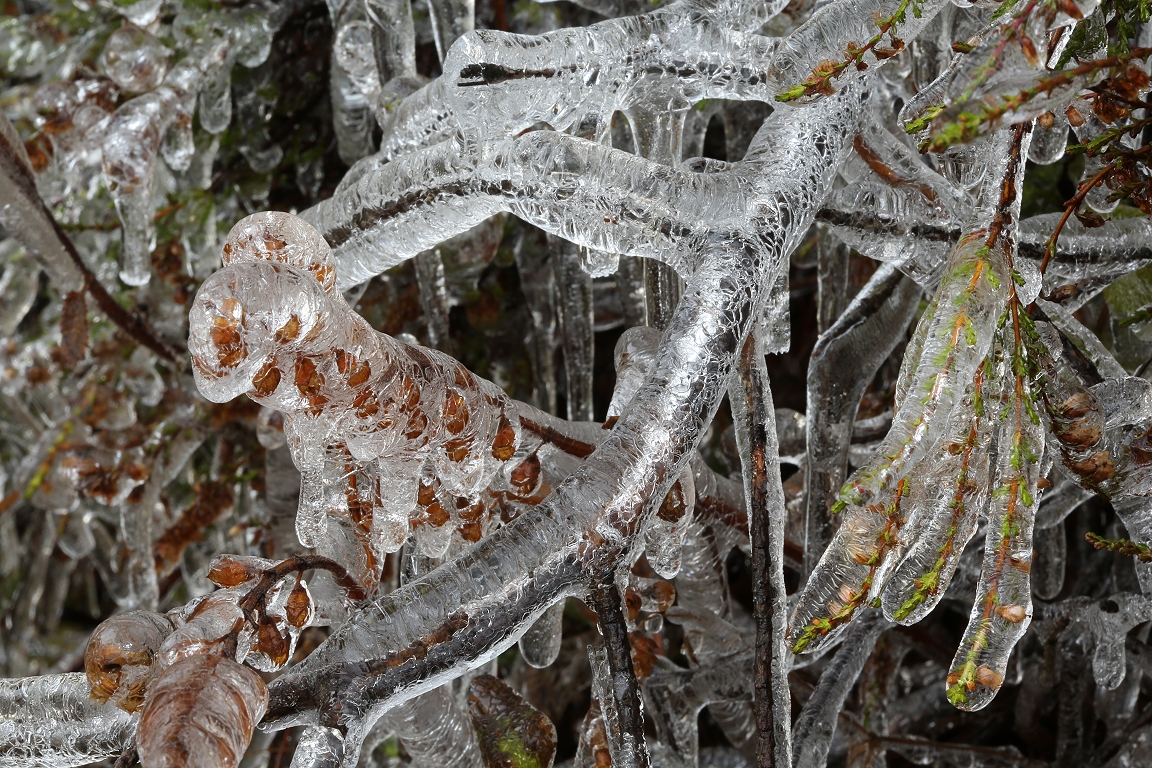
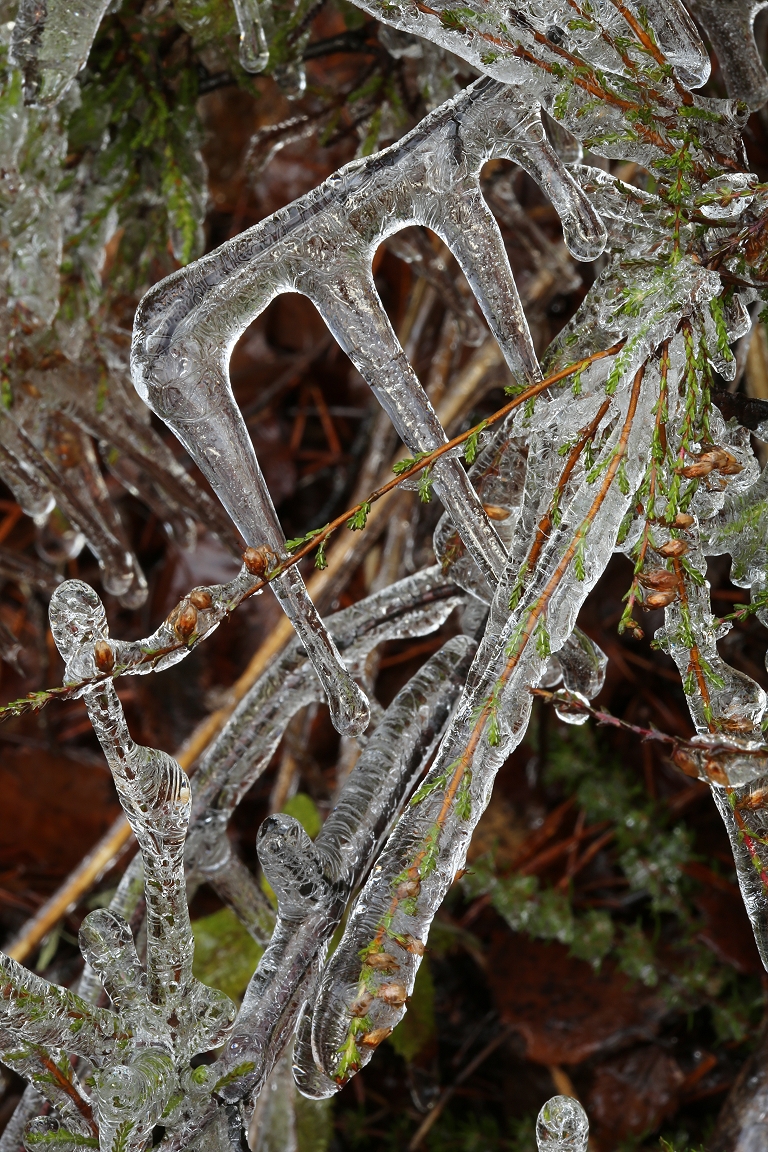
The closer I looked at the patches of ice, the more stunning the individual formations seemed to be. Using the 1:1 macro lens on my camera enabled me to see the pattern on the surface of each section of ice, and these patterns, plus the steady drip of water off the cliff, provided the clues as to why the ice was here and nowhere else.
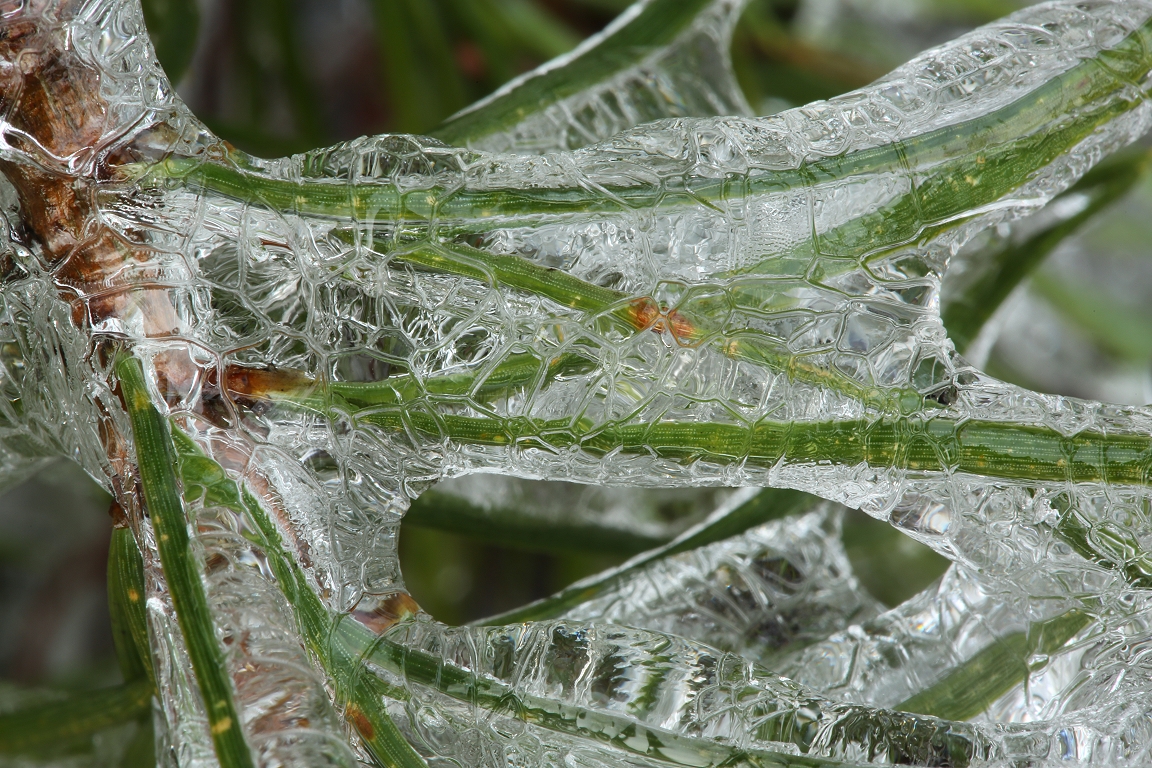
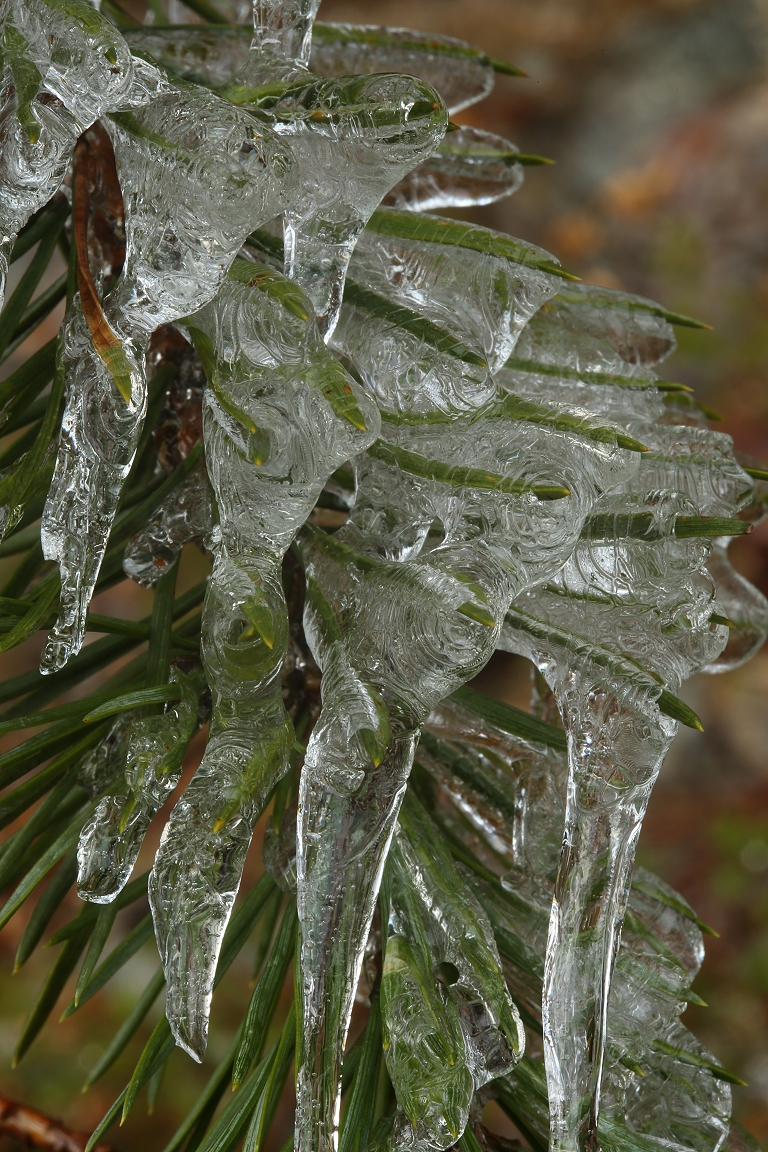
All the patches of ice-covered plants were directly underneath the cliff, which was overhanging in places. I realised that the water dripping from the cliff must have been falling on the plants and freezing in situ, building up slowly, over several days perhaps, to create these wonderful ice sculptures.
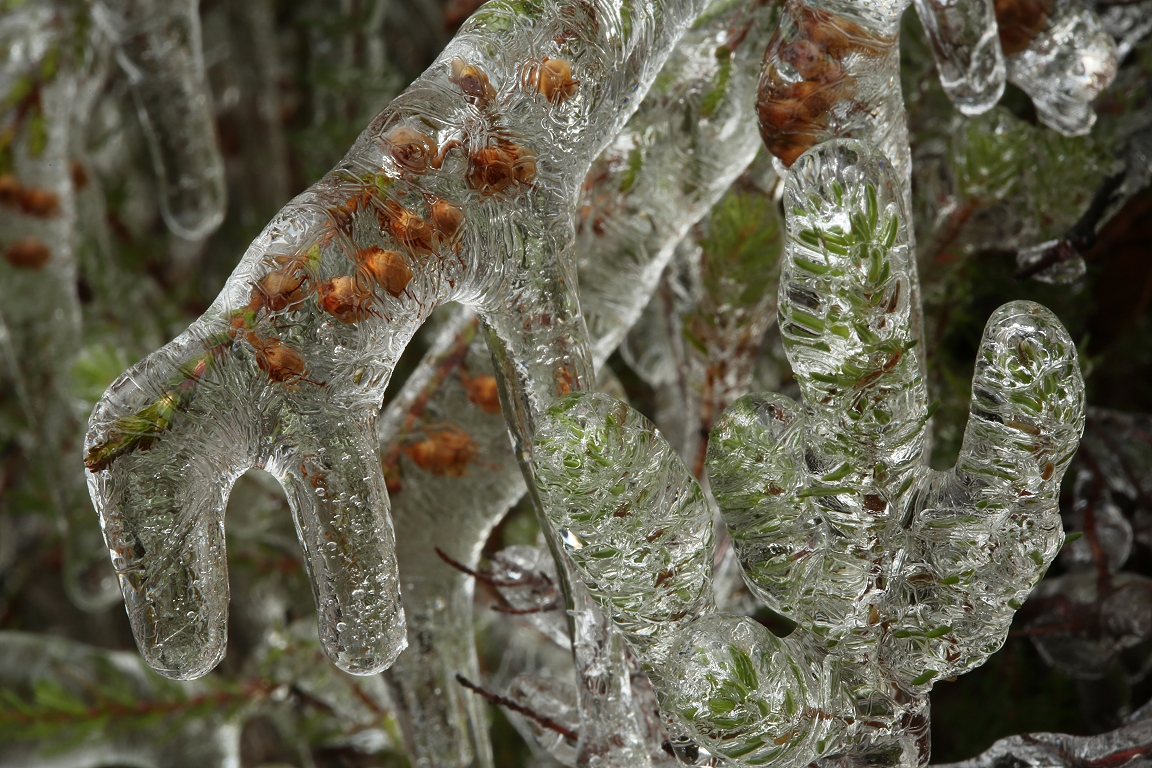
On some of the plants and a young Scots pine, the ice was in the form of icicles, and these had obviously developed in a similar fashion to stalactites in a cave, with the slow but steady drip of water accreting to form the downward-pointing tapered cones of ice. Now, during the day and with warmer temperatures, the dripping water was having the opposite effect: as each drop landed on a patch of ice, it accelerated the thawing process, and in some places the ice visibly reduced as I watched.
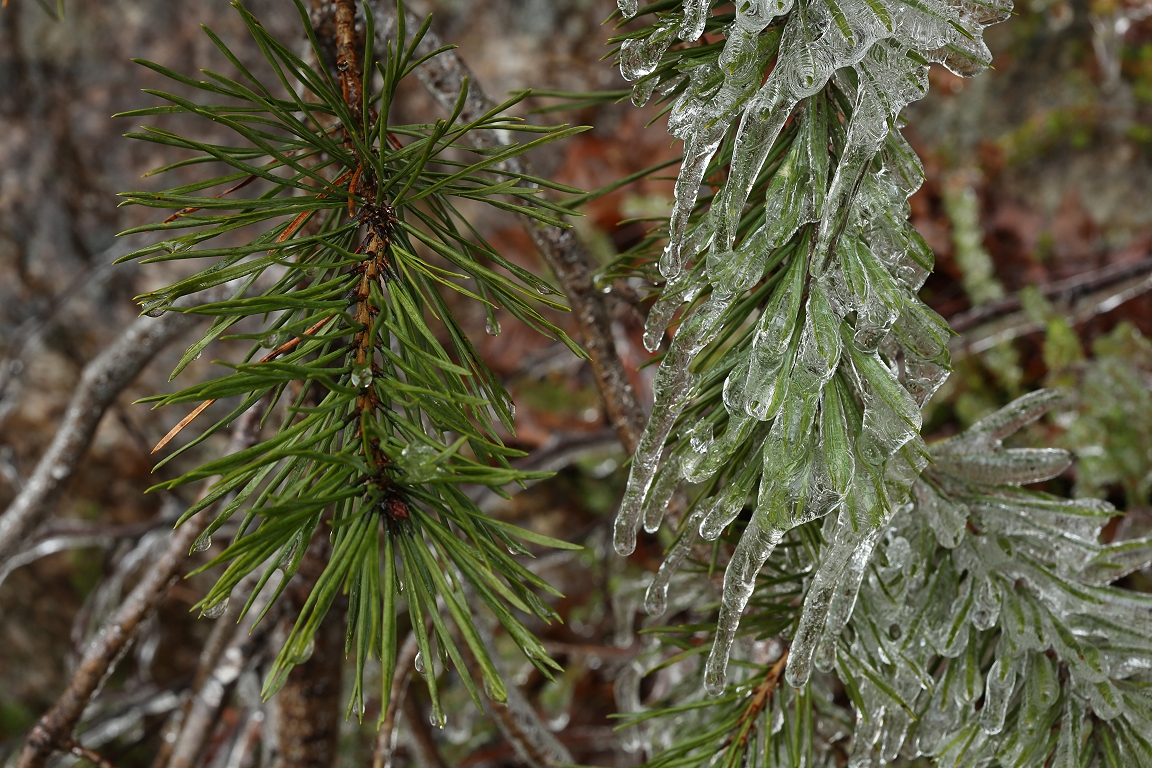
What was remarkable was how extremely localised the ice patches were. It was only the vegetation directly under the part of the cliffs where water was dripping that were coated in ice. In some cases, this meant that some parts of a plant were ice-covered, whilst other parts were completely ice-free. This effect was particularly noticeable on one young Scots pine, where some branches were encased in ice and weighed down by their frozen foliage, while adjacent branches were unburdened, although they were only a few inches apart.
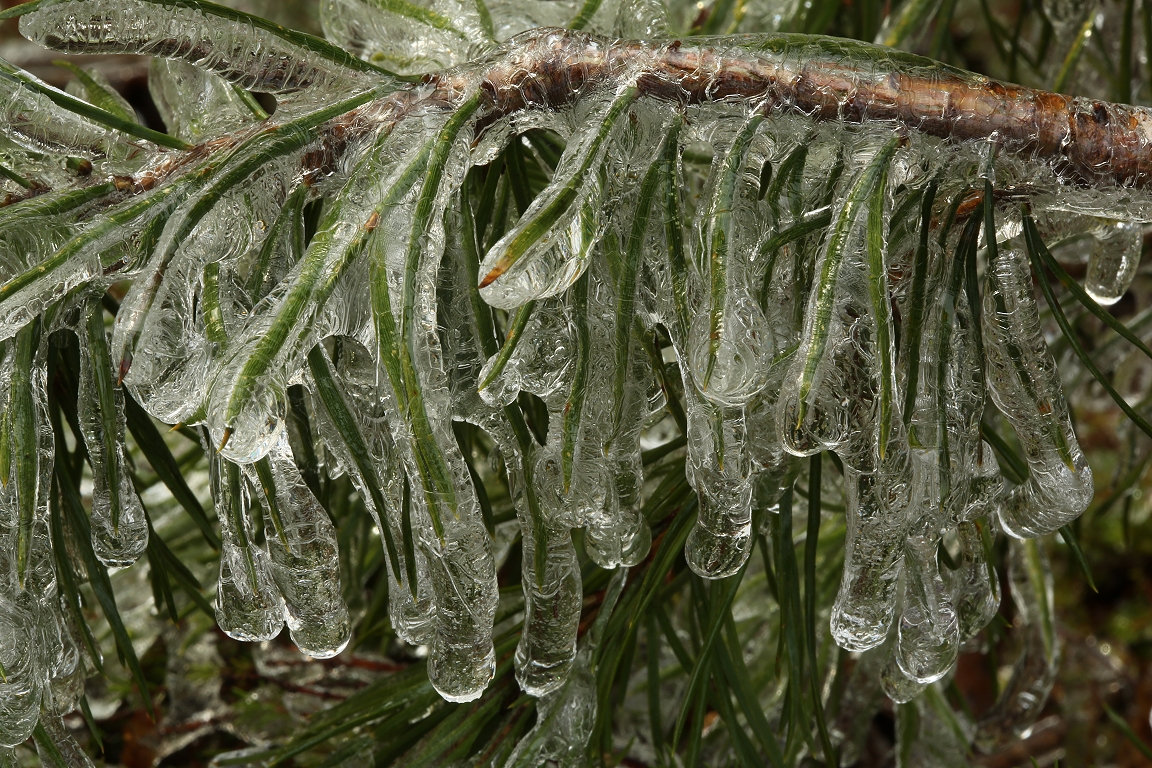
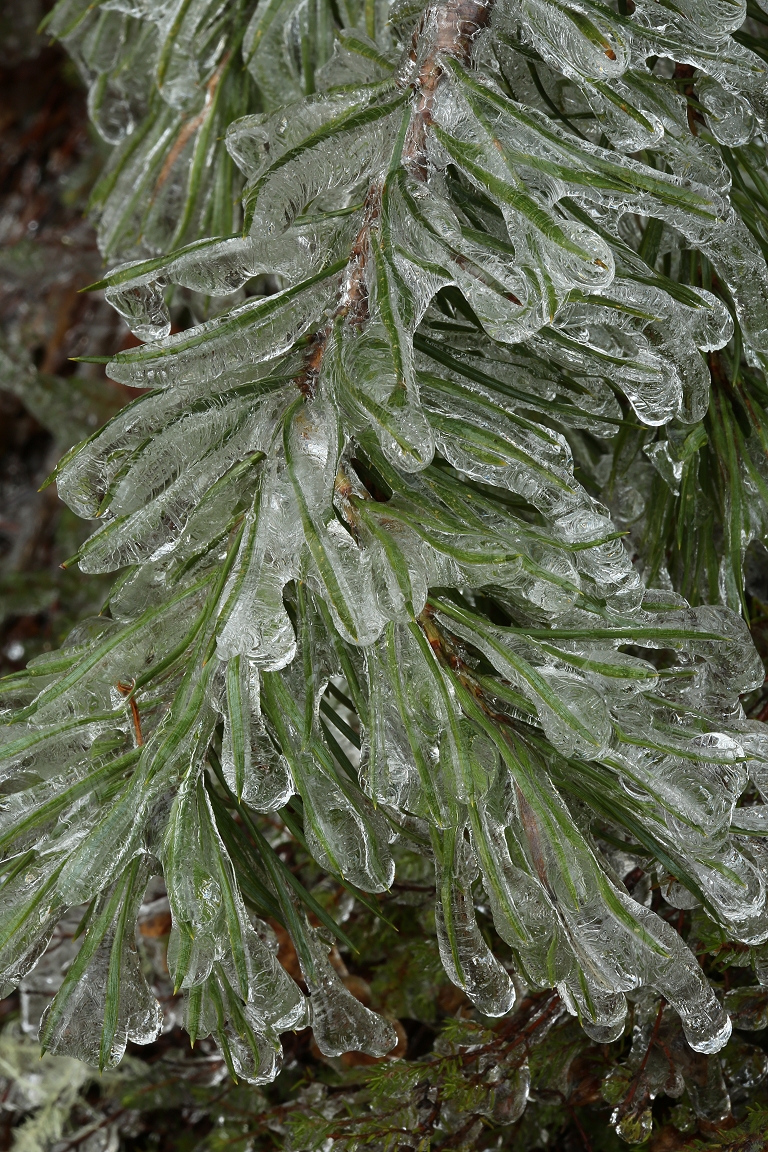
As I continued to look at this wondrous world of miniature ice formations, I realised that it exemplified on a remarkably small scale the concept of a micro-climate! These few patches, each of 1 or 2 square metres, had a unique climate, due to their location under the cliff, that was different to all the surrounding area. I suspect it would be hard to find another example of such a distinctive micro-climate on a similar scale!
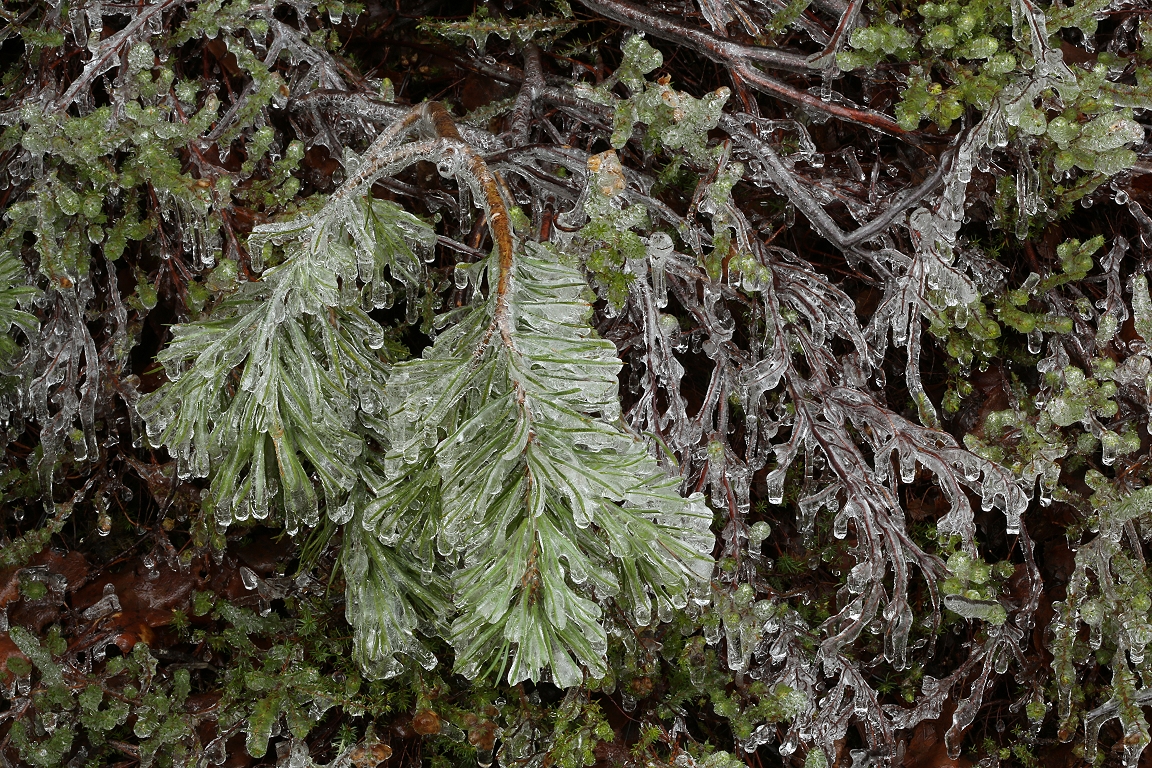
I realised also that this was a highly-ephemeral phenomenon. If the rate of thawing that I observed continued, all the ice would be gone by the next day, I estimated. These stunningly beautiful natural ice sculptures were all very temporary and transient, and, just as no two snowflakes are identical, so I suspected that such a display of ice creations would never be repeated in exactly the same form. How many people actually stopped like I did, and took time to appreciate the wonder that was there? It’s possible I was the only person to do so – I may have been the only one to see and fully appreciate this frozen fantasia …
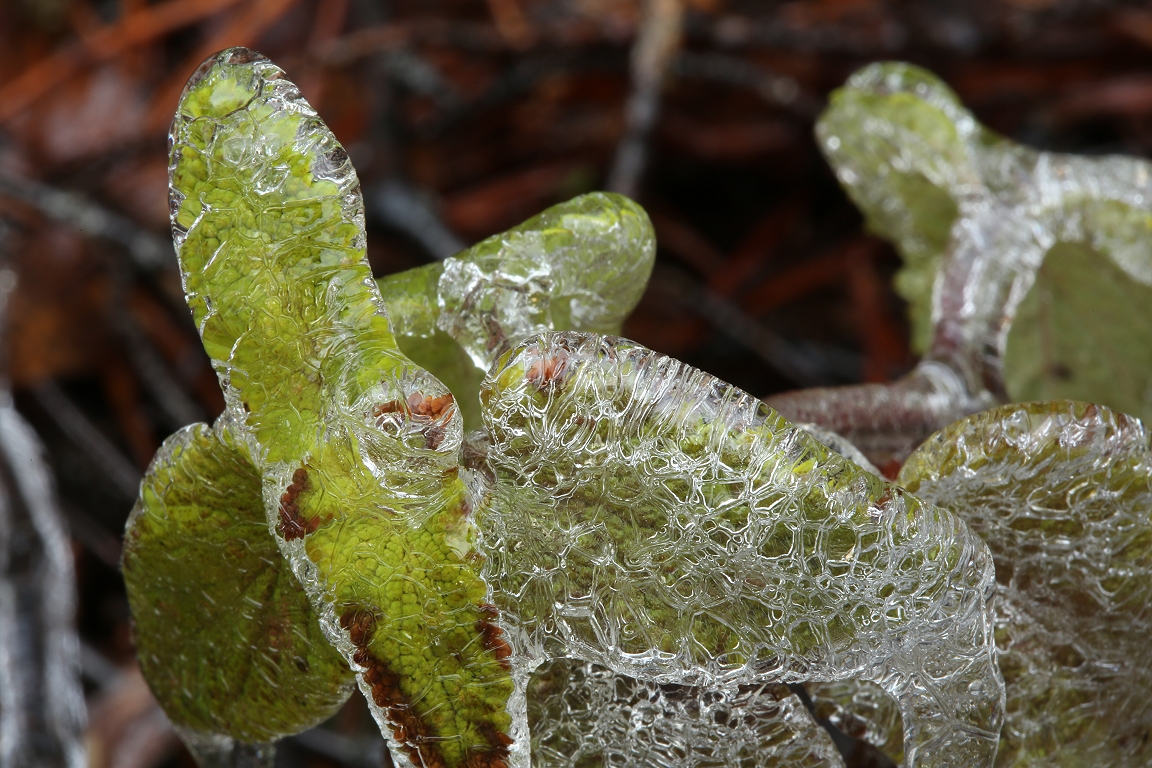
Partly because of that thought, but more importantly because I was entranced by the beauty of the ice formations, I spent almost 3 hours looking at, and photographing this miniature wonderland. Through the images I took, many other people will have an opportunity to appreciate these ephemeral works of Nature’s winter art. This is one of the great joys I experience in taking photographs of Nature – of being able to share some of the wonders of our world with people who might not otherwise come across them.
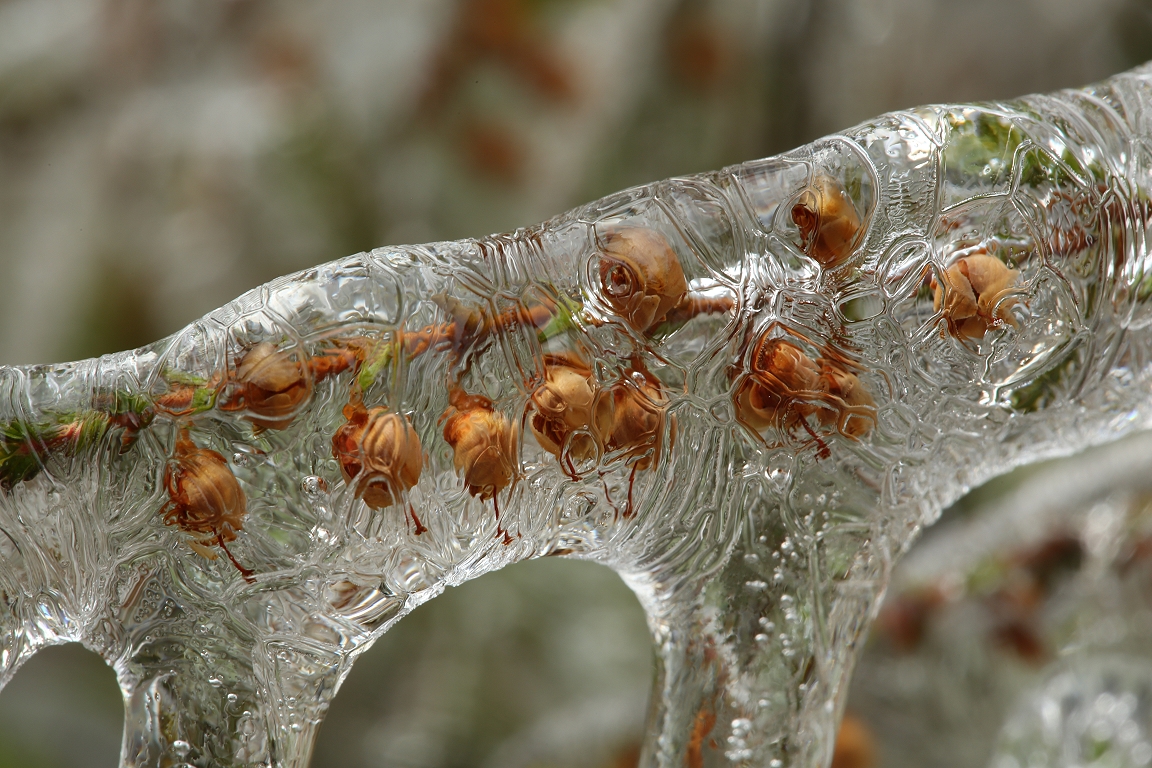
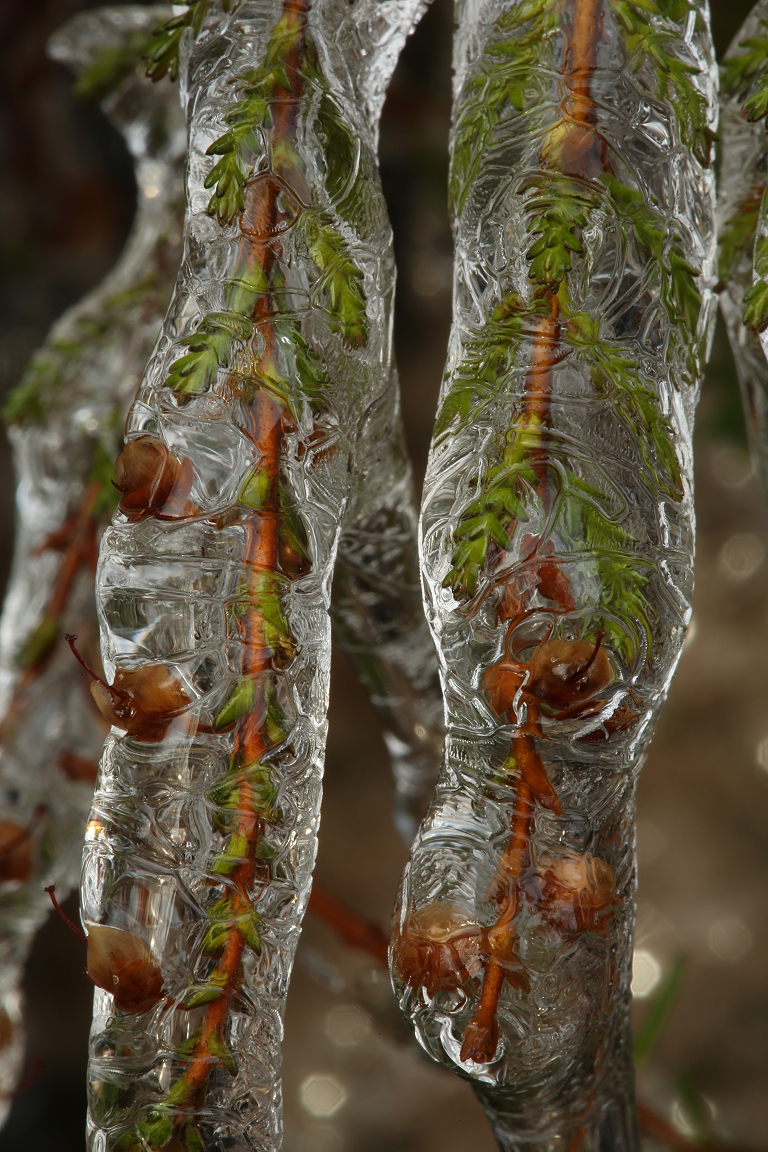
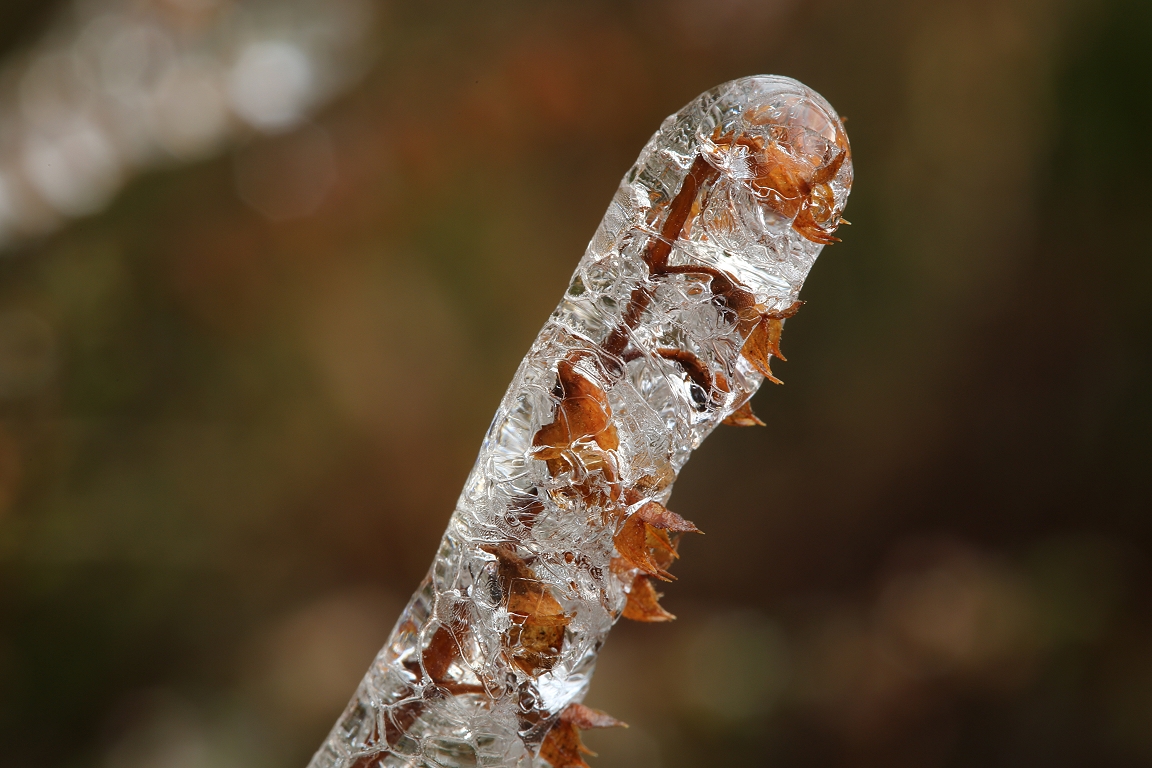
I was particularly moved to see the empty seed capsules of the heather plants on their stems, completely enveloped by ice. These made for very evocative images for me, with the ice providing a crystalline framework that gave an enhanced focus to the seed capsules, whilst at the same time creating an aesthetically interesting visual distortion of them.
Eventually, after over 3 hours, I rather reluctantly tore myself away from the ice sculptures and continued on for another few hundred metres to my original destination for the day – the Allt na Imrich burn. This is another watercourse in Glen Affric that is earmarked for a hydro-electric installation.
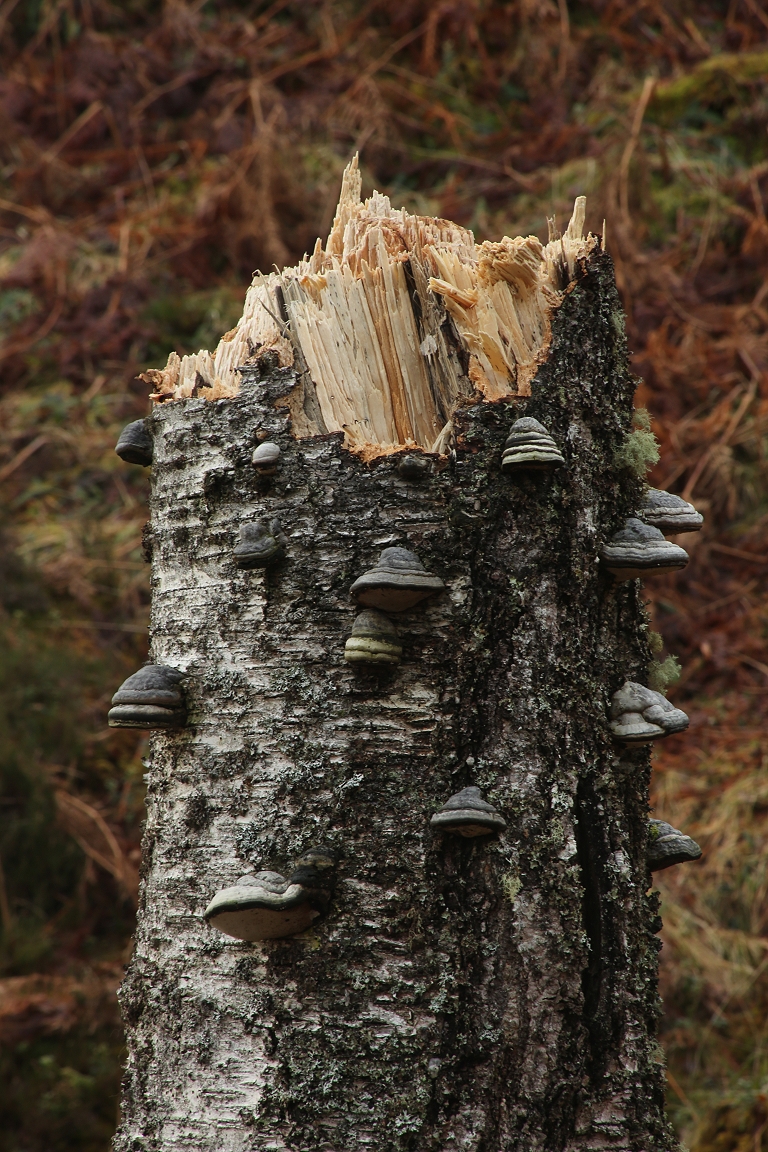
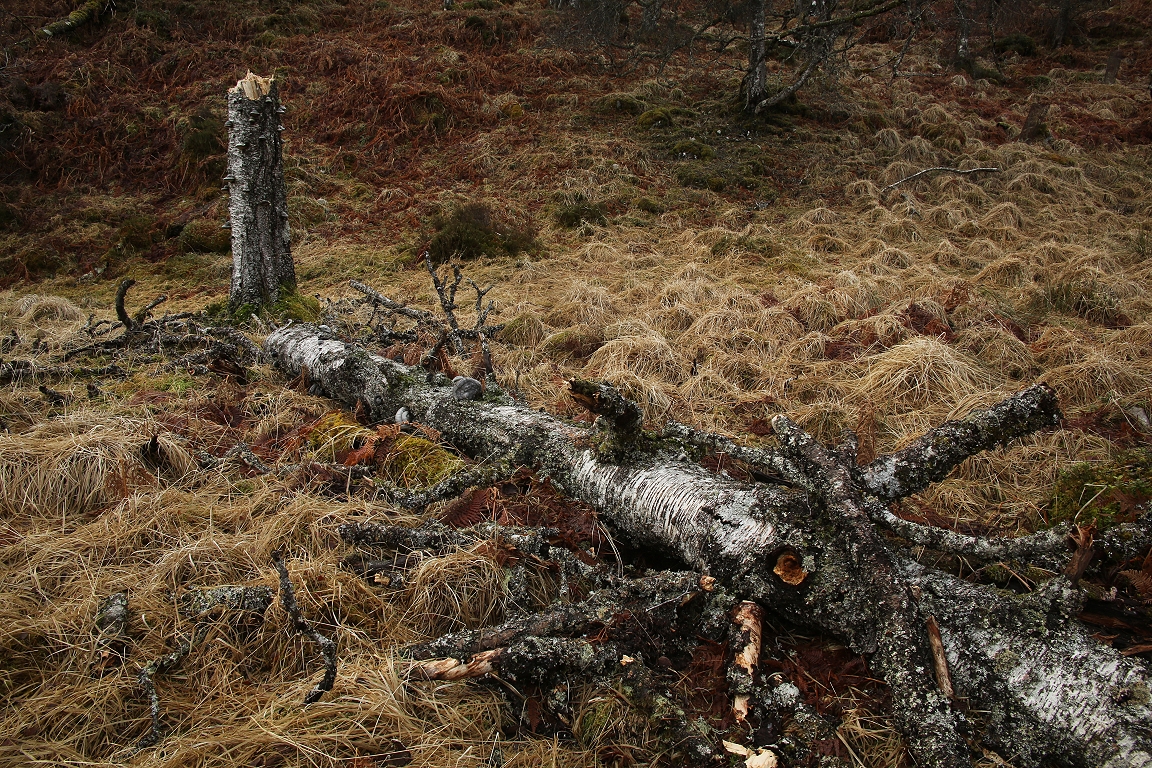
On my way from the car to the burn, I came across a large, fallen birch tree, which I stopped to look at. It, and the remaining standing part of the trunk, were covered in the tough woody brackets of the tinder fungus (Fomes fomentarius) – a species which is common on dead birch trees. It is a saprotrophic species, meaning that it helps to break down the tough cellulose and lignin of the wood, thereby making the nutrients contained in the dead wood available for other organisms. The wood of dead birch trees, unlike that of Scots pines, decomposes fairly quickly, so this tree had probably only fallen in the past few months – certainly, when I last visited this area, the tree had still been standing. Now, it’s joined the ranks of departed friends – those old trees that I’ve known in Glen Affric for many years, but which have died, usually from old age.
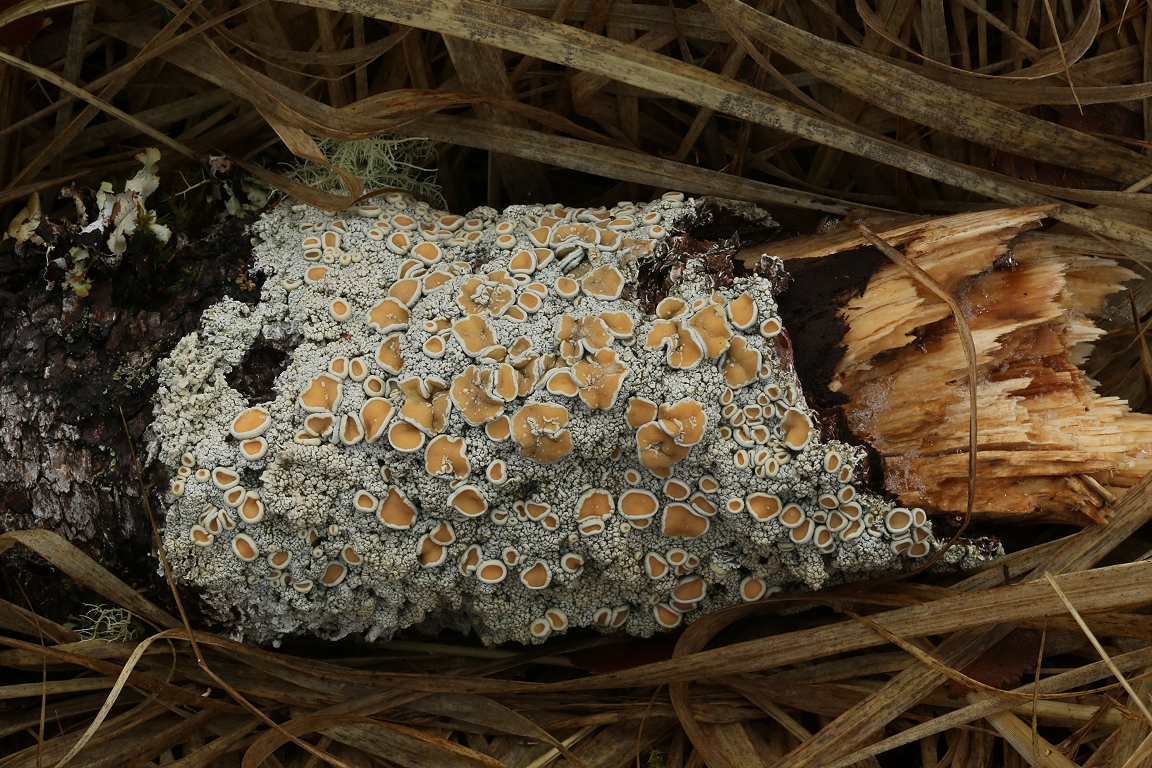
When the main trunk of the birch tree had fallen over, the smaller branches had been smashed, and were scattered all around the log. On one of these broken branch sections, there was a very nice patch of cudbear lichen (Ochrolechia tartarea), a species that is commonly found on the trunks of old birches. It produces round, disc-like, pale brown apothecia, and there were plenty of them visible on this patch.
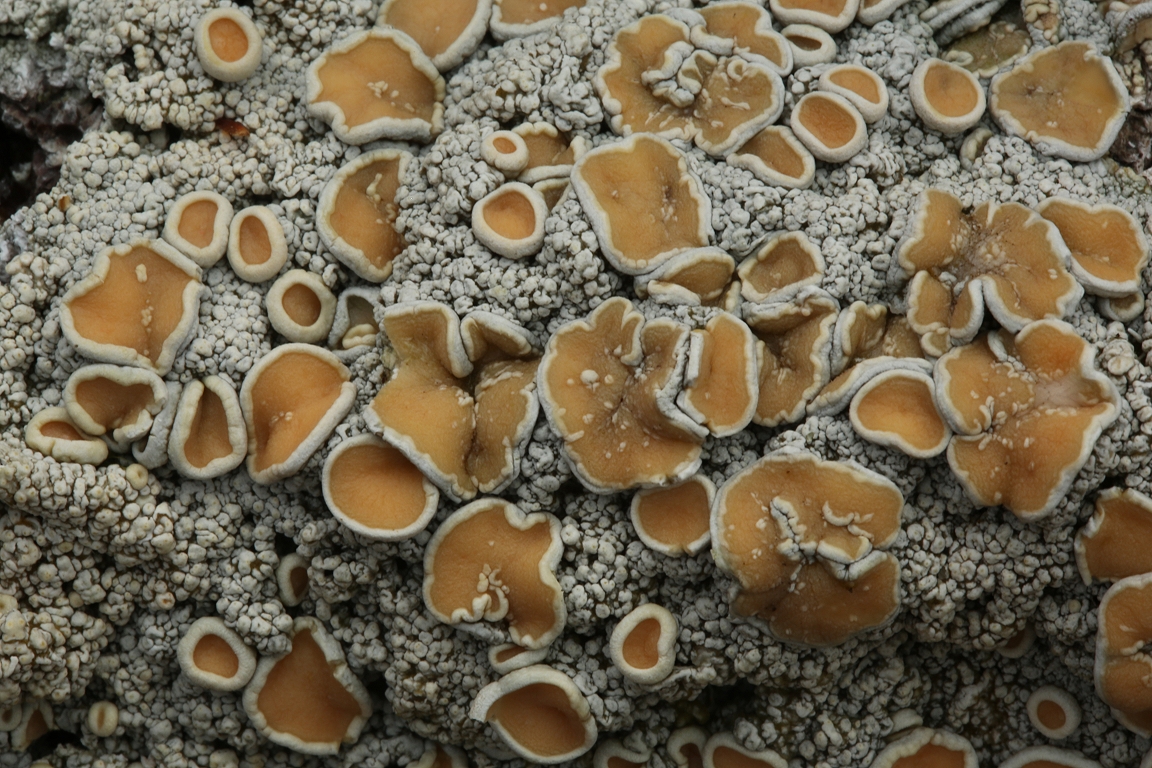
The apothecia are the parts of the lichen which release the spores of the fungal partner in the compound or symbiotic organism that is a lichen. The fungus provides the rigid structure of the lichen, while the other partner, an alga, contributes the ability to photosynthesise – to utilise the energy of the sun to manufacture carbohydrates and sugars that are the lichen’s source of nutrients. This partnership between fungus and alga has enabled lichens to become one of the most successful groups of organisms in the world, and they grow everywhere from the spray-line on rocky coasts, to mountain tops, deserts and forests of every type.
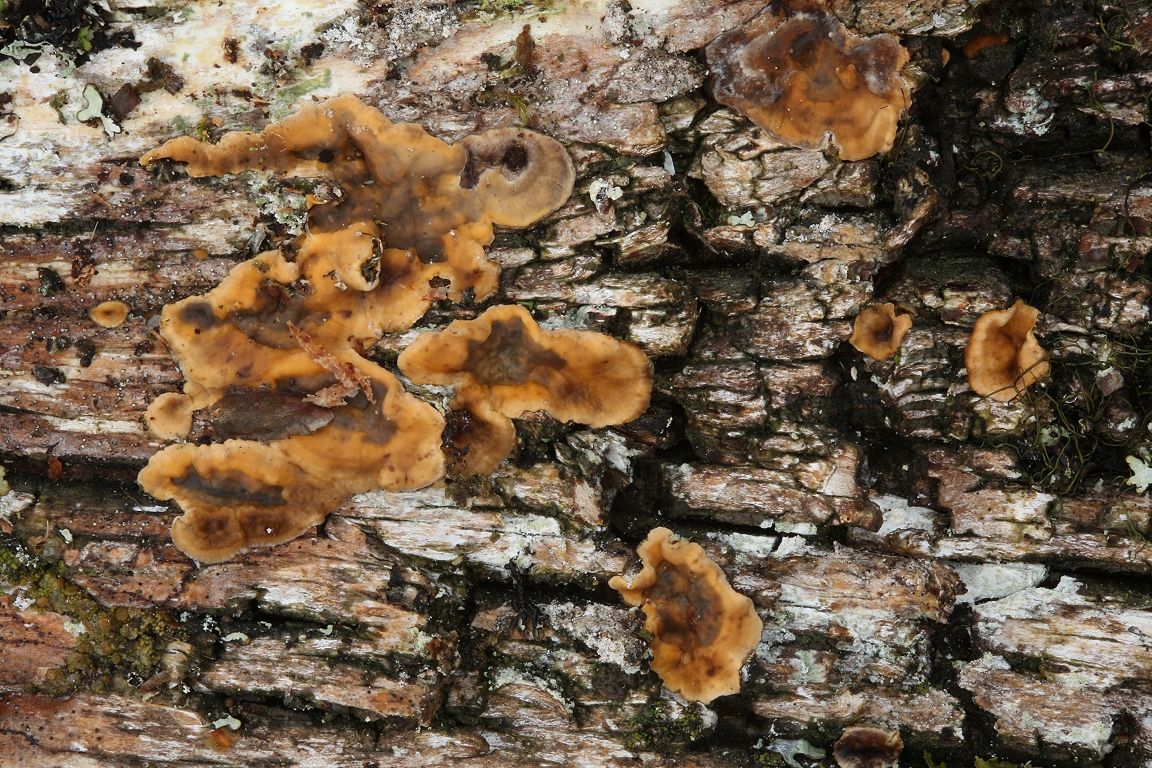
I walked around the main fallen trunk of the birch to see what else was taking advantage of the source of nutrients the dead tree was providing. On one section of bark I found a patch of bleeding broadleaf crust fungus (Stereum rugosum). This species is quite common on a variety of dead broadleaved trees, and gets its common name from the fact that the fungus secretes a red liquid that looks like blood when its surface is scratched. In a blog last year I included some photographs that illustrate this phenomenon.
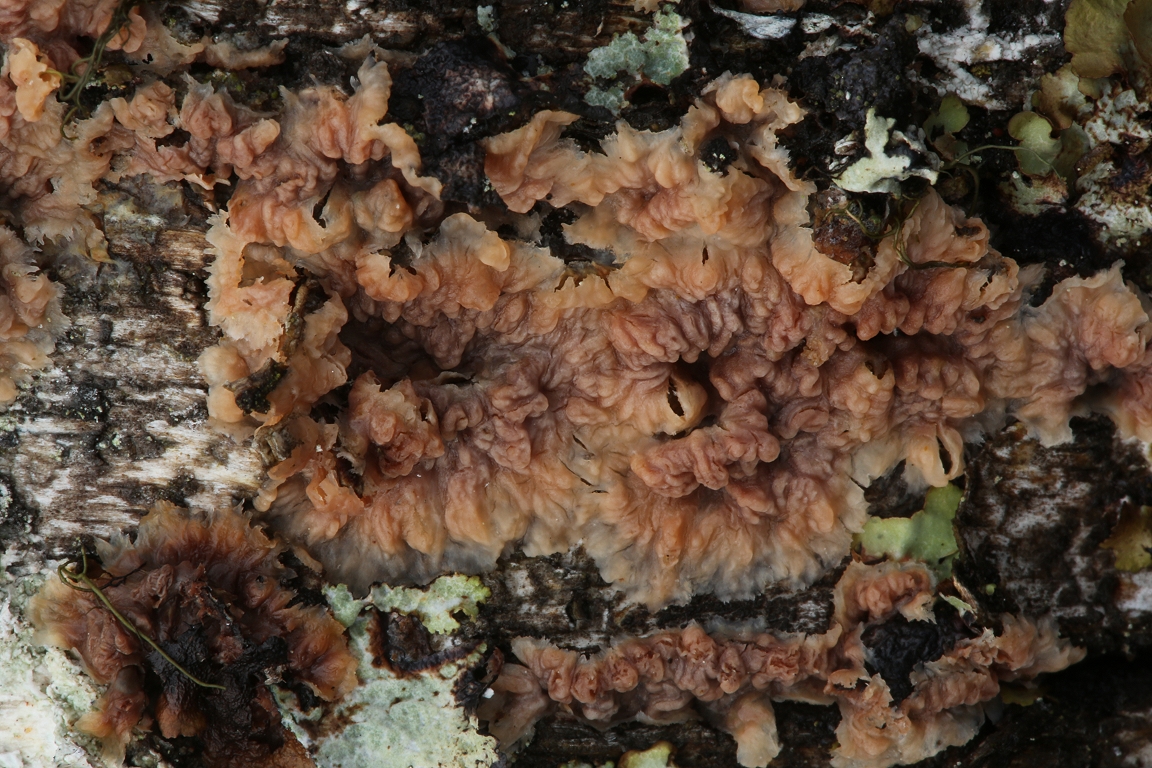
On other sections of the fallen trunk a different fungus was growing. This one had what appeared to be quite a geometric pattern of growth, but it wasn’t a species I recognised. I collected a sample of it, which I’ve sent off to a mycologist who helps me with fungal identifications, and she’s subsequently replied confirming it as being the wrinkled crust fungus (Phlebia radiata).
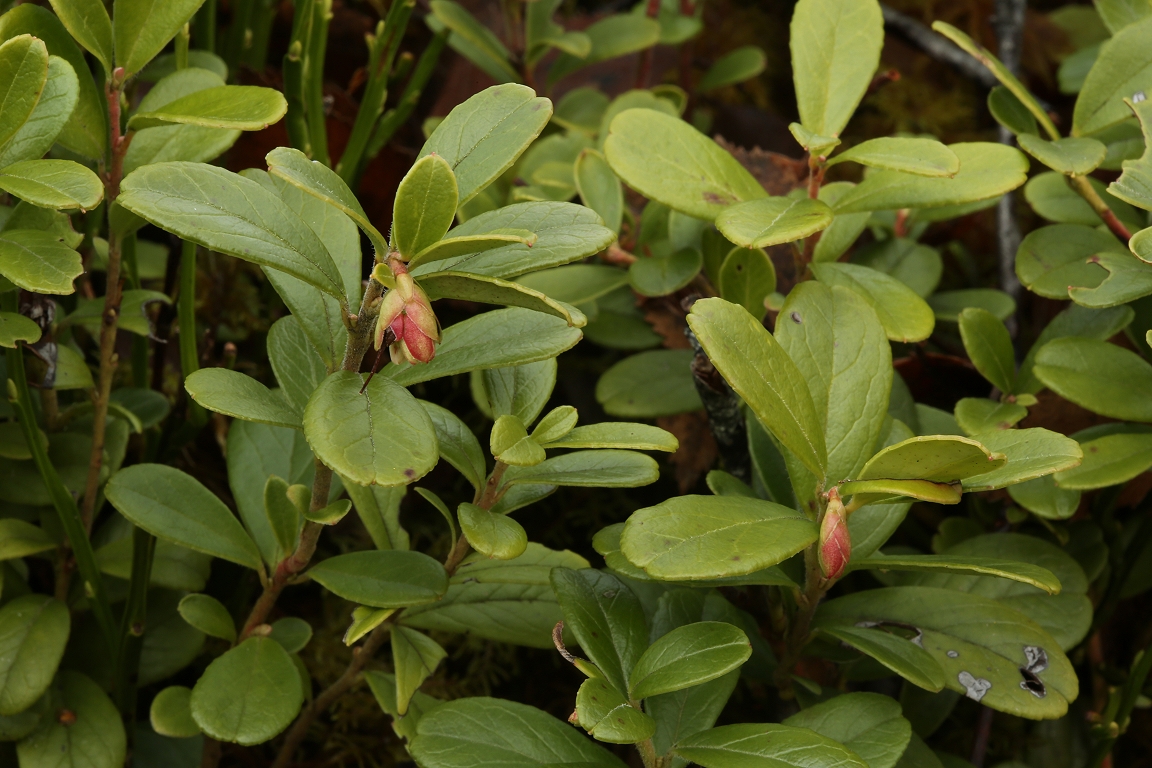
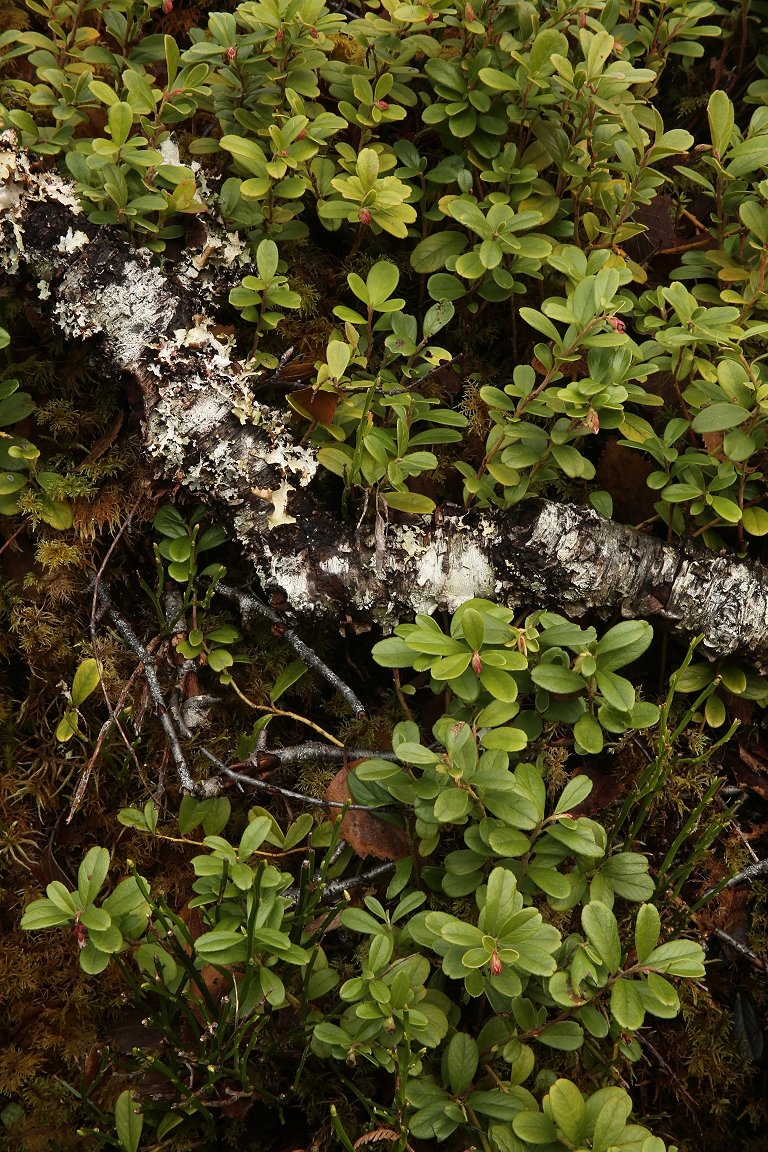
Near the fallen trunk of the birch tree there was a hummock covered in the bright green foliage of cowberry (Vaccinium vitis-idaea). This plant is closely related to the better known blaeberry (Vaccinium myrtillus), but is evergreen, whereas blaeberry is deciduous. It’s one of the few plants which brings green colour to the forest floor in winter, and in the photograph on the left here the buds for this year’s flowers can be seen.
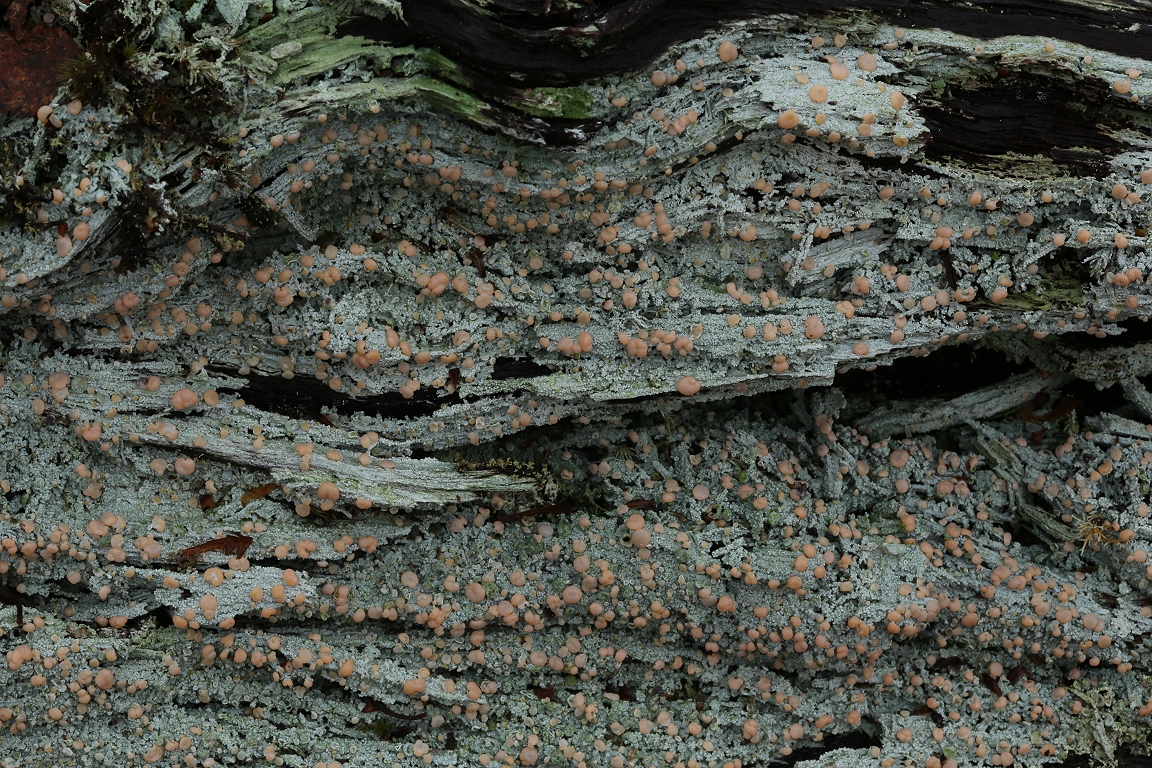
Leaving the fallen birch behind I headed over to the Allt na Imrich burn, but just before I reached it, another smaller and older log caught my eye. This had an extensive patch of a pale greenish-grey lichen (Icmadophila ericetorum) growing on it, which was covered in pinkish apothecia. This is quite a distinctive species, occurring on old dead wood and on peat banks.
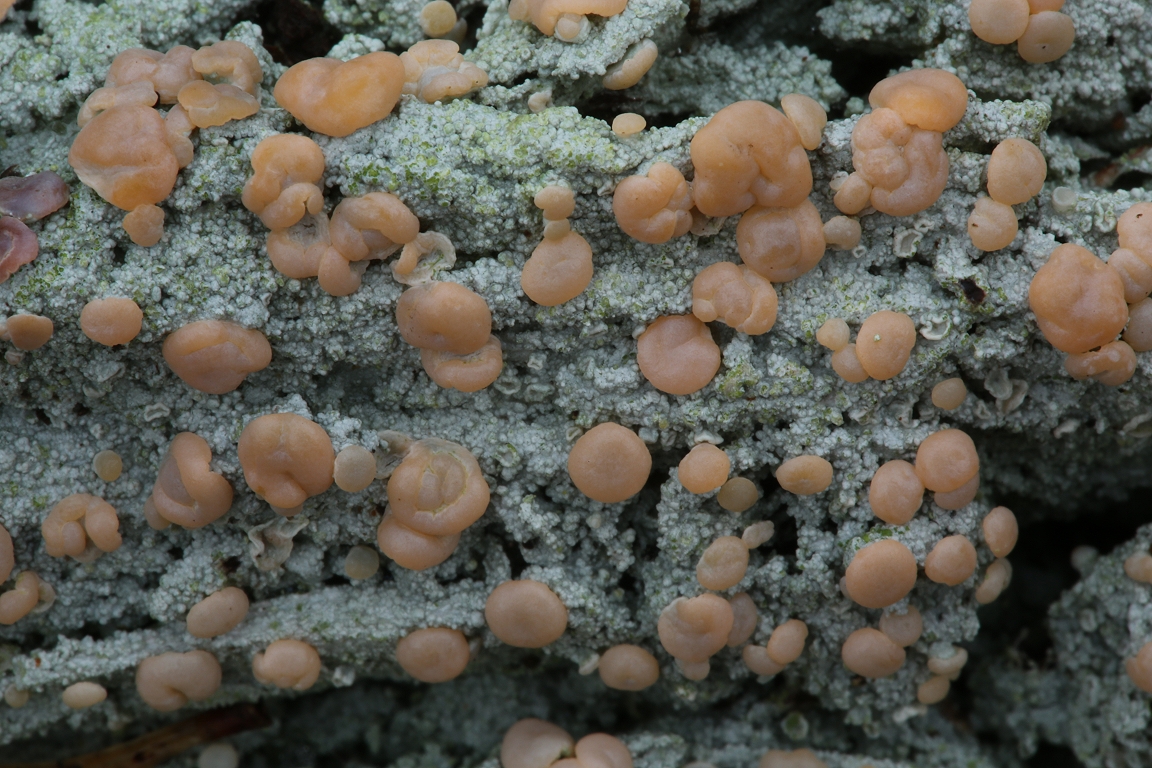
The apothecia are usually abundant, and, in North America, where this species also occurs, they are apparently sometimes called ‘fairy puke’ – a rather derogatory name for what are actually quite beautiful features of this lichen. This species is one of the crustose lichens – a scientific term which is derived from their growth habit, which is crust-like on their substrate (the tree bark in this case).
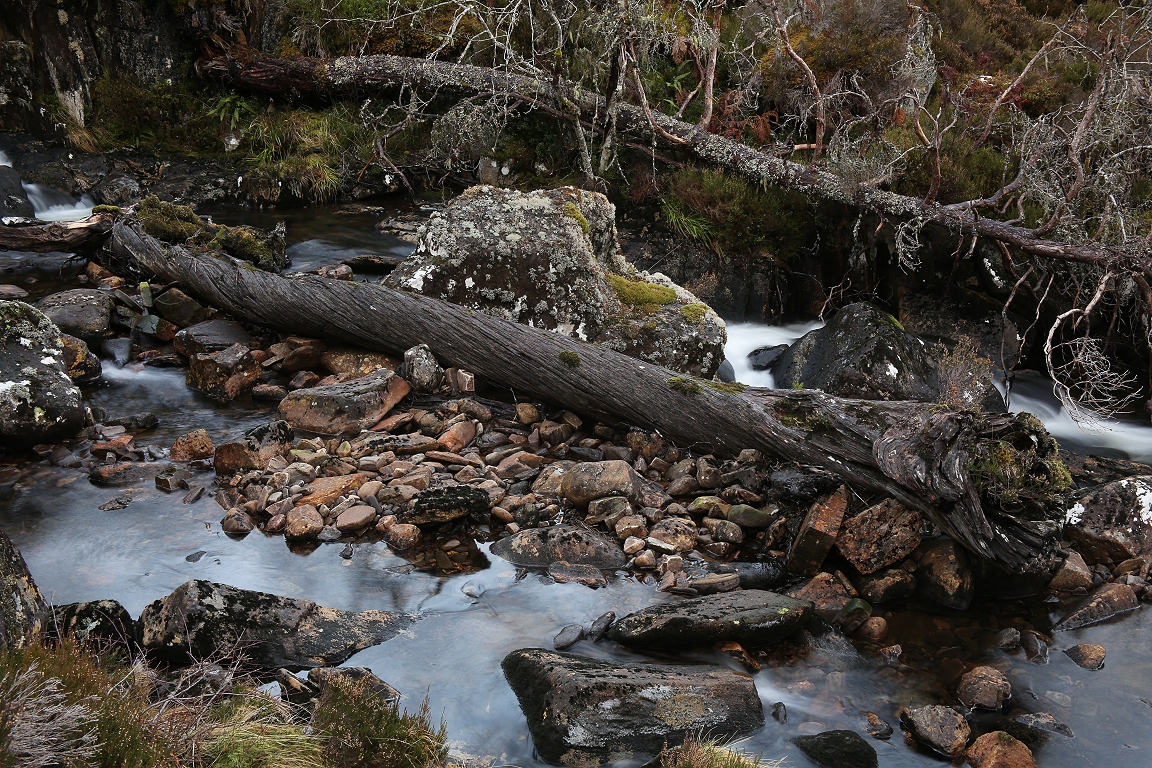
By the time I got to the burn itself, the light was beginning to fade, so I didn’t have an opportunity to explore it much at all. However, I noticed that there were quite a few Scots pine logs that had fallen across the burn at the spot I’d reached. Trunks like these create obstacles that alter the flow of water in the burn, forming a variety of micro-habitats that are invaluable for aquatic invertebrates.
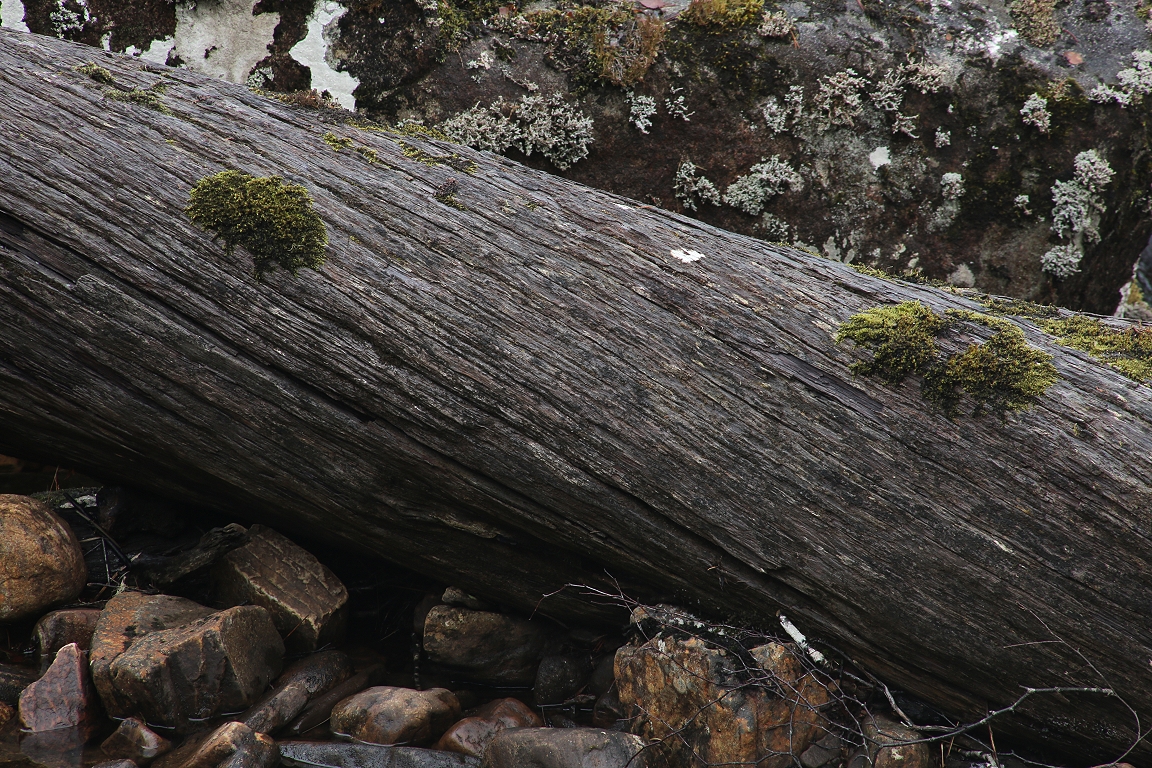
One of the fallen pine trunks had a very clear spiral pattern to the grain of its wood. This is a common feature in many of the old Scots pines in the Caledonian Forest, but the reasons for this growth form, and any ecological benefits it provides to the tree, is not fully understood.
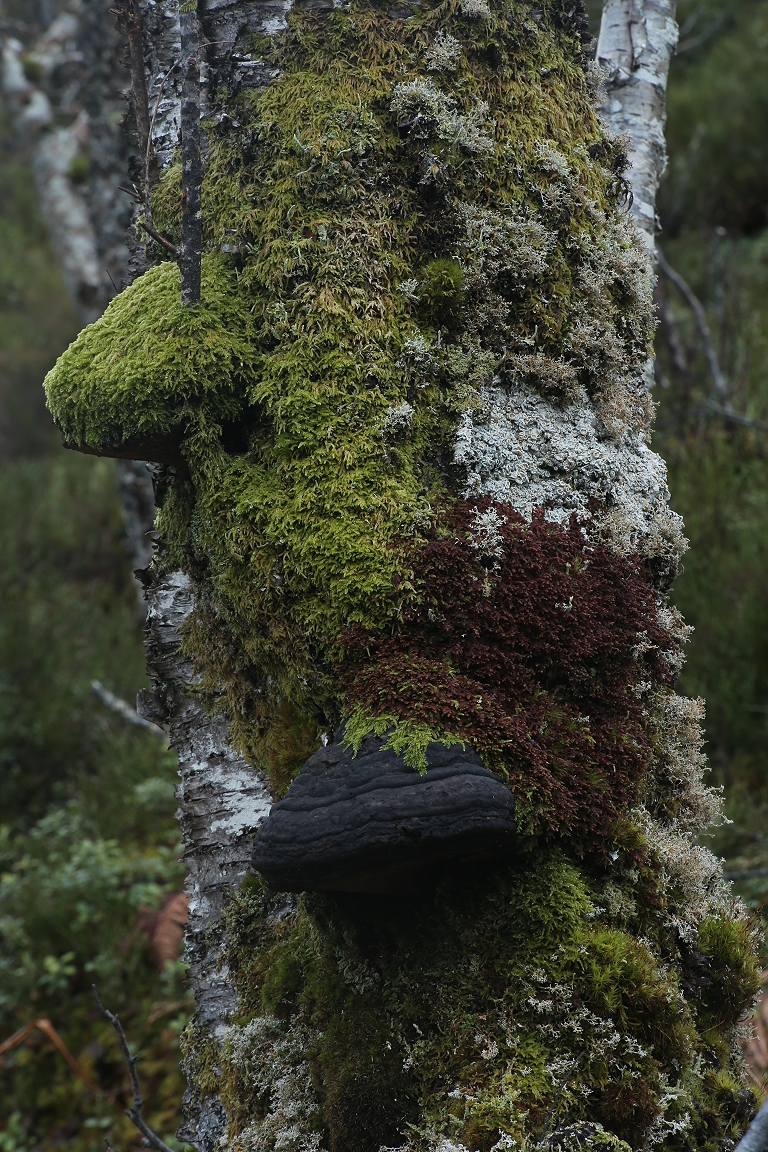
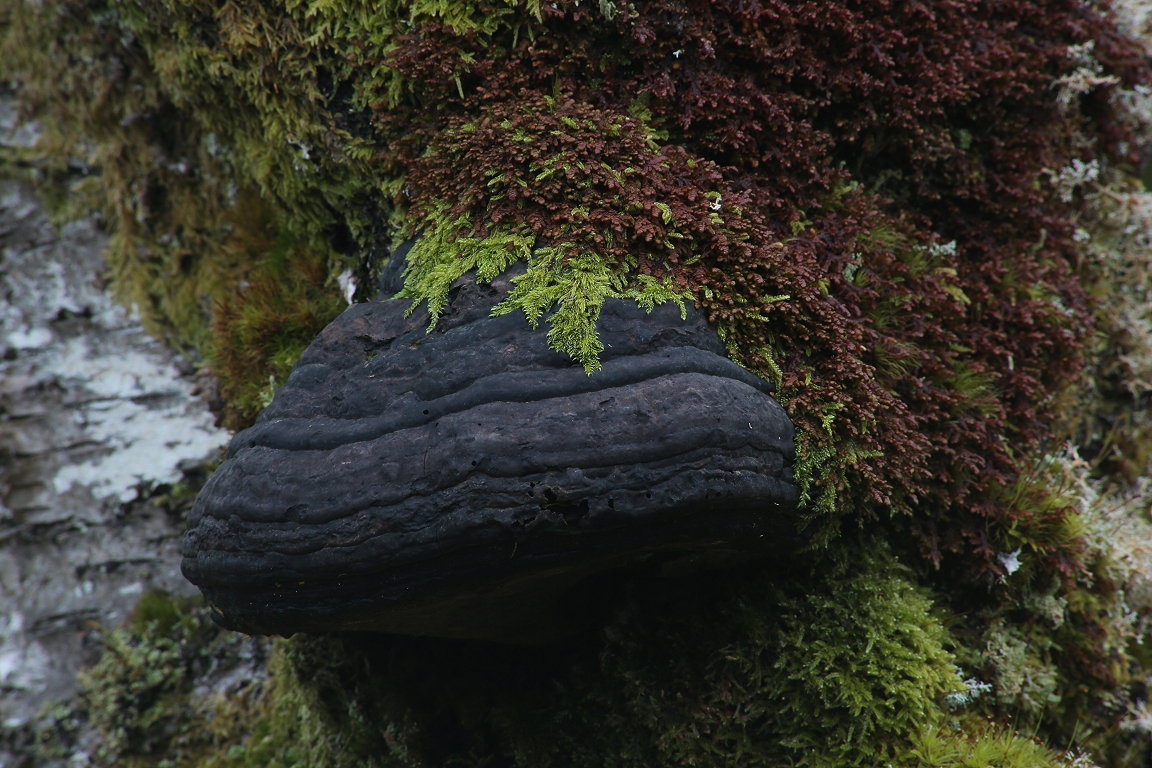
In the fading light, I headed back towards my car, but stopped to take a couple of last photographs when I spotted some rather photogenic moss-covered tinder fungi (Fomes fomentarius) on a dead birch.
Hi Alan,
Your ice encased plant life photos are amazing, I was wondering if I could use your photos for reference in my painting? (The ice encased ones) I would credit you as the photographer? Would you allow me to paint these?
Sincerely,
Karen Jessen
KSJessenArt@gmail.com
I just cannot take my eyes of the frozen water encapsulating pine`s needles and branches .. Really really amazing shots..
Your photogaphs are trully inspiring!!
Hope to see more of them
dorotheahm@gmail.com
Hi Dorothea,
I add 2 or 3 blogs every month, so if you sign up to receive notifications of when I post a new blog, you’ll get to see lots more of my photos!
With best wishes,
Alan
Hi Alan,
I am your returning trees` buyer and believe that wil really help to restore the Caledonian forest and the habitat for many species.. Was just told by a friend of mine about your fantastic pictures . Great , really beautiful. I wonder what camera do you use? Hope to see more of them on the website ..
Regards and good continuation..
Dorothea C.
Hi Dorothea, Thanks for your comment on my blogs and the appreciation of my photos. I use a Canon 5D Mark III for most of my photography, but I find it’s having the eye that sees a good image, rather than the equipment, that makes for a good photograph.
Thanks for supporting us by buying dedicated trees!
With best wishes,
Alan
HAPPY BIRTHDAY Alan!
I love the magical effect that ice creates and your photos have captured this beautifully.
Thanks, as ever, for sharing your engaging photography, knowledge and writing,
David
Hi David,
Thanks for the birthday greetings – I spent most of the day out in the forest at Dundreggan, so that will provide the content for my next blog, coming in a few days!
With best wishes, Alan.
Another great post Alan. I love your passion for all aspects of natural history. :o)
Many thanks Rob – I was particularly inspired by the ice that day. With best wishes, Alan.