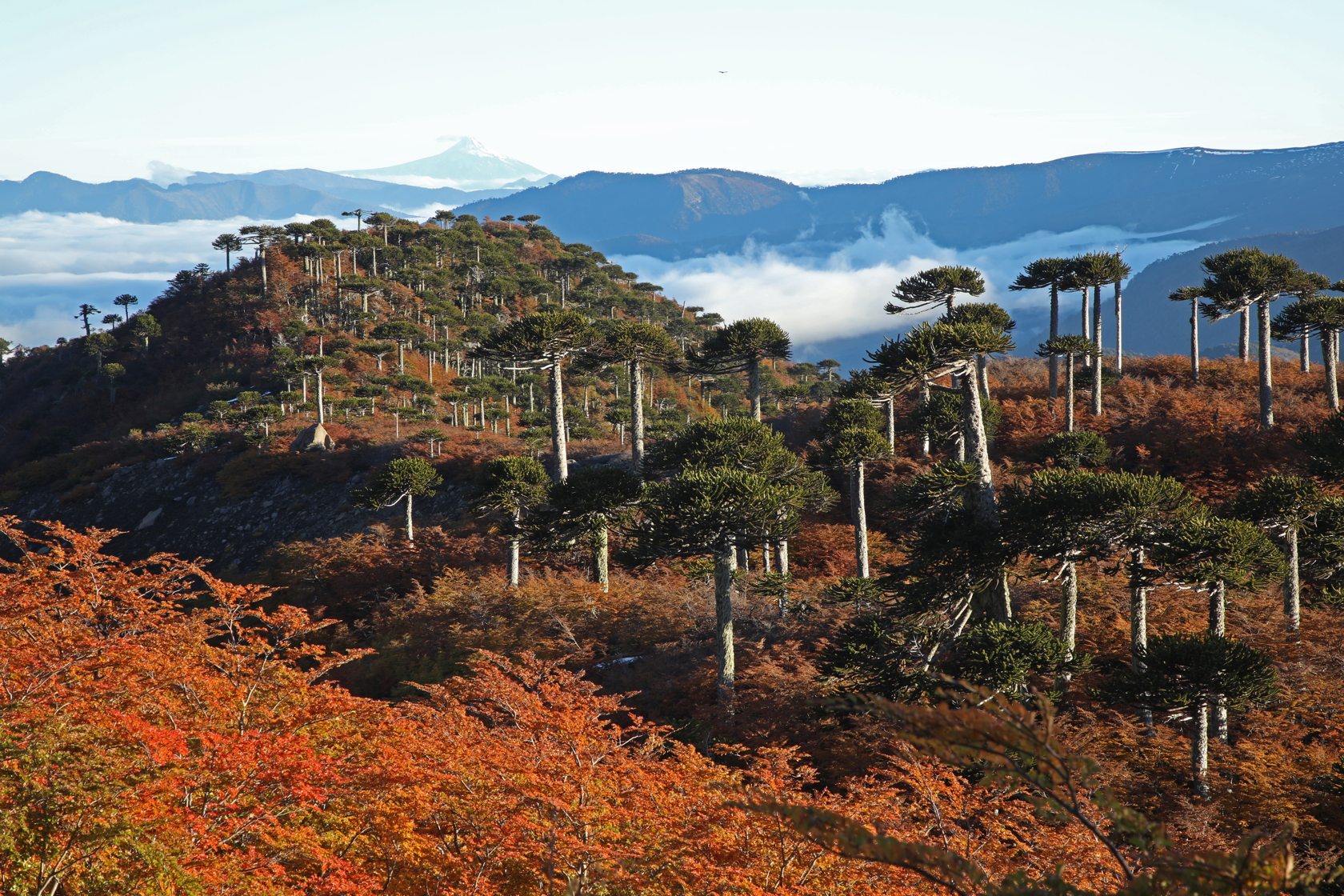
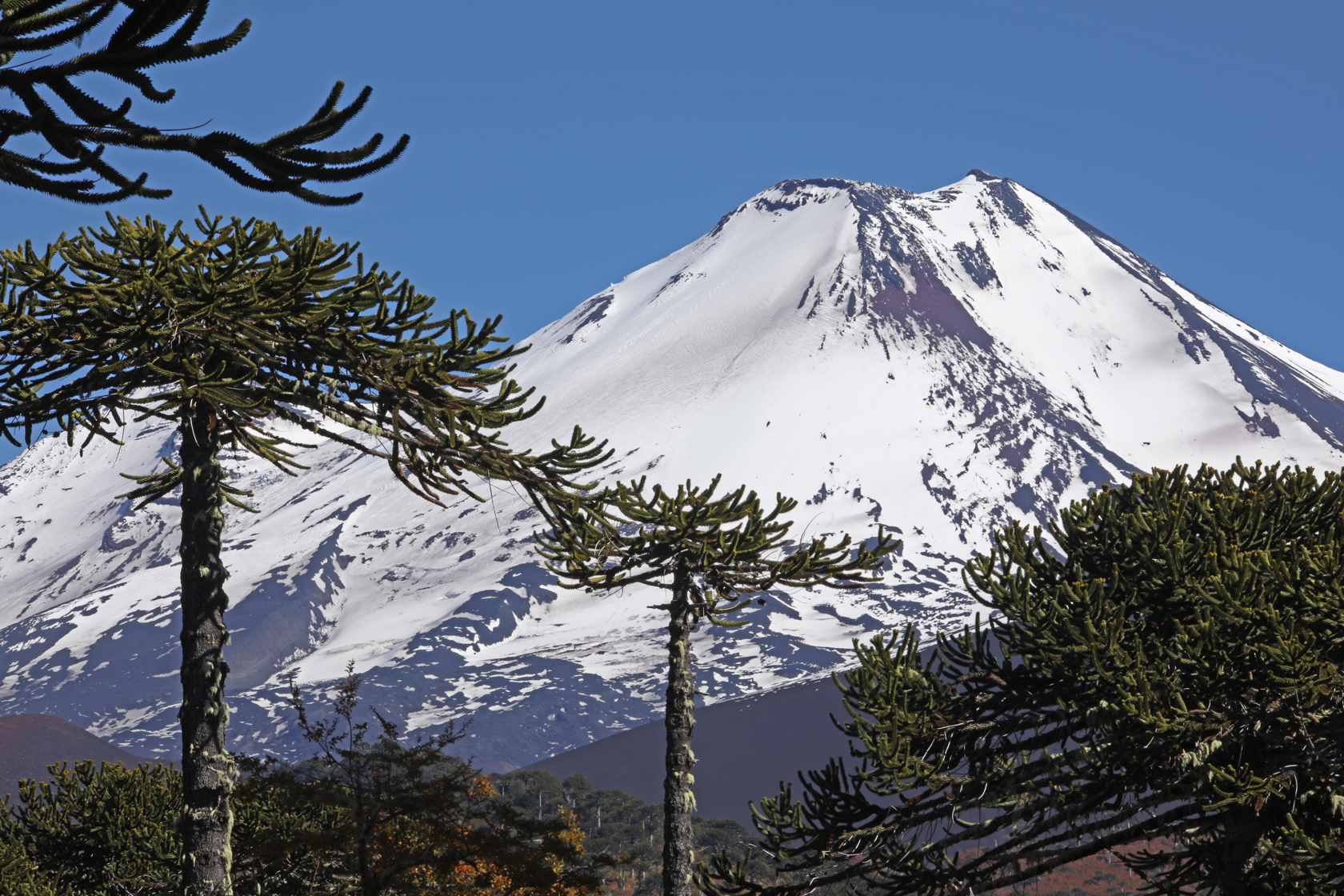
During my most recent trip to the Araucaria forests of southern Chile in late March and April of this year one of my most memorable days was towards the end of my journey, when I was in Conguillio National Park. Centred around the active volcano, Volcan Llaima, the park contains a large area of forest dominated by the tree known in English as the monkey puzzle (Araucaria araucana), and gains its name from the large lake, Lago Conguillio, immediately to the north of the volcano. I’ve visited the park during several of my recent travels to photograph the Araucaria forest, and it’s one of my favourite sites to see the tree.

I was hoping to experience the park at the fullness of the autumn colours, and when I arrived there this time, on the 18th of April, I was pleased to see that many of the lenga trees (Nothofagus pumilio) and ñire trees (Nothofagus antarctica) that grow with the Araucarias were already displaying seasonal hues of orange, yellow and red. The weather was cloudless and wind-still, providing perfect conditions to experience the forest and highlighting the colours of the leaves.

I was planning to camp in the park for 4 nights, and unlike many of the other sites I visited during this journey, there is very easy access to the Araucaria trees as a gravel road traverses the park, passing right through the forest.

Arriving in the park in the early afternoon, I spent a few hours exploring the forest near the road, and then, after setting up camp, I decided to take advantage of the clear skies and the absence of the moon to take some photographs by starlight. I’d picked a spot earlier in the day which was readily accessible and where there were some large Araucaria trees that I thought would make good silhouettes against the night sky. I reached the site at about 10 pm, when the last traces of daylight had long since vanished, and the dramatic visual treat of the southern hemispheric view of the Milky Way was on full display. Because of the Earth’s orientation, the view from the northern hemisphere looks out on to the outer part of the Milky Way, whereas here in the south the inner part of our galaxy, with its much denser concentration of stars, is visible.

That, combined with the much lower amounts of light pollution in the southern Andes (a result of the low human population density there), means that the Milky Way is much brighter and more spectacular when viewed from the countries south of the equator than from those to the north. Whenever I’m in the southern hemisphere I always enjoy walking under the stars at night, and doing so now amongst the ancient Araucaria trees was very special. In the stillness and silence of the night, it almost felt like I’d stepped back in time to our planet’s primeval past, before humans changed and destroyed so much of Nature in the world …

The next day dawned cloudless and sunny, so I knew it was my opportunity to fulfil one of my objectives for this trip – to hike the 12 km. long Sierra Nevada trail, up a long ridge which leads to a viewpoint looking across Lago Conguillio to Llaima Volcano. During my previous visit to this park in November 2017, I’d hiked part of the trail, but I’d been unable to go all the way, because of unseasonably late heavy snows that still blanketed the steep path several metres deep, although it was well into spring at the time.

Now in autumn, I assumed the trail would be clear of snow, and there was the added benefit of the brilliant colours of the leaves on the deciduous trees to make the hike worthwhile. The first part of the trail involves the ascent of the lower part of the ridge, leading to a viewpoint that looks out over Lago Conguillio towards the Sierra Nevada itself. When I’d been there in November 2017, the Chilean fire bush, or notro (Embothrium coccineum), had been in full bloom, with its brilliant red flowers adding a splash of colour to the panorama.

Stopping at the viewpoint now, I could see that the notro bushes had woody seed pods on them, and one had opened already to reveal the winged seeds lined up inside, ready to be released to the wind for dispersal.


Walking on from the viewpoint, the trail climbs up the south-facing slope of the ridge, and because this is the southern hemisphere, that is the shady side. I’d not gone too far when I came across some remnant patches of snow, left over from an unseasonal heavy snowfall that had occurred a few days before.


For a few moments I wondered if I would experience a repeat of my visit in November, when the depth of snow further up the ridge had completely blocked the trail, but that was not the case this time. Where the trail returned to the crest of the ridge, a little higher up, there were only some tiny patches of snow to be seen, and instead I was greeted by spectacular views over the forest in the valley below. Because of the higher elevation and the exposed position of the ridge, the Araucaria trees there are stunted, and the autumn colours of the lenga trees were also more advanced, seeming to be at the peak of their colourful intensity on this cloudless day.

The trail follows the crest of the ridge for about 700 metres or so, and after a short distance the view to the other, western side became visible. The twin summit cones of Llaima Volcano dominate the landscape in that direction, and the recent snowfall meant they were completely white in their upper reaches. A few clouds had begun to appear on the flank of the volcano, but everywhere else the sky was completely blue – it really was the perfect day to be hiking this trail.

A little further along, the angle of the ridge changes slightly and the slope drops away quite steeply, giving a view of Lago Conguillio as well. It was really interesting to see how the Araucaria trees on the slopes were significantly taller and much more substantial than those on the crest of the ridge itself. This is due to both the increased shelter from the winds on the slopes compared to the crest and the greater quantity of soils available there for tree roots to thrive in. Soils are generally very thin on the crests of ridges, and this limits the options for trees and indeed any plants to grow there.

After that brief glimpse of the lake and the volcano, the trail continues on the east side of the ridge, where the view is of the upper part of the Truful-Truful valley. The river that flows down there was blocked by one of Llaima’s many eruptions, which created one of the park’s other lakes, Laguna Verde. At this point, the trail is more or less level with the tree line, and I could see the Araucaria and lenga trees dwindling on the upper slopes of the valley and eventually giving way to scree slopes and bare rock.

The tree line does not occur at an absolute, fixed elevation, but varies in this region from about 1,600 metres to 1,700 metres, depending on factors such as depth of soil, exposure and aspect. The tree line tends to be higher on north-facing slopes, because they receive more direct sun, especially in the winter.


At the upper altitudinal limit of tree growth, lenga trees predominate, although they are stunted in size. The Araucarias here are fewer in number, but those that do grow there still tower over their deciduous colleagues, although both are much reduced in height from the trees that occur at lower elevations. The photograph here shows the transition from the forest on the right of the image, which is mainly Araucaria trees at lower elevations, to that on the left, where lenga trees are more abundant, as the ground rises up to the tree line.

From the head of the valley the trail heads west for its final section, eventually reaching a viewpoint that looks directly across Lago Conguillio to Llaima Volcano. Although there had been a few other people on the trail that day, I had spent quite a lot of time taking photographs along the way, and the other hikers had already passed me on their way back down. Thus, when I reached the end of the trail it was late in the afternoon and I had the area completely to myself.

The view from the end of the trail is one of the most famous in Chile, and it features in most of the articles and publicity material about Conguillio National Park. Having been unsuccessful in my attempt to reach it in November 2017 because of the snow, I was doubly delighted to experience it now, all alone, and with the lenga trees seeming to be alight in a blaze of colour in the foreground, as I looked across the lake to the volcano.

With the predecessors of the Araucaria tree having co-evolved with the dinosaurs, I could almost imagine the giant sauropods also appreciating this remarkable landscape so many millions of years ago. The antiquity of the ecosystem and the fact that other Araucaria trees closely related to the present day species dominated much of the planet’s land masses during the Jurassic and Cretaceous Periods led to Conguillio National Park being used for some of the footage in the BBC television series, ‘Walking with Dinosaurs’, that was broadcast in 1999.

Although this landscape certainly feels primordial, it must nevertheless have changed considerably since the time of the dinosaurs. Llaima is one of the most active volcanoes in Chile and recent eruptions occurred on 1st January 2008 and 5th April 2009. Lava flows from those and other eruptions cover significant areas of the park, and are still stark and bare, having not yet been colonised by vegetation. Like Laguna Verde, Lago Conguillio was formed as the result of lava flows, and the Sierra Nevada, which gave its name to the trail I had followed, is another volcano, although it has been dormant for a long time.

The region where the Araucaria trees grow in the Andes is characterised by a series of volcanoes, many of which are active. Villarrica Volcano, which can be seen in the distance to the south of Conguillio, was the most recent to erupt. A burst of volcanic activity in 2015 caused the evacuation of the nearby town of Pucón, and it is still steaming at this time. It’s an exciting and dramatic landscape to visit (and photograph!), but I understand it must be nerve-wracking at times for the local people when one of the volcanoes suddenly comes to life.

By this time it was quite late in the afternoon, and I knew I needed to start the return journey. With 12 km. to walk back, it was already clear that I would be doing at least some of the trail in darkness , and I’d brought my head torch with me for just this eventuality. However, I kept finding more and more interesting perspectives, and images, of the Araucaria trees, so my progress was quite slow, and my photographic count for the day was already over 400!

The sun was now low in the sky and would soon be setting, so I was hoping to get some interesting images in the time that photographers call the ‘magic hour’. That’s the time leading up to, and just beyond, sunset (or sunrise), when the light is often at its most dramatic. Looking behind me, I noticed a couple of solitary Araucaria trees silhouetted against the sky, with the sun on the other side of them, so I stopped there for a while to take the ‘starburst’ images featured here.

Another reason that I had prolonged my sojourn at the end of the trail is that the area is well-known as a good site to see Andean condors (Vultur gryphus). Like the green-backed firecrown (Sephanoides sephaniodes) that I wrote about in my recent blog, ‘The Hummingbird stake-out’, this was another of my key target species to photograph on this trip to Chile. Despite looking for them I hadn’t seen any condors during my previous four trips to Chile, or indeed on this latest one, and it had felt all along that this day would be my last chance to do so.

However, although I’d been regularly scanning the sky up here near the steep rock faces of the Sierra Nevada – what I thought was the most likely place to see condors – I’d not seen even a distant glimpse of one. As I headed back down the trail, the tremendous experience I’d had of the beauty of the place – the views of the volcanoes, the colours of the lenga trees, and the presence of the ancient Araucarias themselves – was tinged slightly with disappointment at the non-appearance of any condors.

That was only a momentary, transient feeling though, because the ‘magic hour’ light had arrived. It brought a new grandeur and a breathtaking illumination to the landscape, which completely overwhelmed any sense of lack that I had. As I looked across the canopy of Araucaria trees and Lago Conguillio to Llaima Volcano, the final shafts of the day’s sunlight caught some small passing clouds, turning them pink for a few brief moments.

Looking in the other direction was even more spectacular, as the clouds that had been slowly moving into the valley below had now filled it completely, leaving Villarrica Volcano as an isolated ‘island’ standing out above them, with a pink-tinged sky all around. Combined with the silhouettes of some Araucaria trees, this seemed to me to be an archetypal image of this remarkable landscape, touching deep ancestral memories of a primeval world.

Then, just as I was fully immersed in the experience of the sunset, and when I had given up all hope of seeing any condors, not one but two birds came into sight, circling high overhead! Their appearance then was a truly unexpected gift that touched me deeply…
Condors are masters of gliding on the air currents and thermals, and this pair were soaring effortlessly, without flapping their wings, on what must have been one of the last rising columns of air of the day. They were too high for me to get any close-up photographs, but I watched them for a minute or two, taking several images as I did so.

The Andean condor is a huge bird, with a wingspan of up to 3.3 metres. Although some albatrosses have greater wingspans, when a condor’s weight is taken in combination with its wingspan, it is the largest flying bird in the world. Occurring from Colombia in the north of South America to Tierra del Fuego at the southern tip of the continent, it is a defining symbol of the Andes, and had considerable significance in the cultures of the indigenous peoples there.

After a couple of minutes the pair had risen up, out of sight, and I turned my attention back to the sunset colours and the play of light on the wisps of clouds that were drifting across the slopes of the volcano. Then, looking through my telephoto lens, I was astonished to see a movement across my field of view – it was another condor! This one was gliding at eye level, and although the light was fading, and the slopes of the volcano were in shadow and therefore quite dark, I did manage to get one reasonable image as the condor soared past.
I surmised that the three condors I had seen were related, with one of them being the offspring of the other two, but I had no way of knowing if that was correct…

With the sun gone below the horizon, the light was now fading quite rapidly, and just a narrow band of yellow and orange remained, glowing on the western horizon. More clouds were also approaching around the northwest flank of Llaima, in a pincer-like movement with those that I’d already seen to the south. There wasn’t a breath of wind where I was though, and I took a few moments to savour the stillness and beauty. I felt deeply privileged and in a state of true awe, realising I was the only person to have this experience, as there was no one else out on the ridge at this time of the day.

I knew I should be heading down the trail as I still had about two hours of walking to get back to the road and my car, so I packed away my camera. However, just as I was about to set off, I noticed the crescent moon in the sky…


It was therefore another 10 or 15 minutes before I actually started walking down the trail, which quickly led into the darkness of the forest, as it descended from the exposed ridge. Occasional gaps in the tree cover provided tantalising glimpses out over Lago Conguillio, which was now completely shrouded by the clouds that I had seen earlier, moving in from both the north and the south.
I’ve always enjoyed walking in a forest at night, and this was no exception – it’s an entirely different experience to walking the same route in daylight. My heart was completely filled with joy from the tremendous experiences of the day as I walked through the silent, peaceful darkness.

After an hour or so I reached the viewpoint where I’d seen the Chilean fire bush, or notro, with its seed pods in the morning, and I stopped there for a short break. Lago Conguillio was now totally obscured by the clouds beneath where I stood, whilst above them many stars were visible, and the moon appeared to be a brilliant circle of light, although it was in fact still just a crescent. It was another magical experience at the end of one of the best days of my entire trip to the Araucaria forests of Chile. I still had another hour or so to walk, plus a 15 minute drive to get to my campsite, so it would be a late night. However, I already knew I’d be up early again the next morning. All the low-lying clouds meant that the Araucaria forest would be filled with mist when dawn broke and daylight returned, and that’s another very special time to be out amongst these ancient trees …
Thanks Alan for the tale of an inspirational journey in Conguillio, it tells about your commitment and passion for these sacred lands. I’d never imagine such a loved description of the Sierra Nevada trail, which I’ve done dozens of times.
Conguillio has a master of tree’s wisdom by your work over here, It’s an honnor to share your emotions by the reading of your blog. Again, thanks.
Hope to see you again on your next visit to Curacautin.
Hola Antonio,
Many thanks for your feedback, and I’m delighted that you enjoyed my blog about the Sierra Nevada trail in Conguillio. Did you see my other recent blogs about the Araucaria forests in Chile? They’re at: http://www.alansblog.org.uk/?p=7830 and http://www.alansblog.org.uk/?p=7854 .
I’ll be posting another blog from Conguillio in the coming weeks, about the next day after I hiked the Sierra Nevada trail, so keep a look out for that.
I’m still working on my book about the Araucaria forests, and once it is published (next year?) I plan to make another visit to Chile to help promote it – hopefully we can meet up again then.
With best wishes,
Alan
Dear Cousin Alan
just to let you know your cousin Douglas in Jersey just read your blog with much interest.
What a wonderful experience for you. Seeing the Condors must have crowned it all.
Valery joins me in sending much love,
Douglas
Dear Douglas,
Many thanks for your comment and I’m glad you enjoyed the blog – I’ll be posting more blogs about Chile in due course.
I hope you’re not suffering too much from the heat in Jersey this summer!
With love & best wishes,
Alan
Stunning. Thanks – I enjoyed this with you – vicariously.
Thanks for the positive feedback Wendy!
With best wishes,
Alan
Thanks Alan. So amazing to see The monkey puzzle in it’s true Home- I often feel sorry for British Monkey Puzzles. They look strangely out of place and sometimes look pretty miserable into the bargain. I want to dig them up and take them back where they belong. Just love reading all your blogs. Thank you so much for this wonderful gift you give to us. X
Thanks for the feedback Gina. Monkey puzzle trees here in the UK look naked and lonely to me, as they’re missing the lichens etc that cover them in their native habitat. Also they’re often planted as single trees, and therefore don’t have an opportunity to reproduce, as both and male and female tree are needed for seed production. Anyway, I’m very glad to know you enjoy my blogs!
With best wishes,
Alan
Another amazing blog — you certainly enjoyed a very special experience. I find that whenever I venture out into Nature I always have a few ‘wow’ moments; Nature never disappoints. Thanks for sharing your experience. The shots are simply spectacular, particularly the night shots.
With kind regards
Many thanks for another positive comment about my blogs, John. Your words ‘Nature never disappoints’ are so true in my experience!
With best wishes,
Alan
Wow what an amazing day, I’m so jealous.
Another inspiring blog.
Thanks so much Alan.
Thanks for the feedback, Philip. It was indeed a very special day!
With best wishes,
Alan