
In 1997, the Forestry Commission’s research branch made a remarkable discovery when they were surveying a remote and small remnant of the native pinewoods of the Caledonian Forest in Glen Loyne, in Lochaber. They found that the average age of the 80 or so surviving old Scots pines (Pinus sylvestris) there was 440 years, with one individual 550 years old, making them the oldest known pines in Scotland.
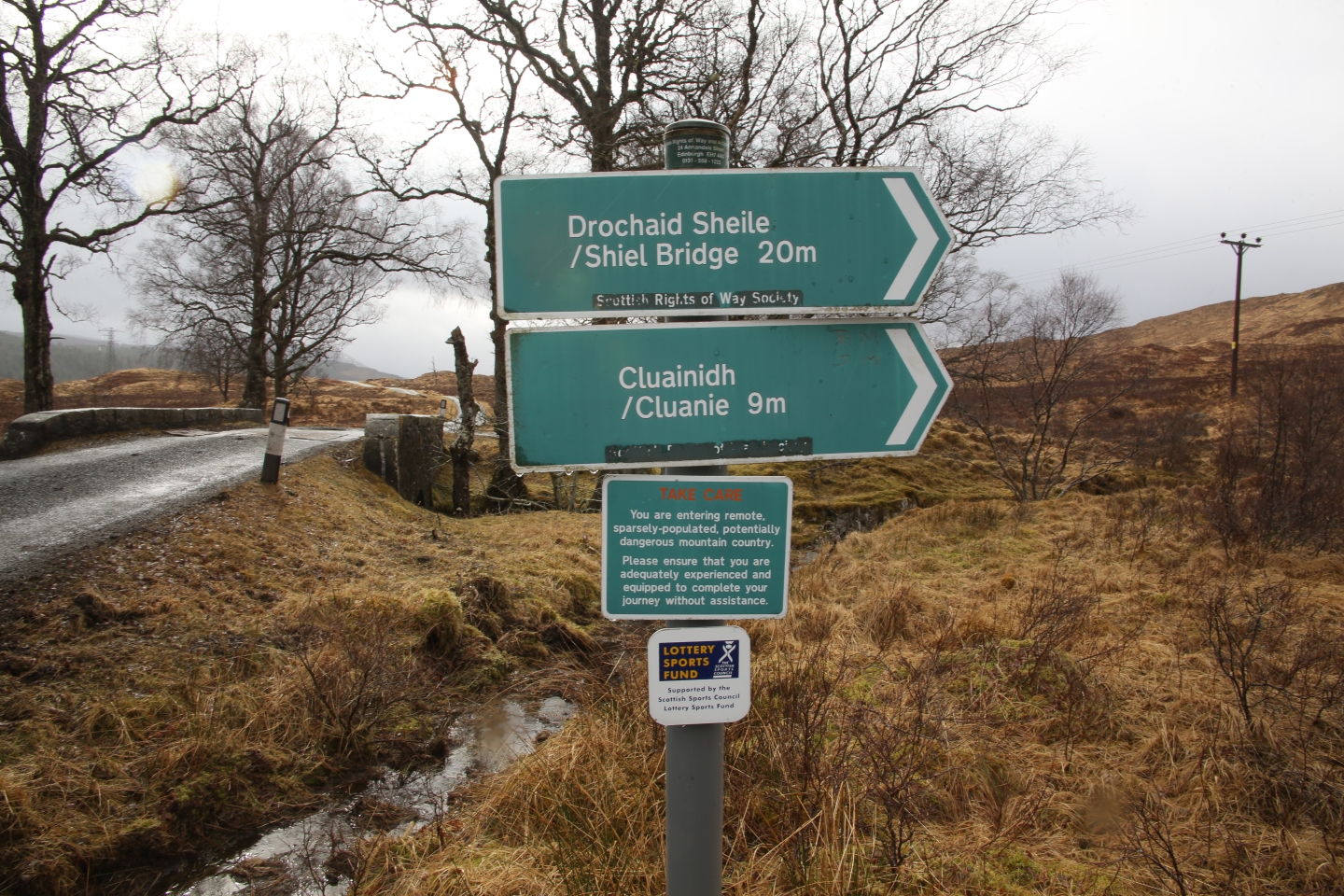
I had known about these trees for many years, but had never visited them, so in early April I decided it was time to go. The site is not easy to reach, as there is no road in to Glen Loyne. Instead, there’s a footpath that leads from just west of Tomdoun, on the road from Glen Garry to Kinlochhourn, over the hills to the north, passing through Glen Loyne and coming out at Cluanie, on the road from Invermoriston to Shiel Bridge and Kyle of Lochalsh.

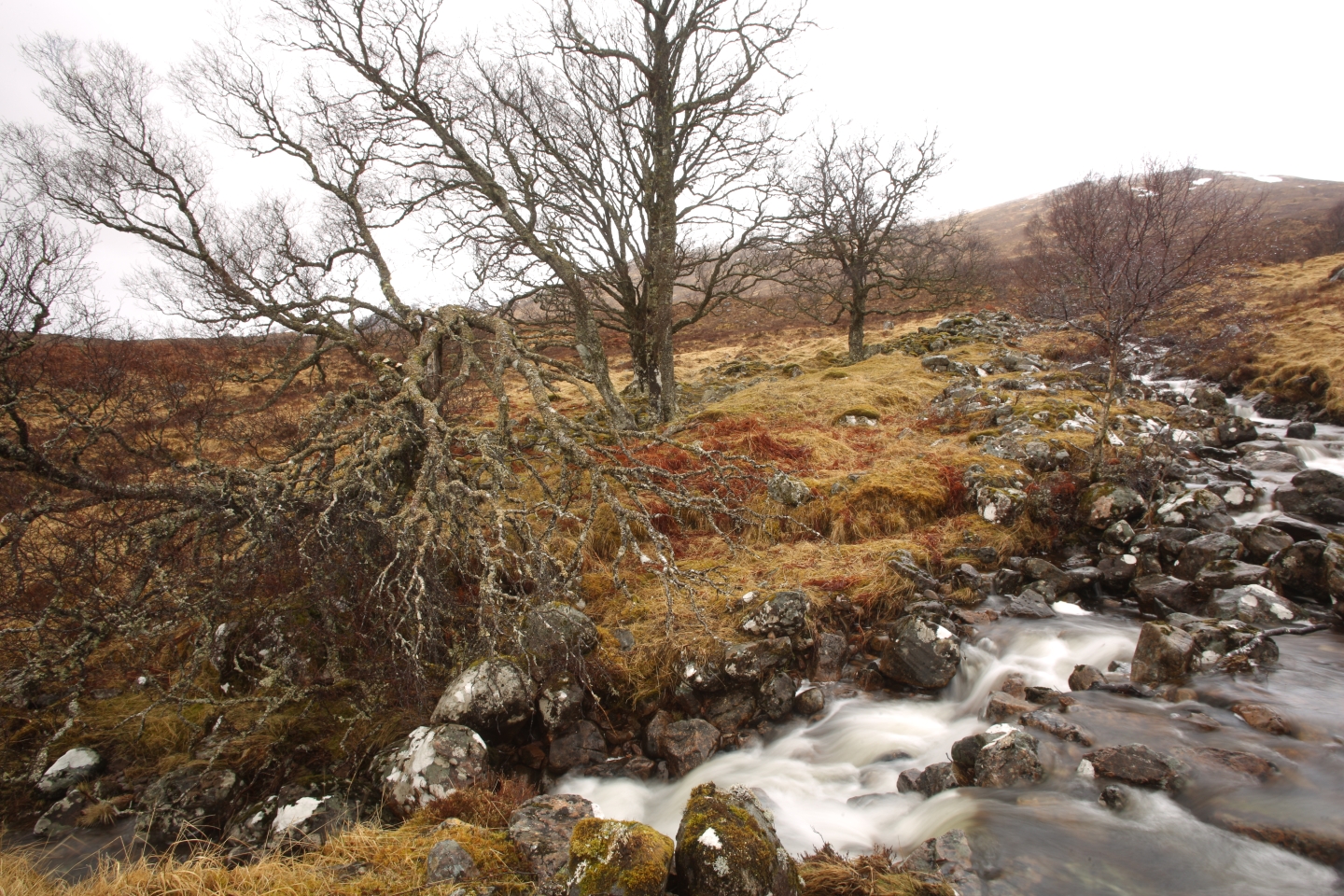
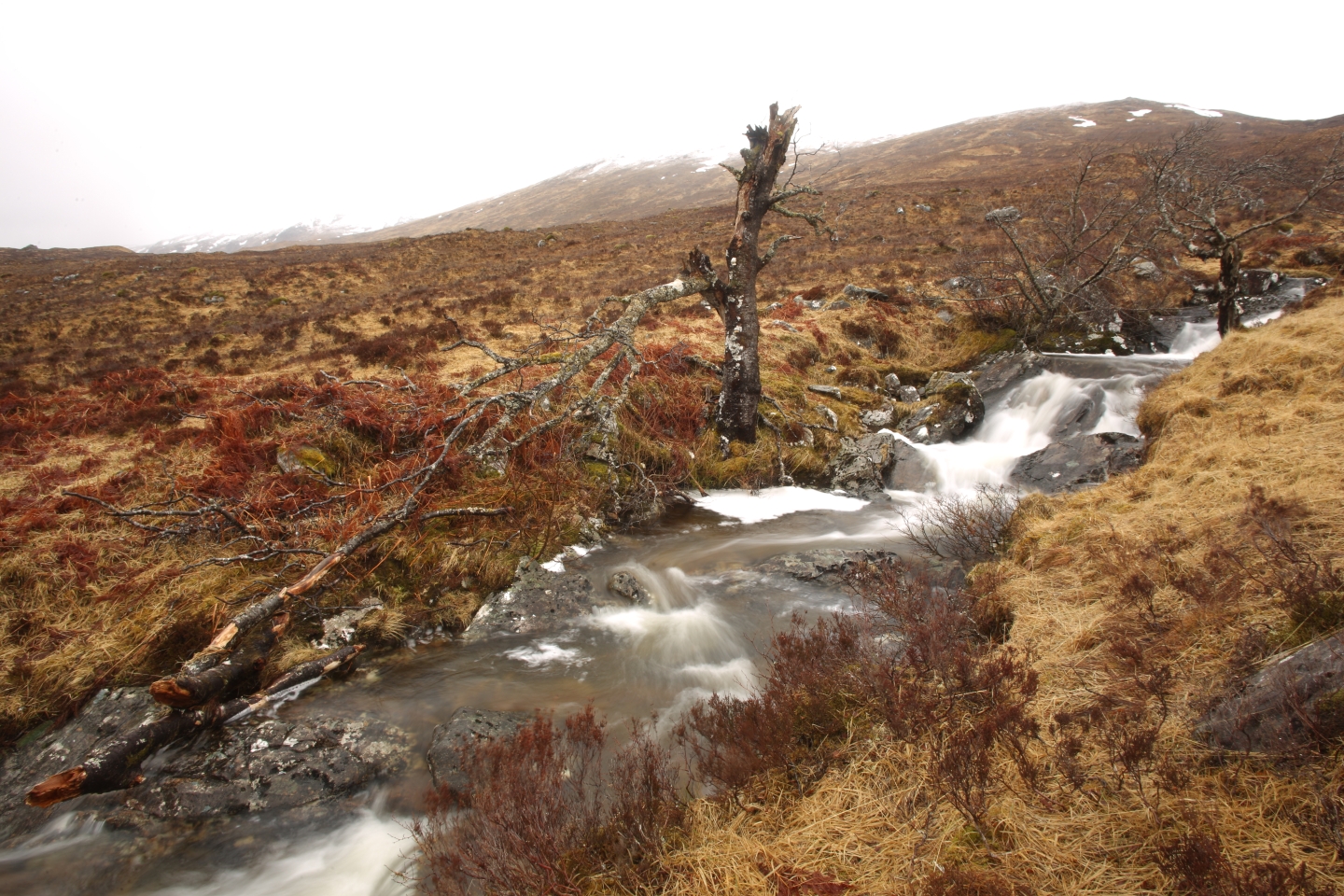
It was quite a cold and wet day when I set out, and it had obviously been raining or snowing a lot recently, because there was plenty of surface water on the ground, and on the path itself. The route follows the Allt a’ Ghobhainn watercourse up the hill, just to the west of a fenced exclosure where young Scots pines are growing as part of a native woodland restoration scheme. There’s a scattering of trees up the watercourse itself, mainly alders (Alnus glutinosa) and downy birches (Betula pubescens).
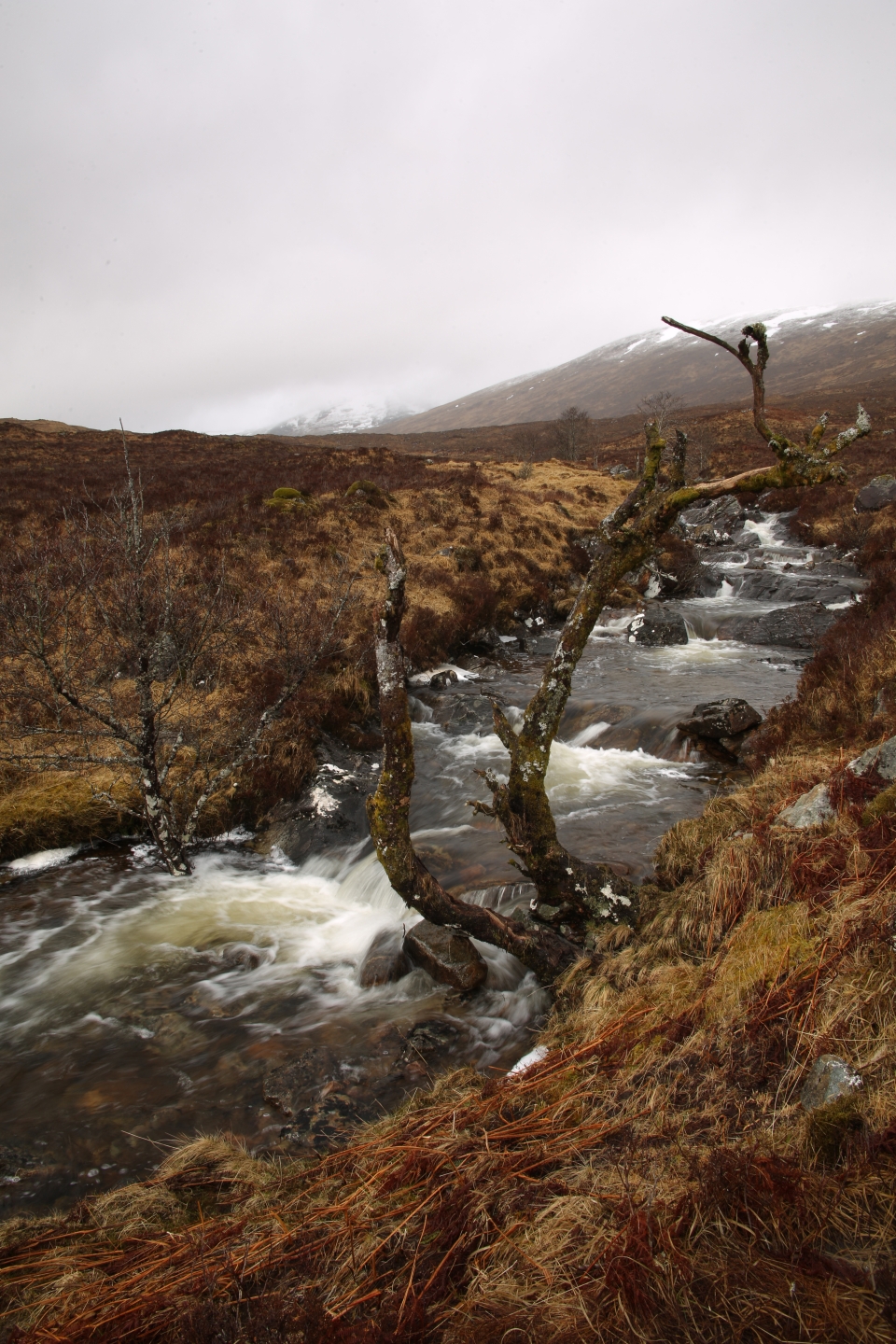
This is typical of so many west Highland landscapes, where the once widespread cover of native forest has been reduced to isolated groups of trees, growing in inaccessible places on the burns, or on rocky outcrops.
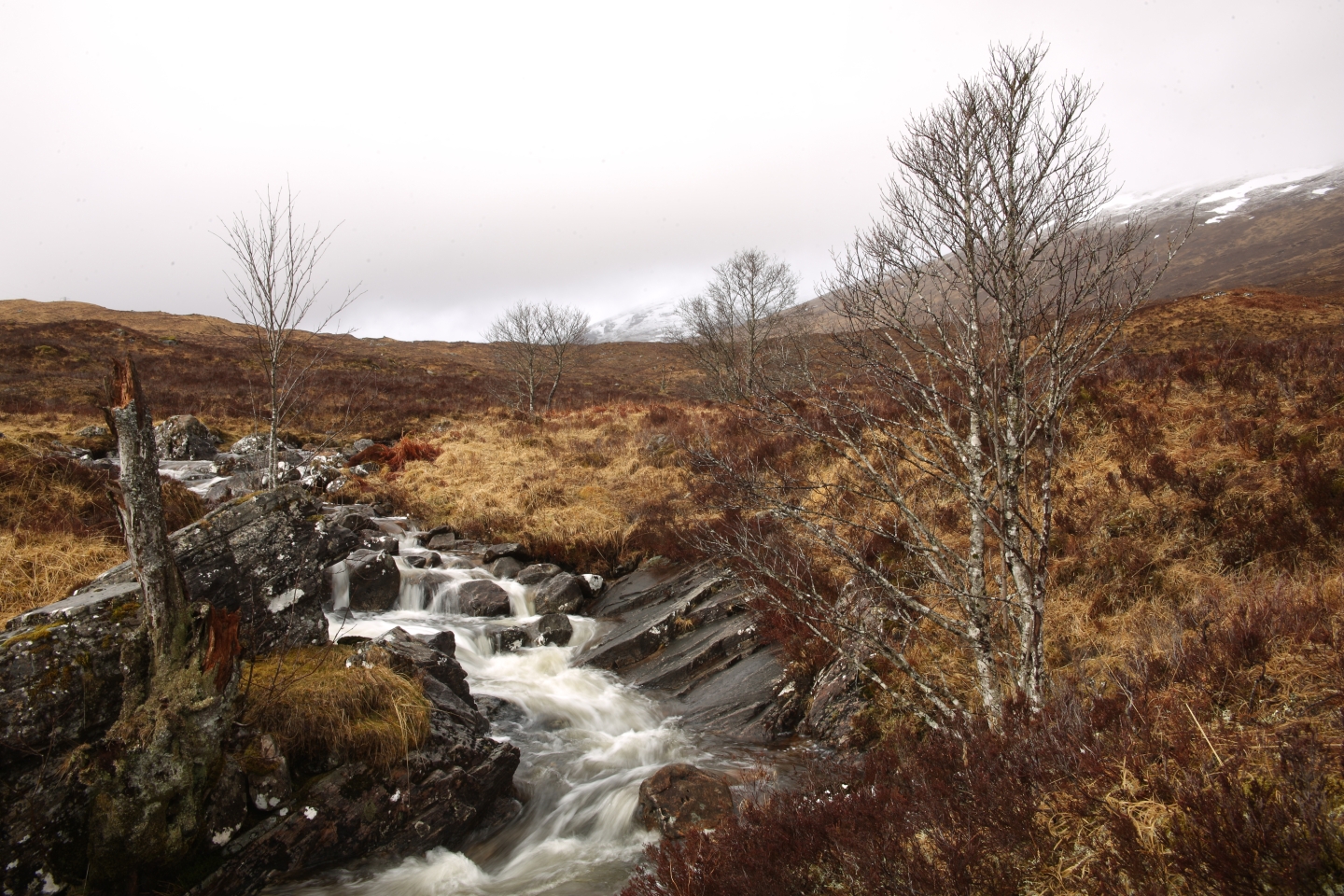
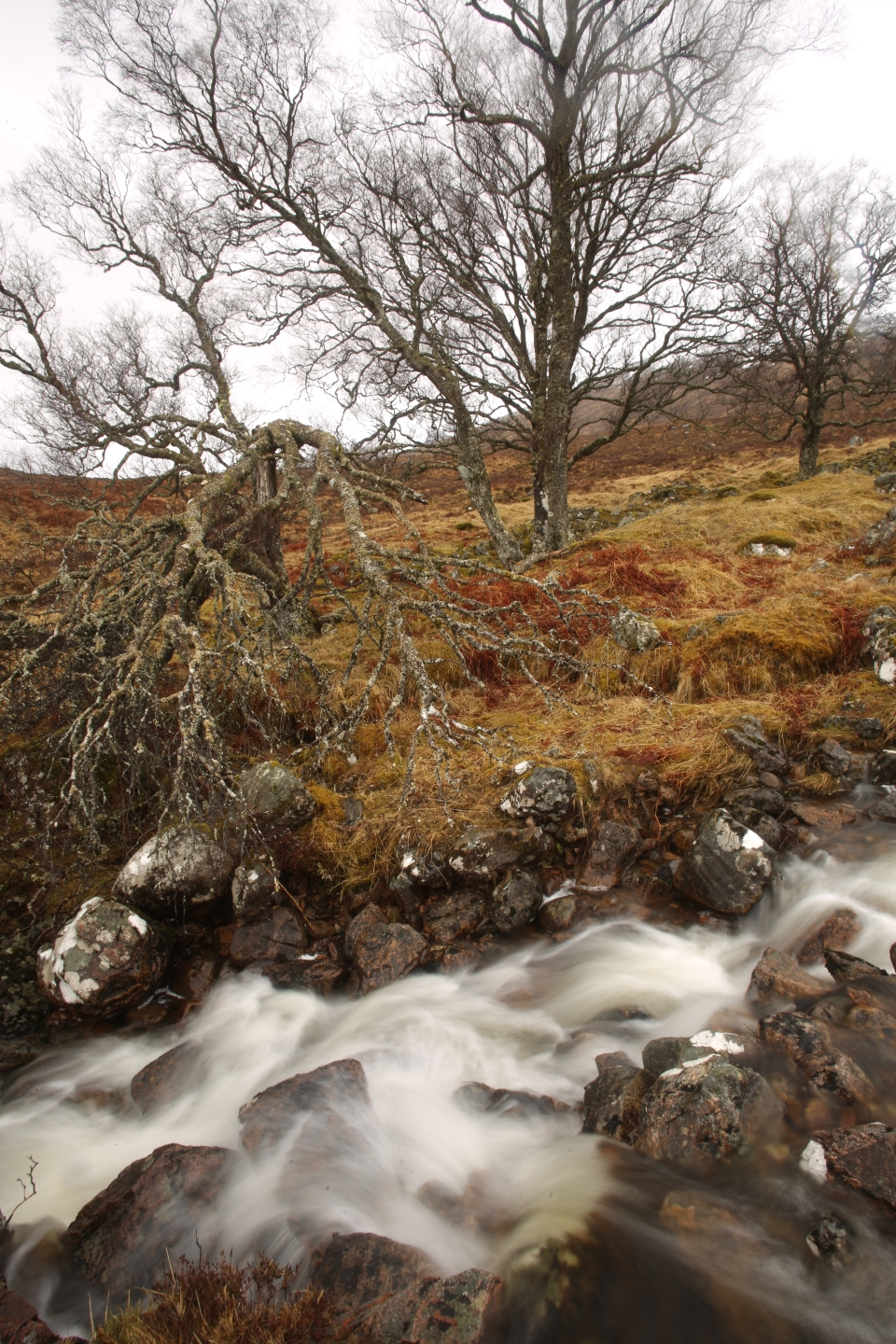
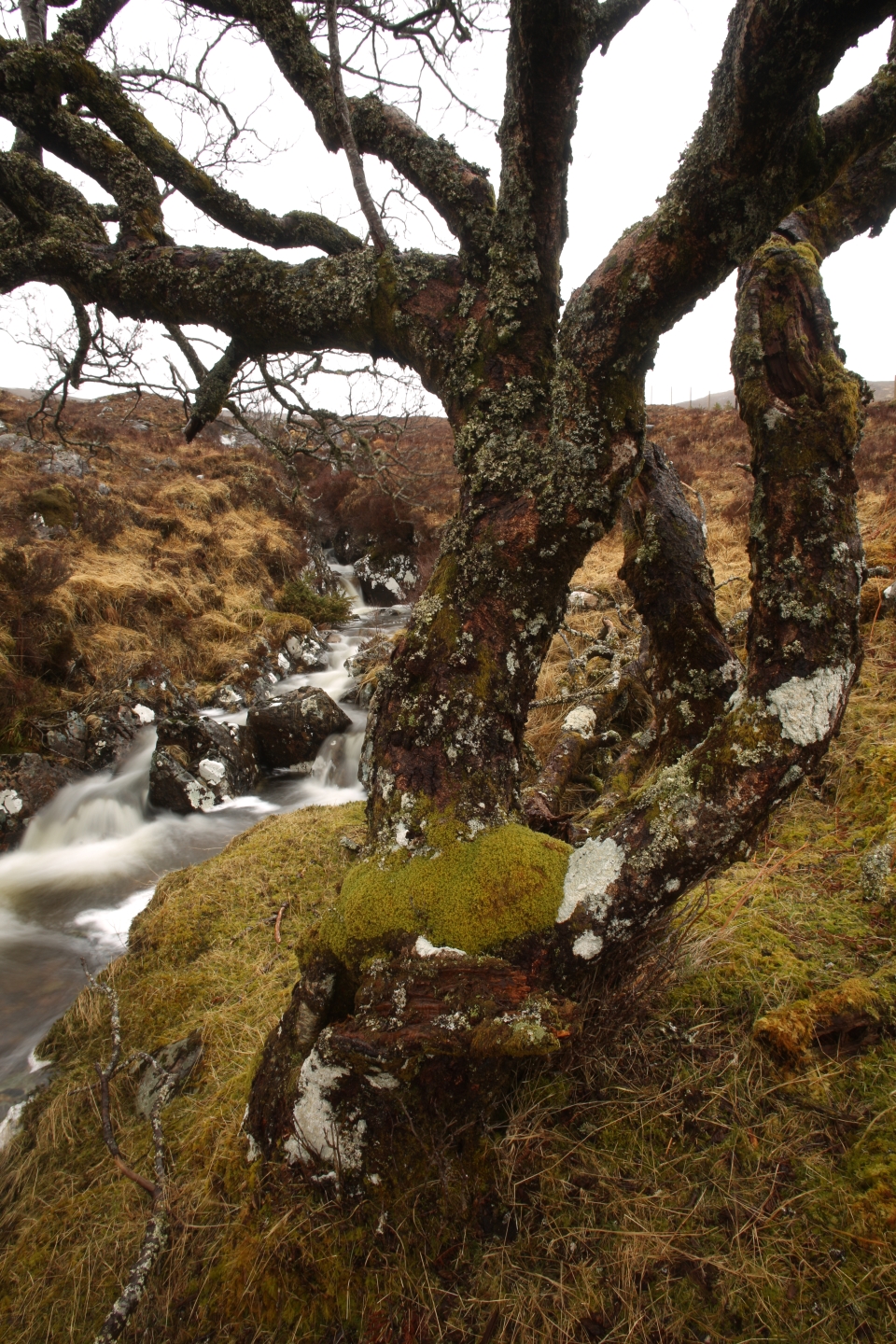
As I followed the burn upstream, I came across some groups of living trees, particularly birches, that were in better condition, but there was no sign of any young trees getting established at all.
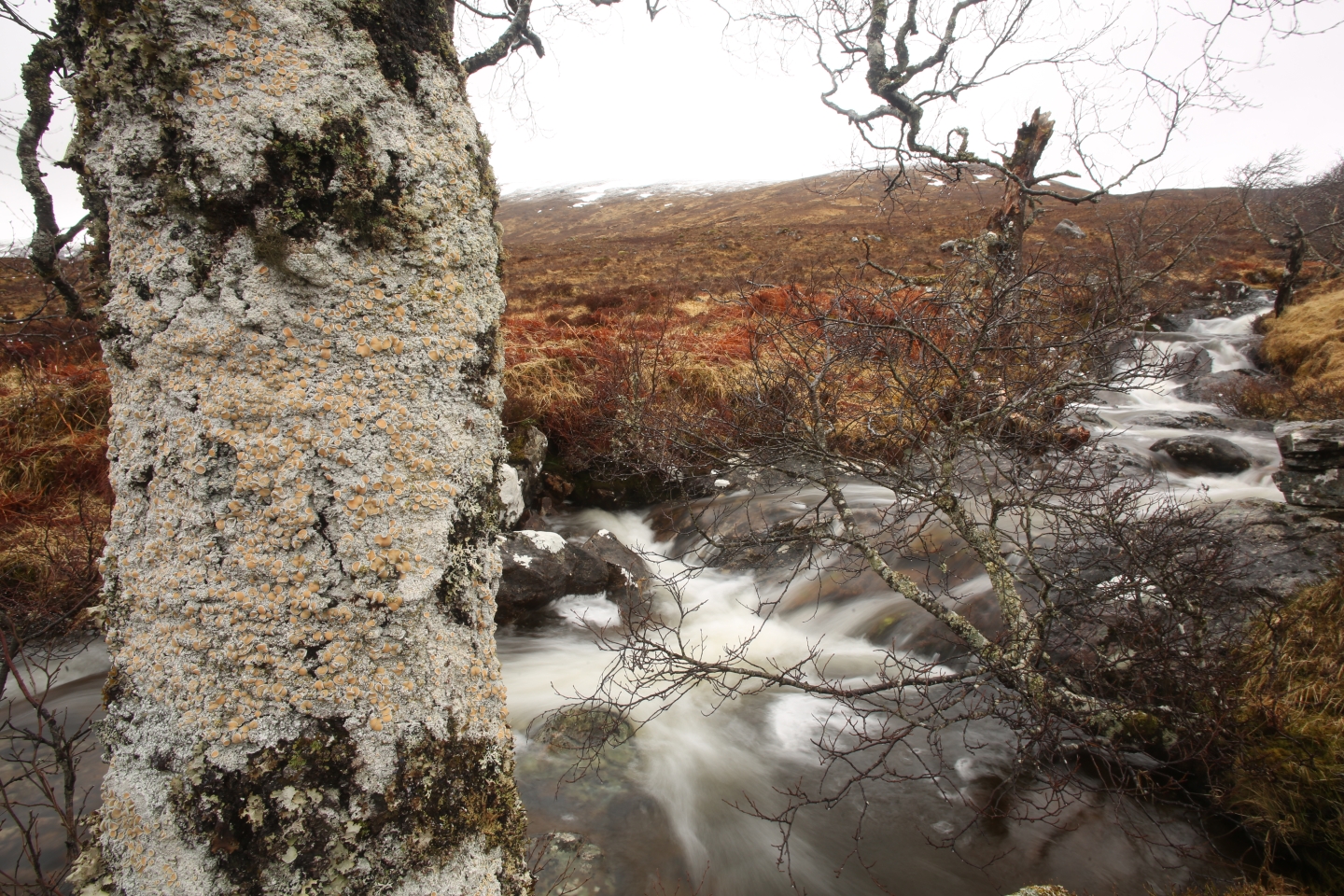
I came across one birch with a large patch of cudbear lichen (Ochrolechia tartarea) on its trunk. This is an easily identifiable lichen, being mostly white, and usually featuring lots of pale brown disc-shaped apothecia, with white rims on them. Sometimes referred to as ‘jam tarts’, these are the parts of the lichen that release the spores of the fungal partner in the symbiotic relationship between fungus and alga that gives rise to the composite organism that we know as a lichen.
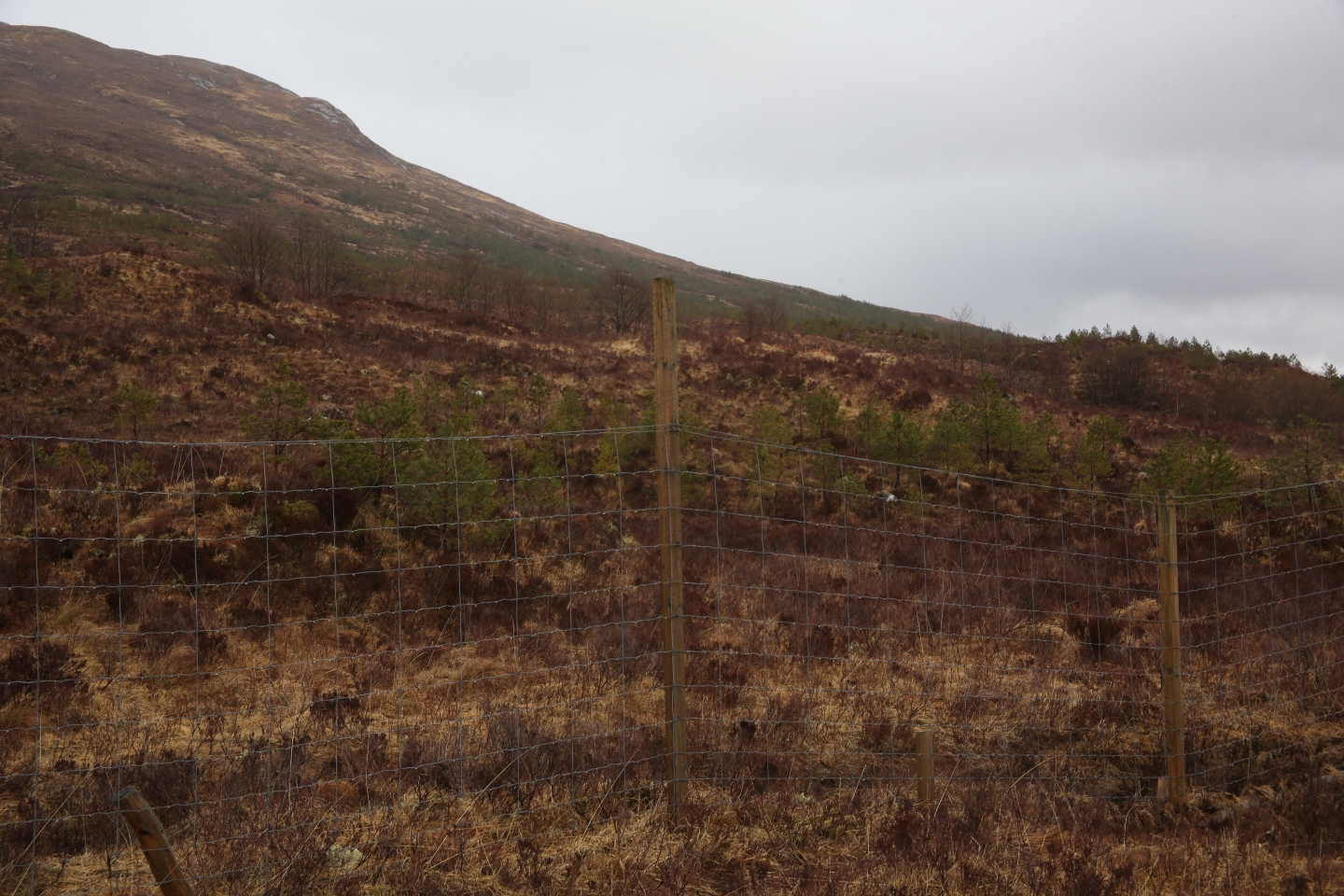
As the path followed the edge of the new planted area of pines for quite a distance, I had a good view of the young trees inside the fence, which provided a stark contrast to the absence of any new life on the outside. Most of the pines looked like they were doing quite well, but higher up the hillside they were smaller in size and seemed to be struggling with the tougher conditions of increased elevation, greater exposure to the wind and likely impoverished nutrient levels in the soil.
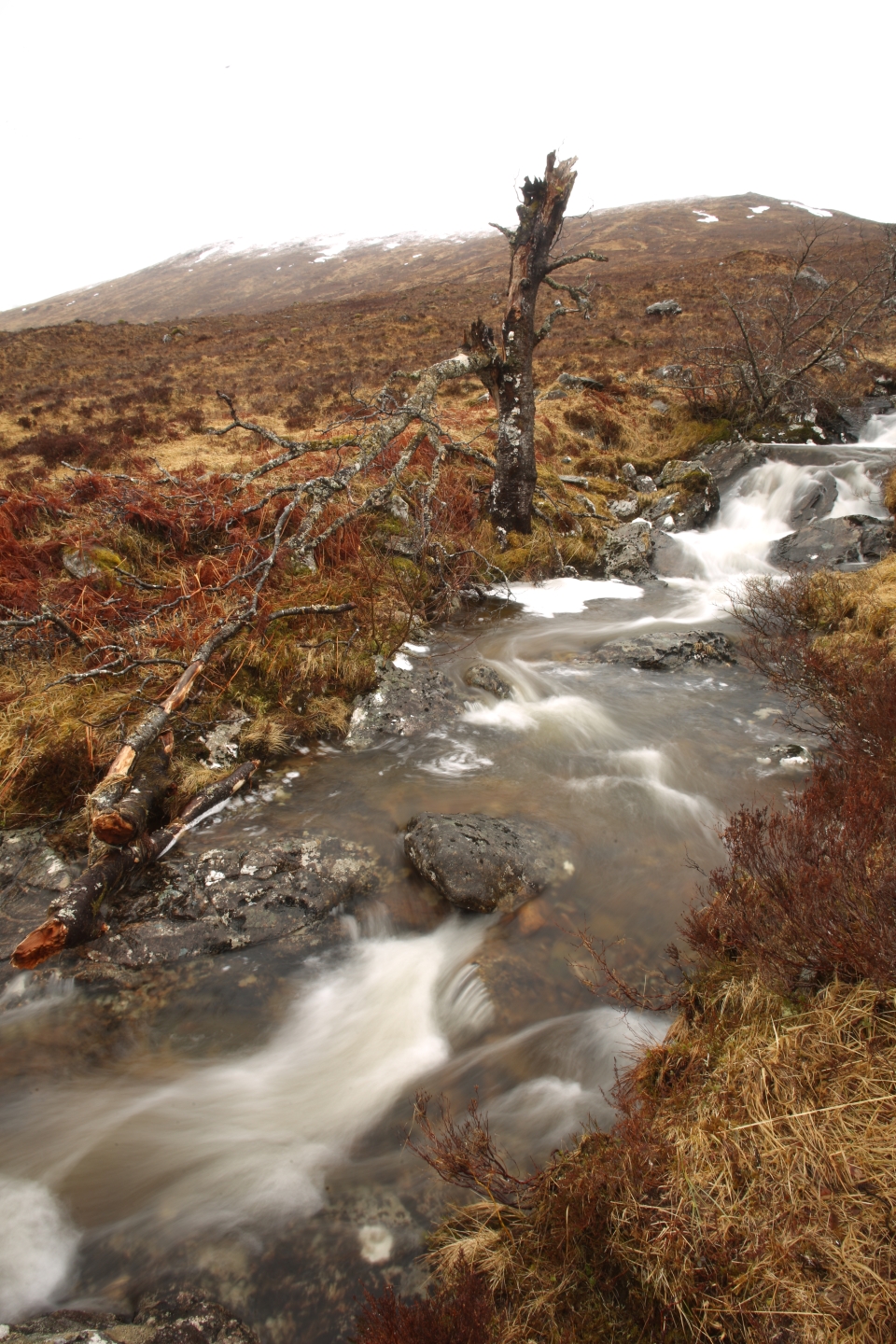
Further up the burn, the surviving trees became sparser again, and more of them were dead. Landscapes like this are full of pain for me, as I can see that the vitality of the ecosystem there is still dwindling away …
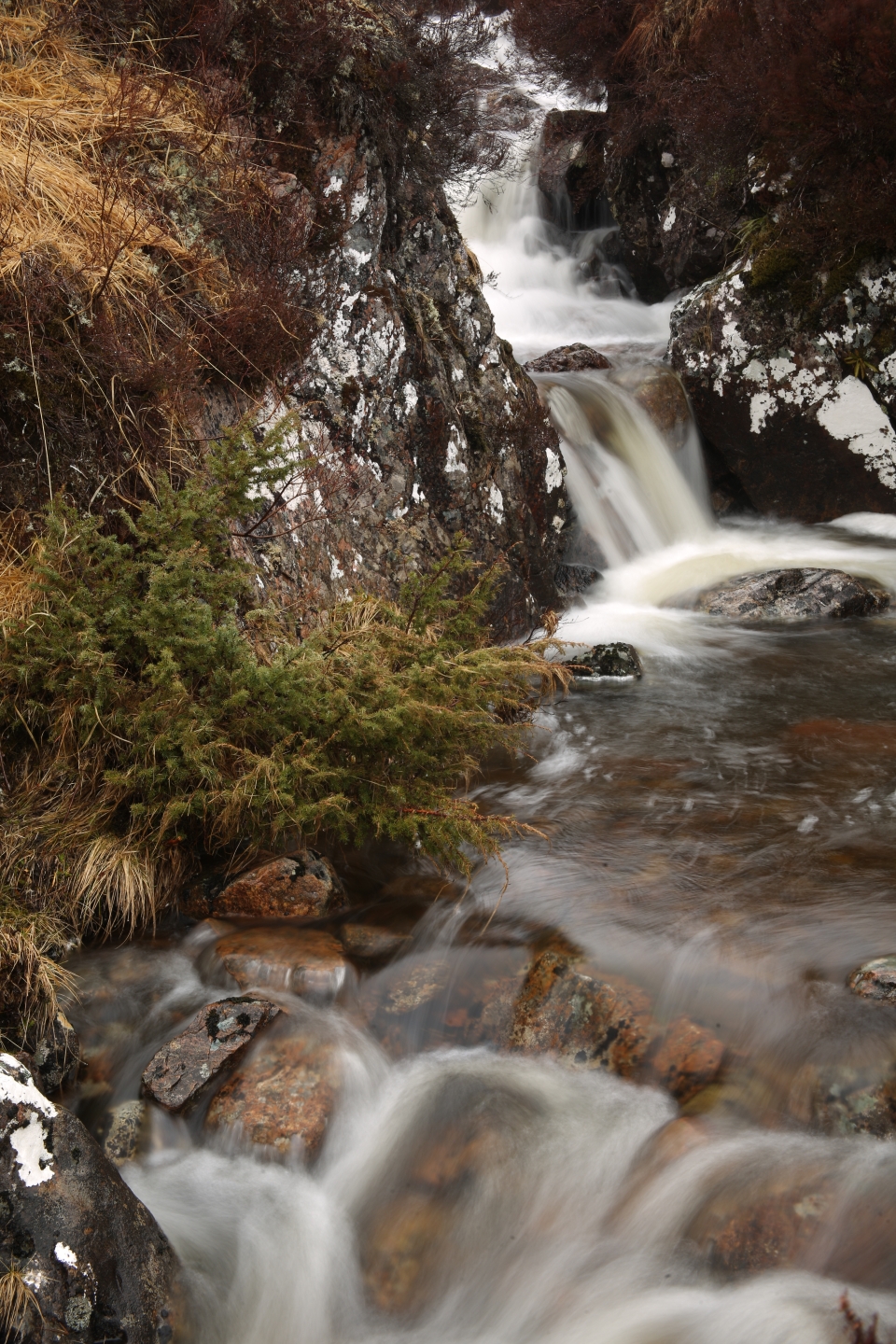
The sadness I felt at the decline of the woodland there was lifted sometimes, such as when I found a small juniper at the edge of the burn. I had no idea where the nearest mature juniper was, which would have provided the seed for this one (and which would have been carried here in a bird’s gut.
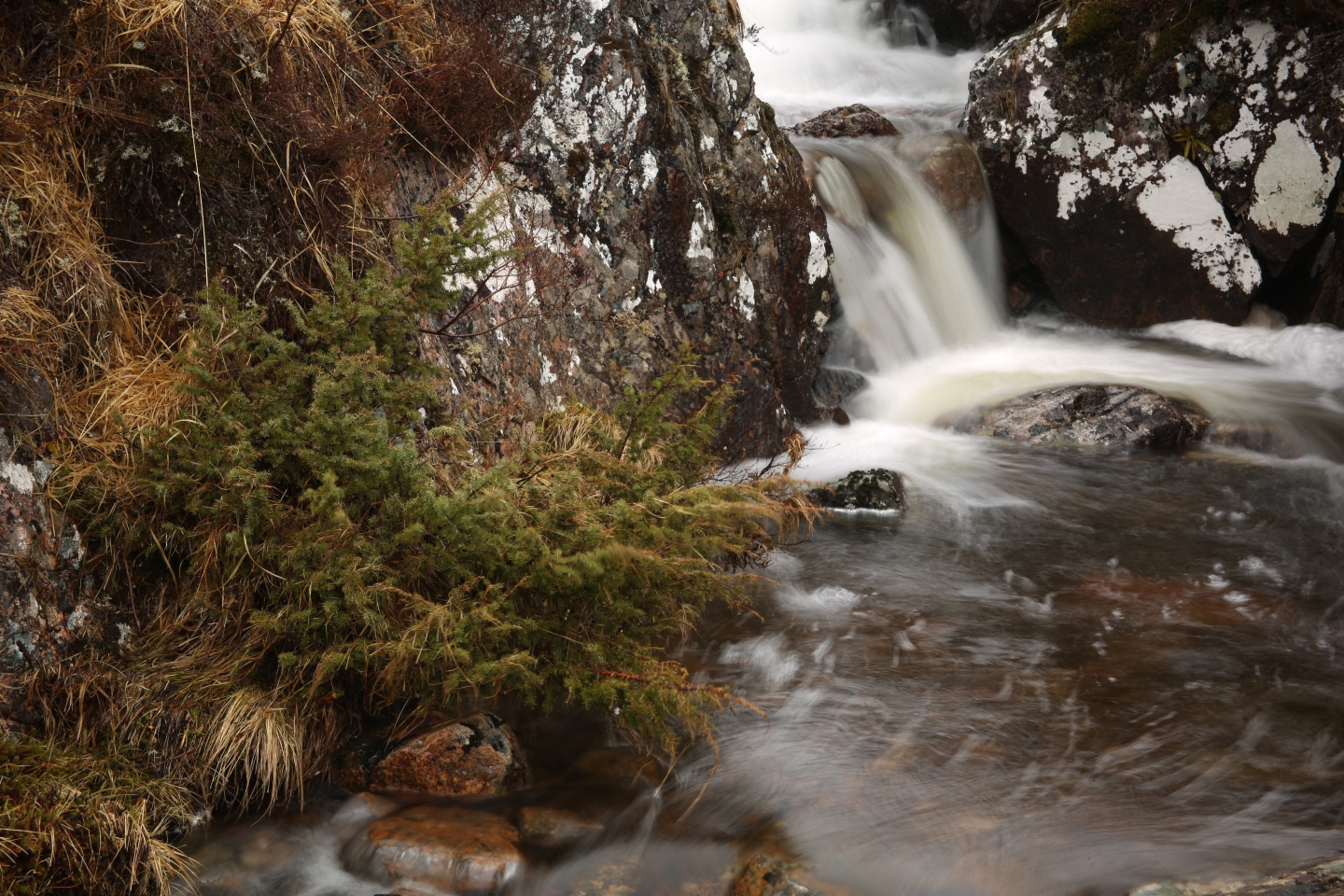
However, the fact that a juniper seed had made its way to this spot, and that the plant had germinated and appeared to be growing healthily, where deer must have overlooked it, shows both the resilience of wild Nature, and the fact that trees and shrubs will grow in many parts of the Highlands, if they are given a chance. Juniper (Juniperus communis) is relatively uncommon in the northwestern Highlands, being more abundant in the drier eastern parts of the country, such as the Cairngorms, but we do have very good junipers at Dundreggan, which is only about 20 miles from this site.
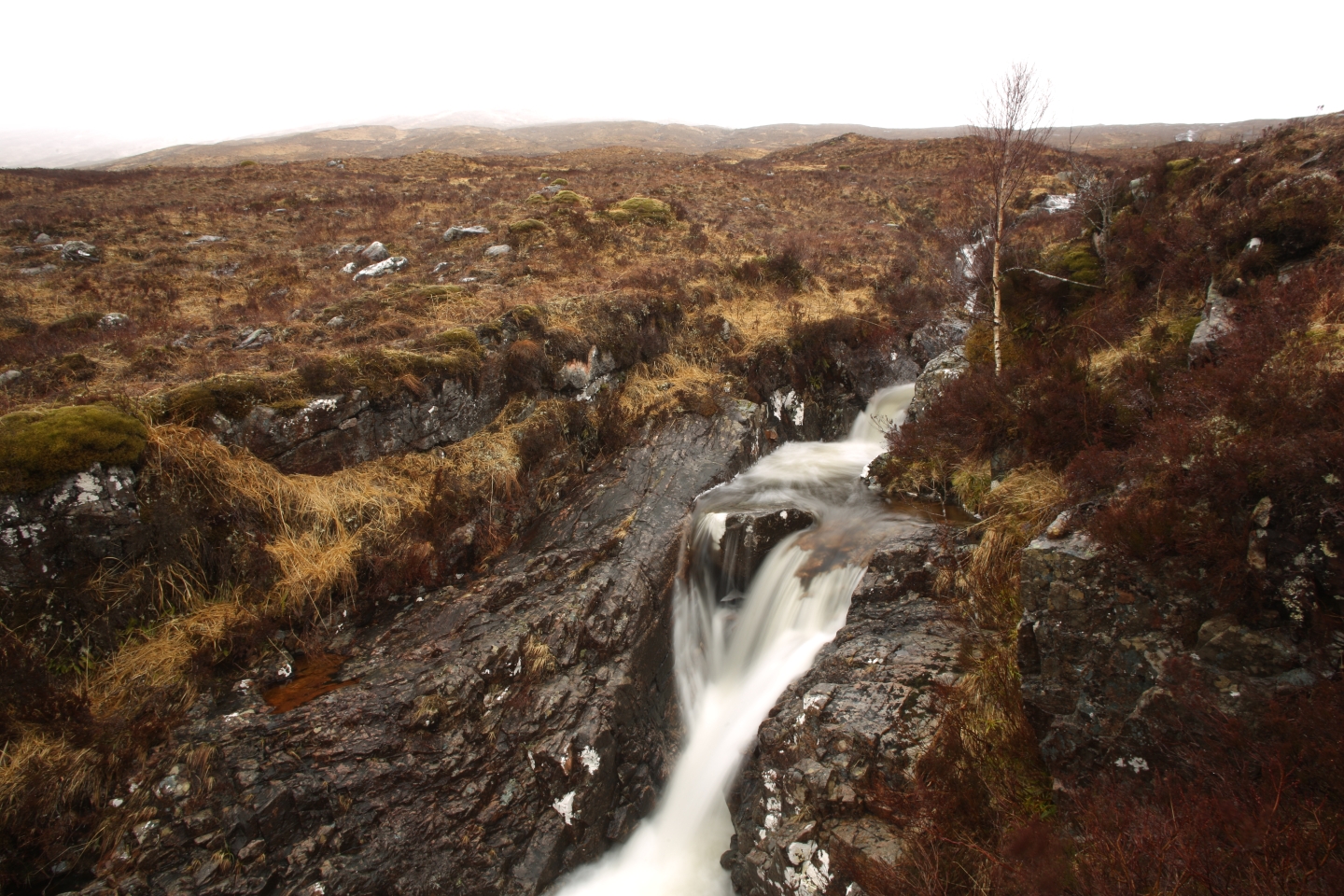
I continued on upwards, and soon came to the end of the trees – there was a solitary, small and quite young-looking birch growing at the top of a cascade on the burn. Like the other trees lower down, the seed it grew from had the good fortune to land in a place where it could germinate and grow without being eaten by red deer (Cervus elaphus). I was having some challenges taking photographs as the weather consisted of intermittent driving rain, sleet and hail, making it very difficult to avoid getting water drops on the lens of my camera.
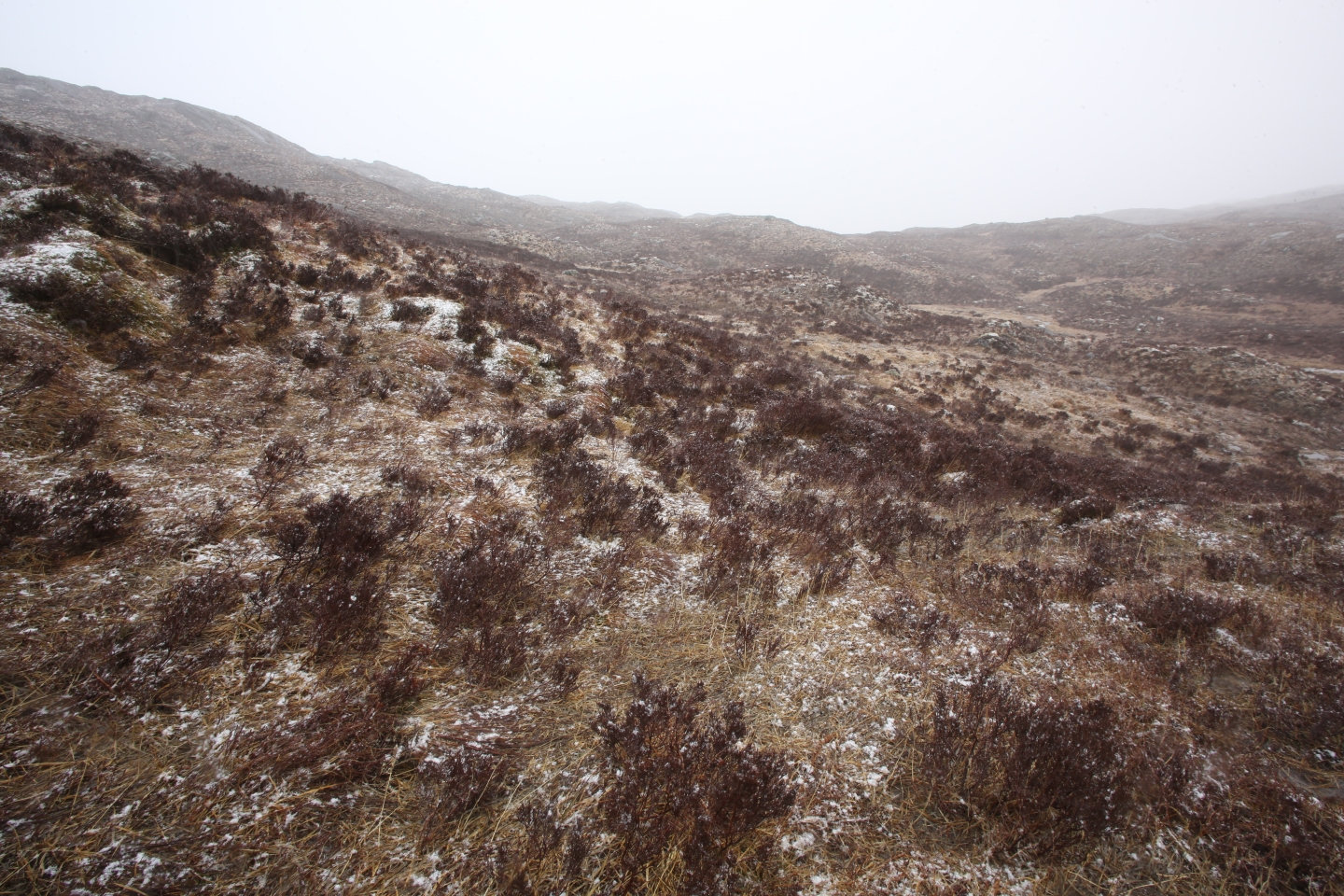
Hiking up a little further, the terrain began to level off a bit as I approached the top of the ridge that separated Glen Quoich, where I’d parked my car and begun walking, from Glen Loyne to the north. With the increased elevation, the precipitation turned from sleet and hail to snow, and it was falling heavily and accumulating on the ground all around me. I’d definitely journeyed back into winter by this point, and the low temperature and strong wind made it quite cold indeed.
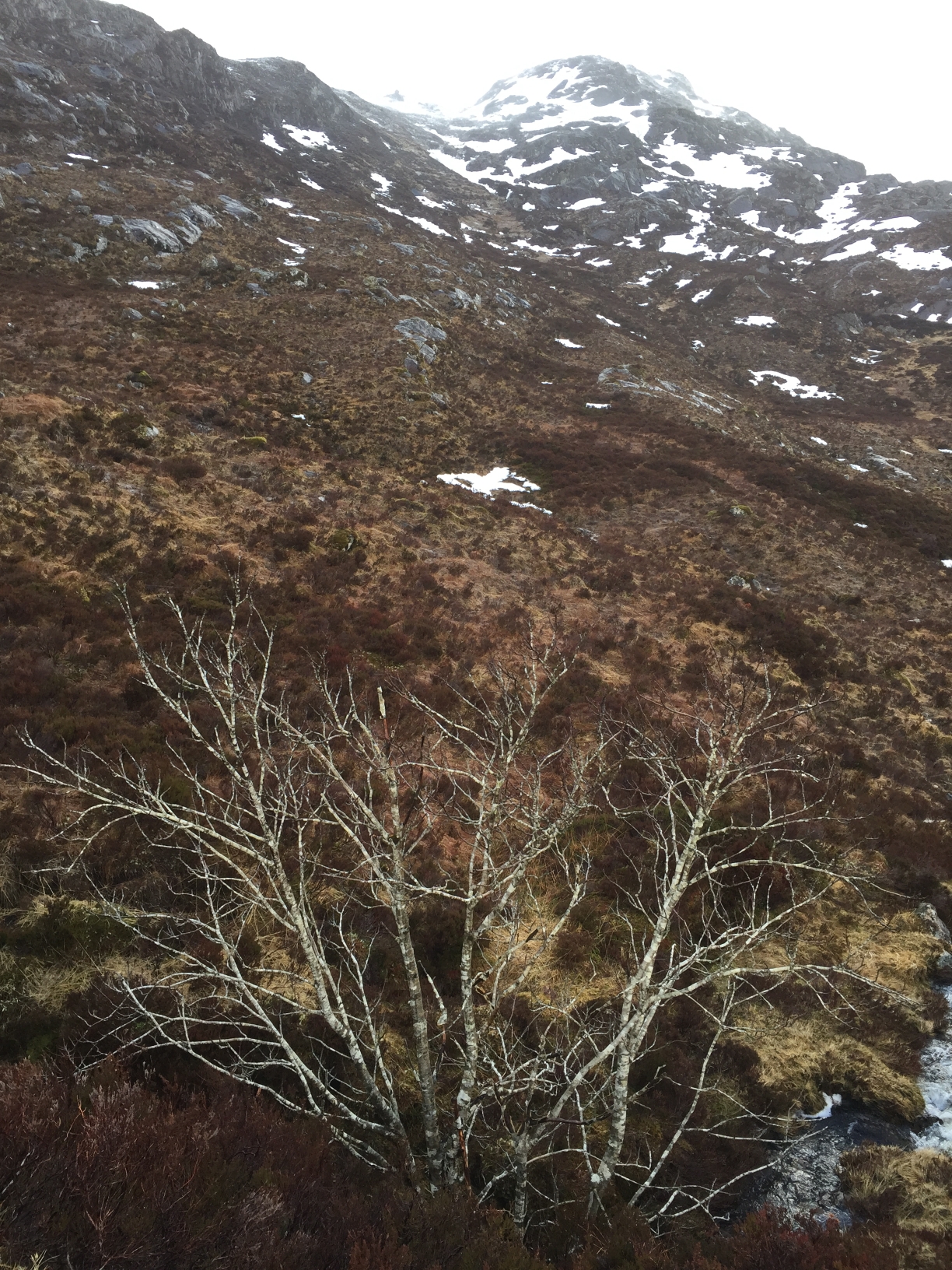
Once I was over the crest of the ridge however and began the descent into Glen Loyne, the snow relented for a little while and I got a bit of a view towards Spidean Mialach, a Munro just to the west of the path I was on. Rising to an elevation of 996 metres on its summit, this is quite a dramatic mountain, especially from the north side, where I was now looking at it from. My view was interrupted by intermittent snow flurries however, and they seemed to add to the mystique and atmospheric ambience of the mountain … The path descends more steeply than it had risen on the south side, and I was surprised (and delighted) to encounter a large rowan tree (Sorbus aucuparia) in one place, quite high up on the slope. It was growing in a small but steep gully beside the watercourse I was following, and it was this relatively inaccessible location that had enabled it to survive and flourish there.
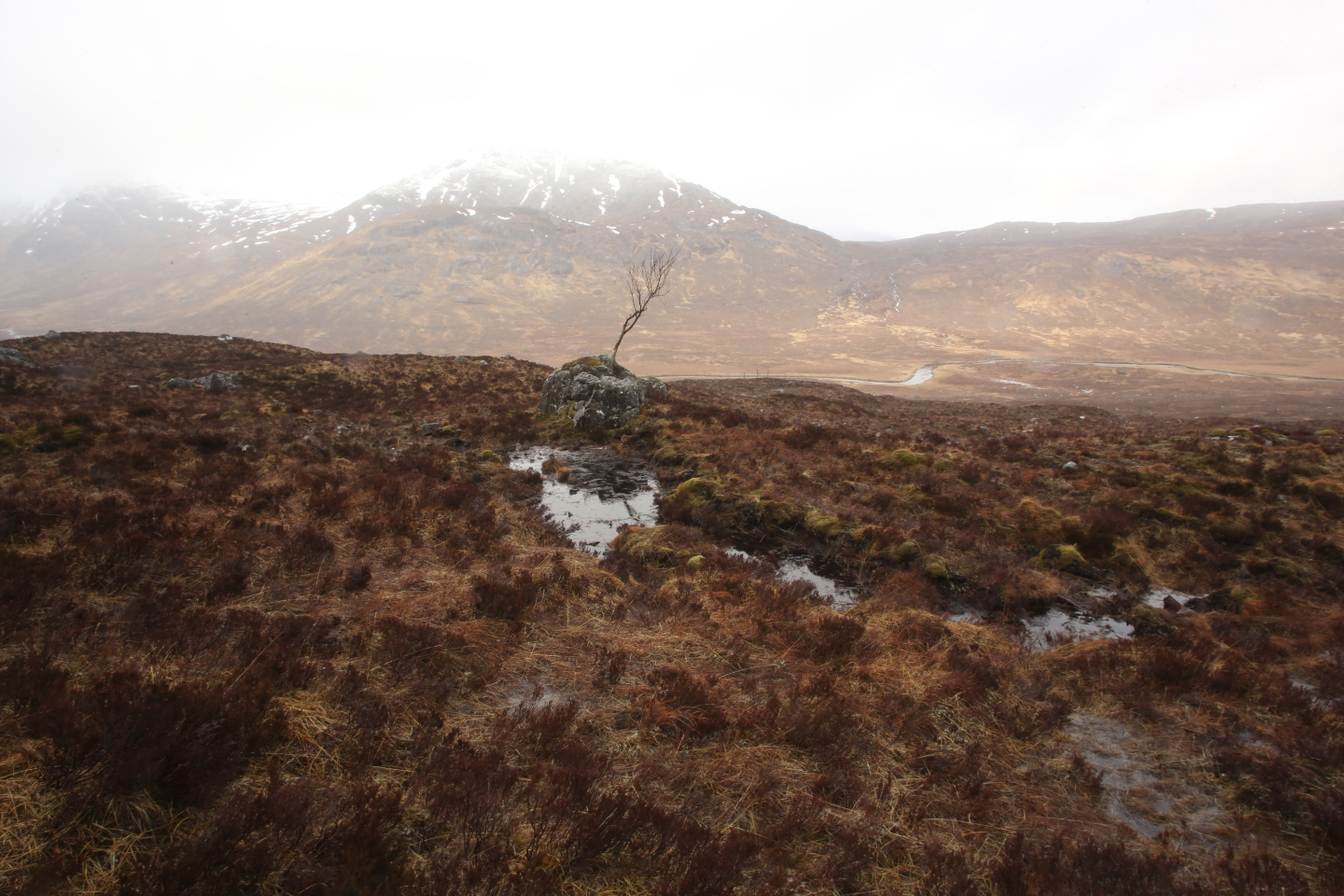
Continuing on downwards into Glen Loyne itself, the valley looked desolate and treeless, or so it seemed. However, I did come across one other solitary rowan, growing on top of a large boulder, where it was out of reach of deer. This is a common sight throughout the Highlands, as rowans germinate in remote sites, where their seeds are deposited in birds’ droppings, but they only survive in inaccessible places like this, because they are so palatable to deer.
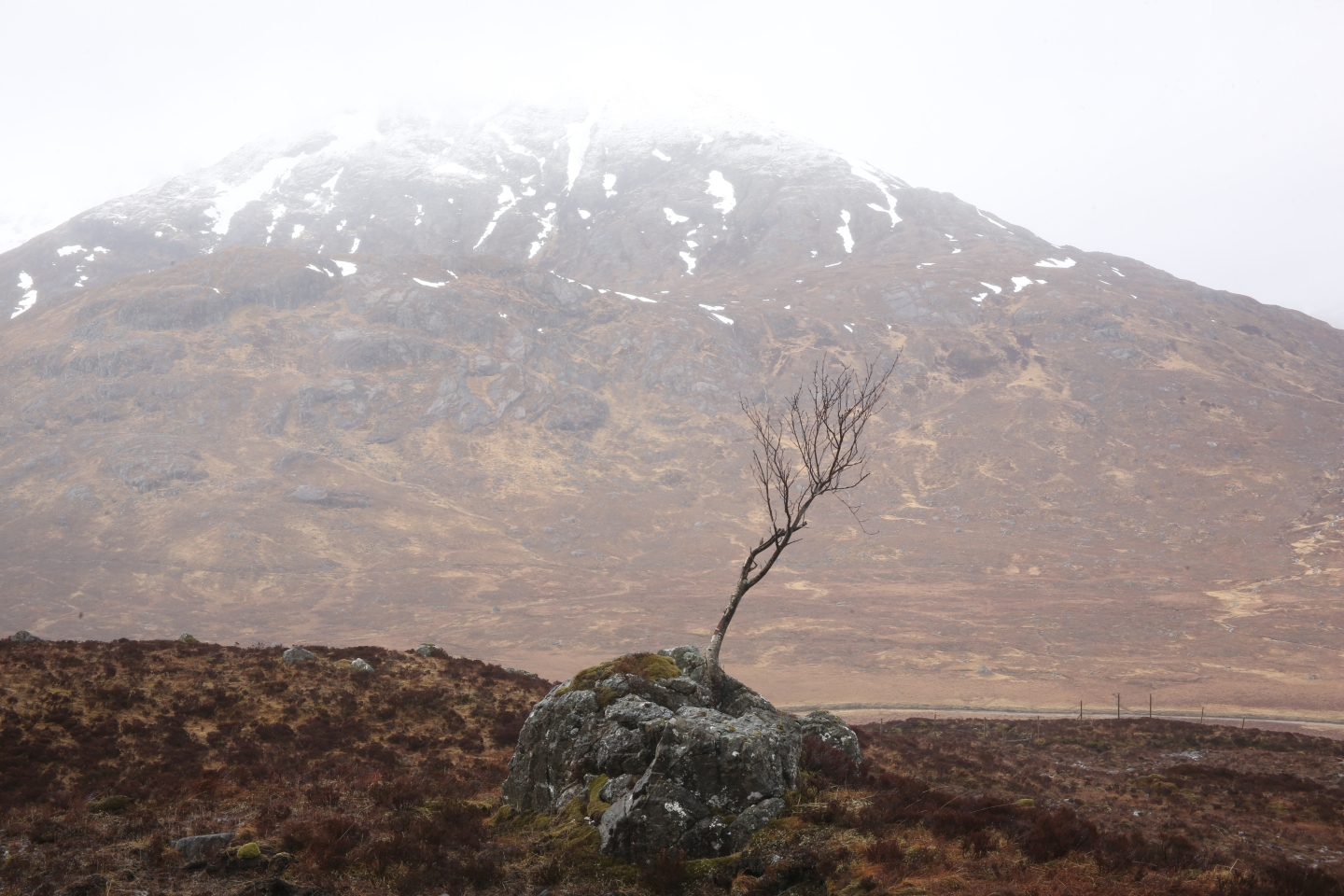
This particular rowan seemed especially sad to me, because of the bleakness of the surrounding landscape, and as I spent some time with it, the question kept coming in to my head – how could people have allowed this near-total deforestation to have taken place? As with many glens in Highlands, I felt a tremendous sense of sadness and loss in the landscape here, and I’m guessing that it may have been very depressing for some of the local people in the past, who saw the loss of the forest occurring, but perhaps felt impotent to do anything about it, because they had no ownership rights to the land.
From my perspective today, it seems almost incomprehensible that such depletion of the land could have occurred. It is our generation now that has to deal with what we’ve inherited, and from our position of deeper understanding of ecosystems, and greater material wealth, we’re not operating under the same constraints as previous generations, so we have the opportunity to really make a difference in bringing the land back to a condition of better ecological health and sustainability.
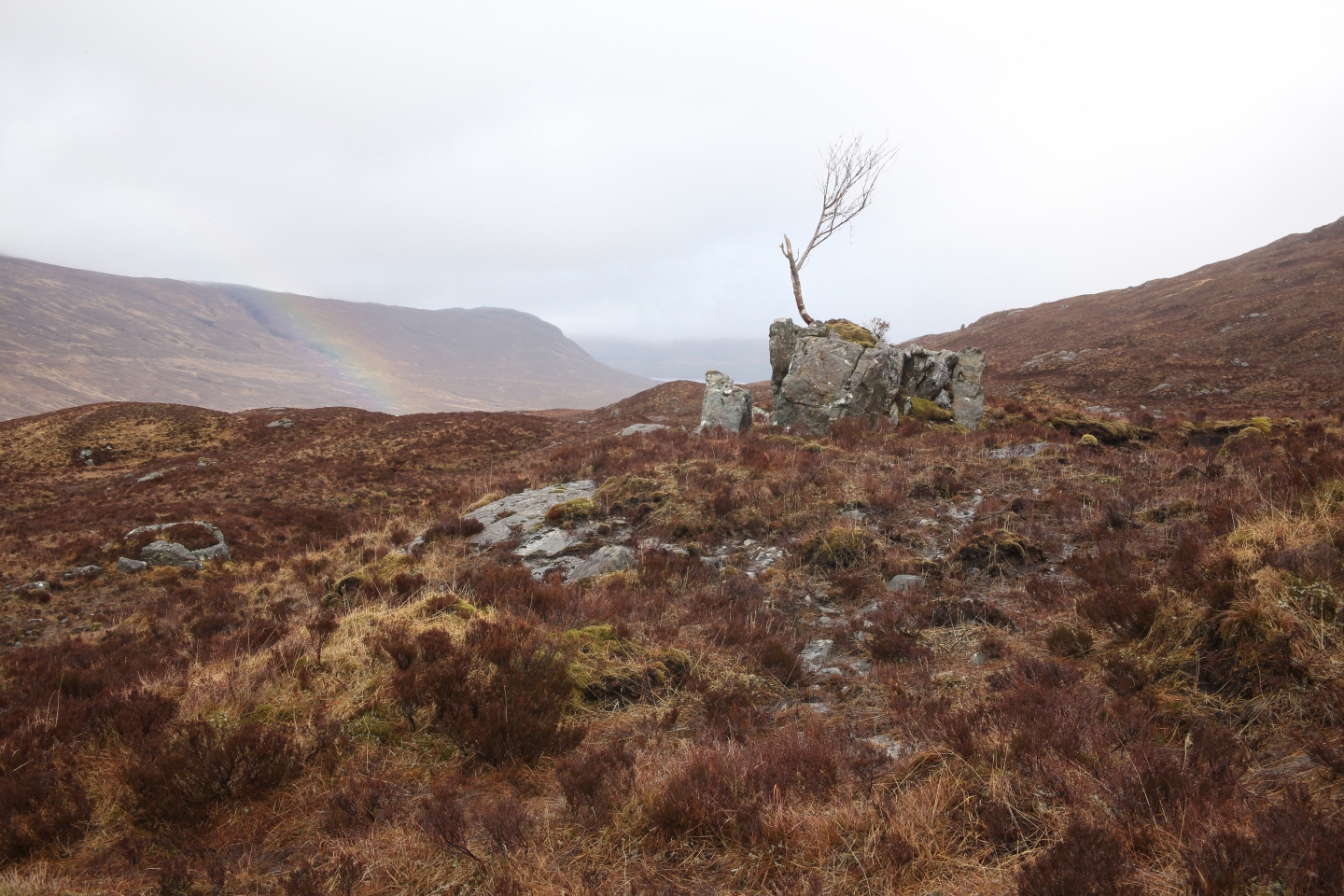
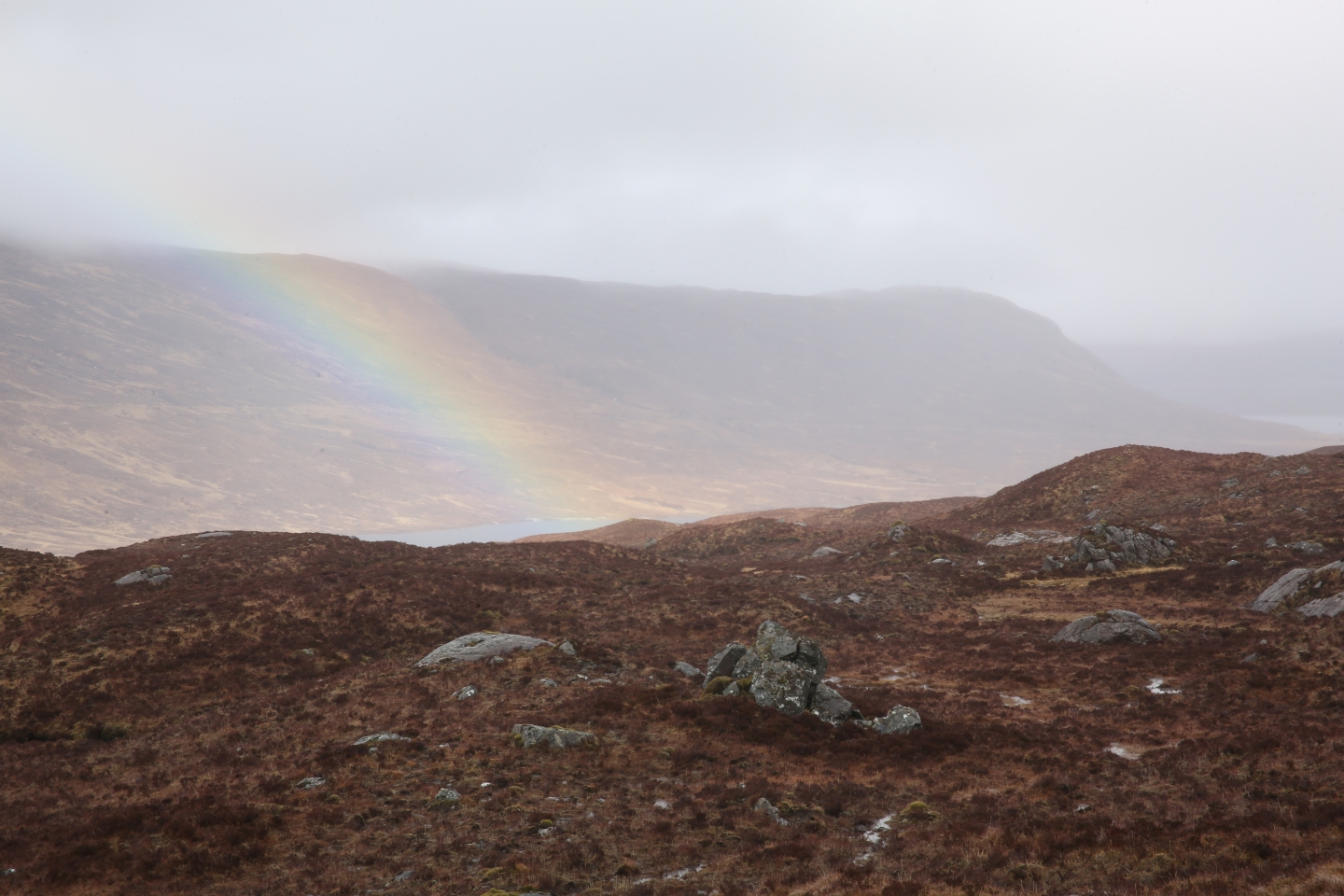
While I was photographing the solitary rowan, the sun came out briefly, and as it was also still alternating between rain and sleet, a rainbow appeared briefly in the sky, over Loch Loyne. I managed to get a few quick photographs of it, including one with the rowan in it, and the rainbow seemed like a positive symbol as though it was indicating there was a vibrant and rich life awaiting the rowan, and indeed the land all around there.

The footpath continued on to the west slightly and after about 400 metres or so I came to a deer fence which has been erected around most of the old Scots pines in the Glen Loyne pinewood remnant. This is to enable natural regeneration from these old trees, but on entering the exclosure I could see little evidence of any young pines beginning to grow amongst the old ones. However, further down the slope into the valley bottom, and within the same fenced exclosure, I could see that a lot of pines had been planted, presumably to help provide ecological continuity from the old pines.
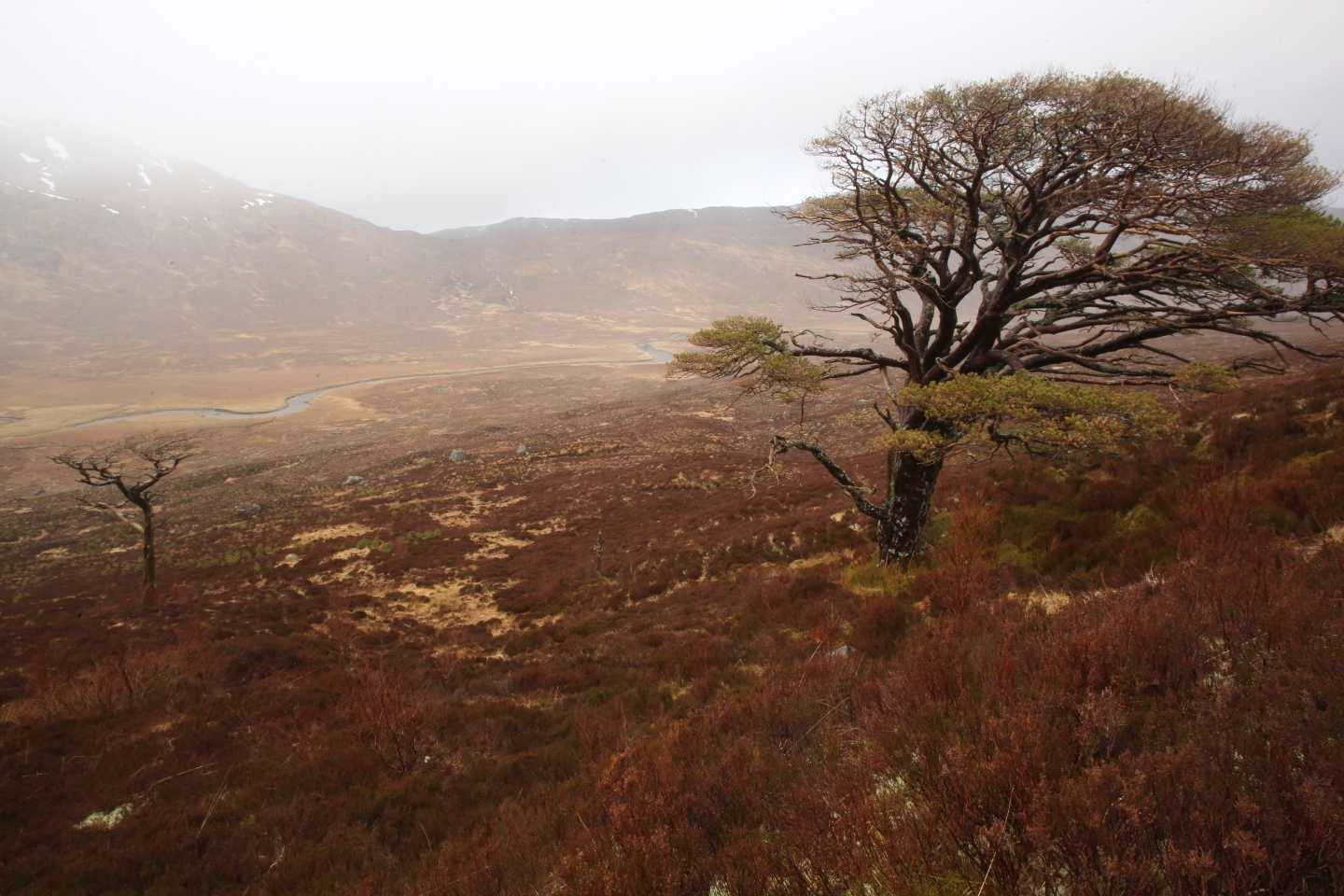
I had heard that the pines in Glen Loyne did not look particularly impressive, given their age of up to 550 years old, and indeed the ones I saw looked like they had been constrained in their growth by the harshness of the environment and the exposure to the elements there. I was certainly feeling exposure to the elements myself, as the wind was blowing strongly from the west, bringing intermittent sleet, hail and snow, and making photography very difficult, as moisture drops were constantly getting on to the lens of my camera.
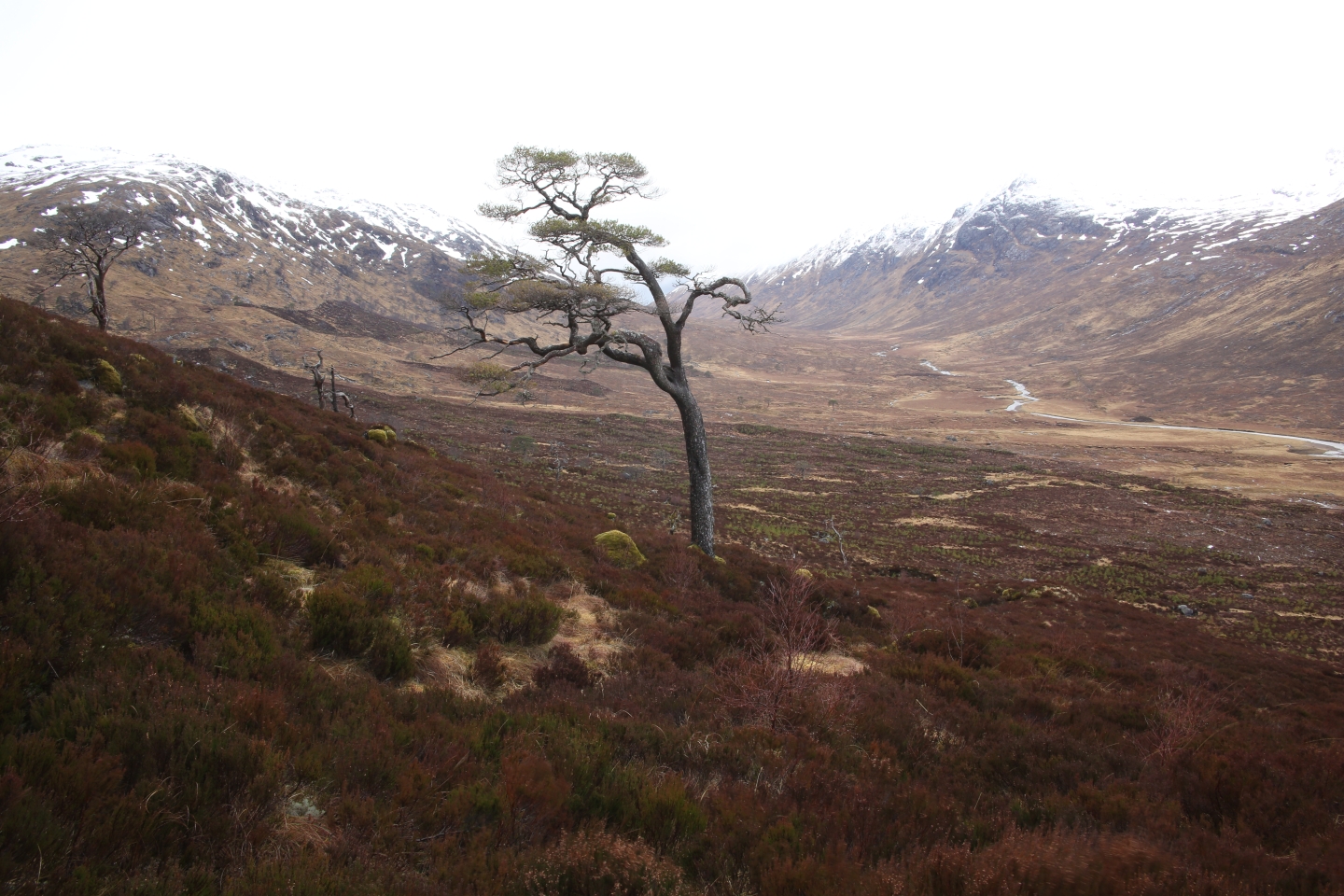
The old pines appeared to be widely scattered over quite a large area, and I didn’t have time to look around them all, as the day was getting on, and I had a long walk back to my car and then a longer drive to get home as well. Plus, the weather was getting colder and wilder and despite wearing all my wet weather gear, I was beginning to get soaked right through, because of the very difficult conditions, with driving snow etc.
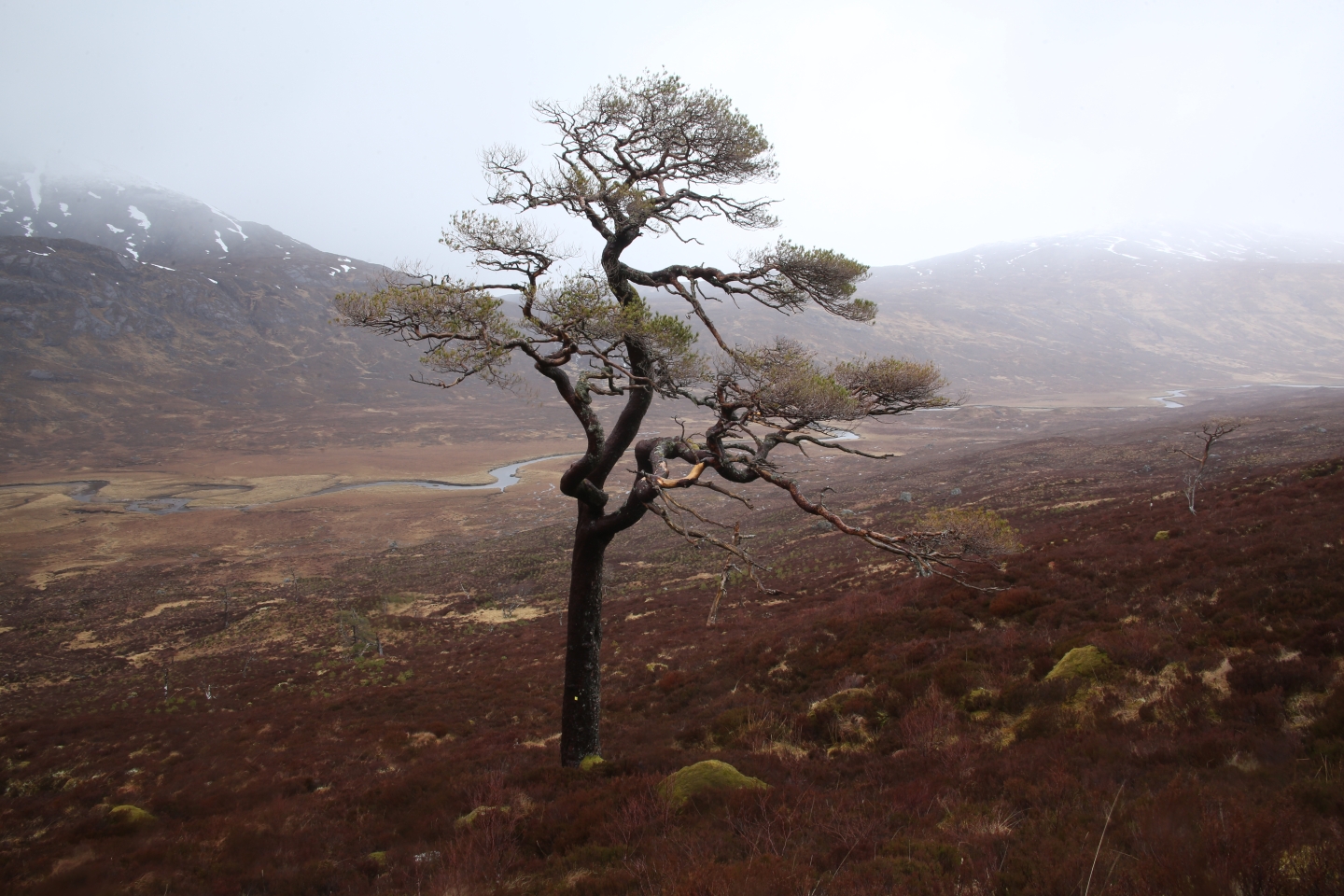
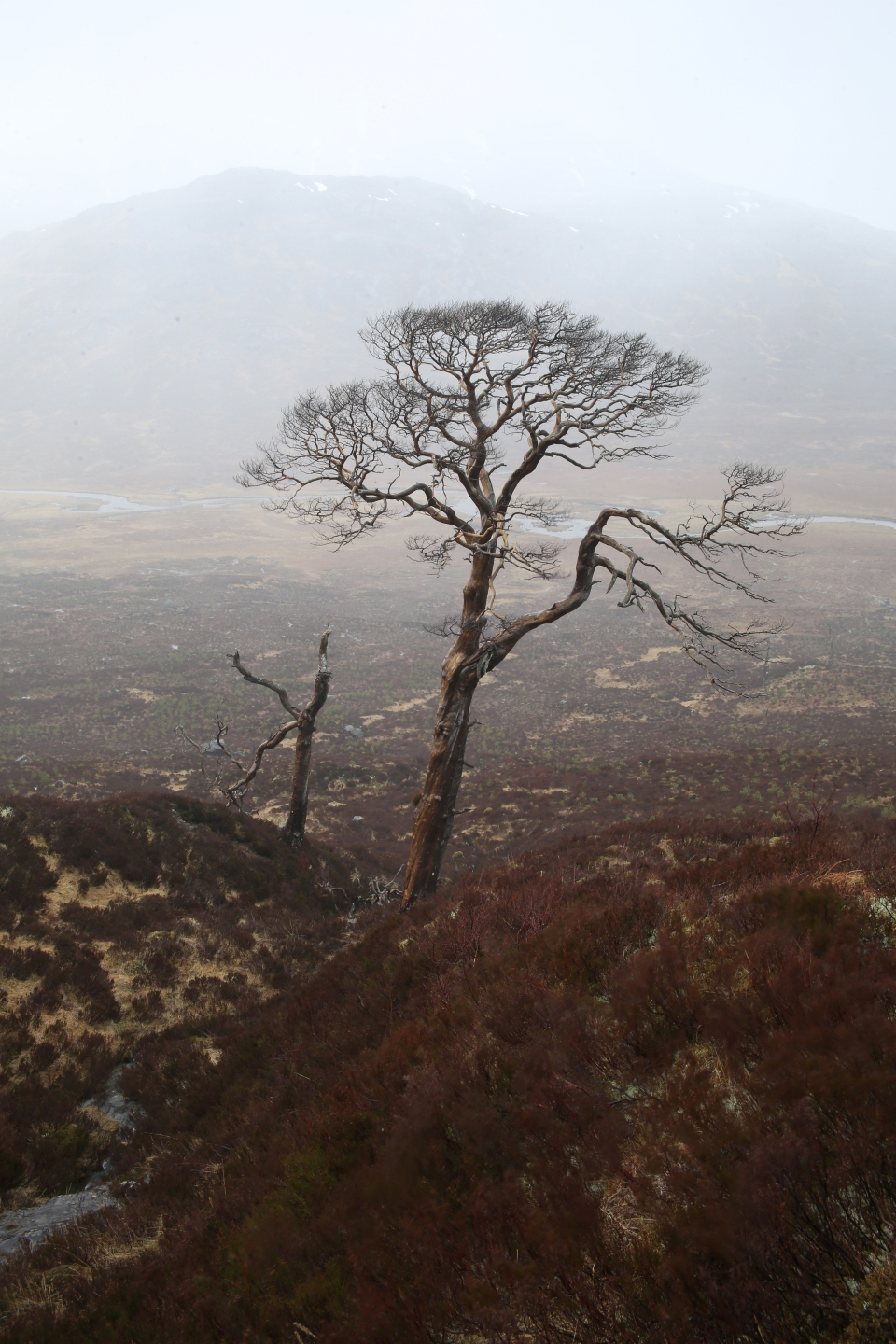
I felt privileged to be in the presence of these, the oldest pines in the country, but I was also saddened and depressed to see the condition of the surviving trees. They all looked like they were on their last legs, and it appeared to me that almost all of them would die in the next few years.
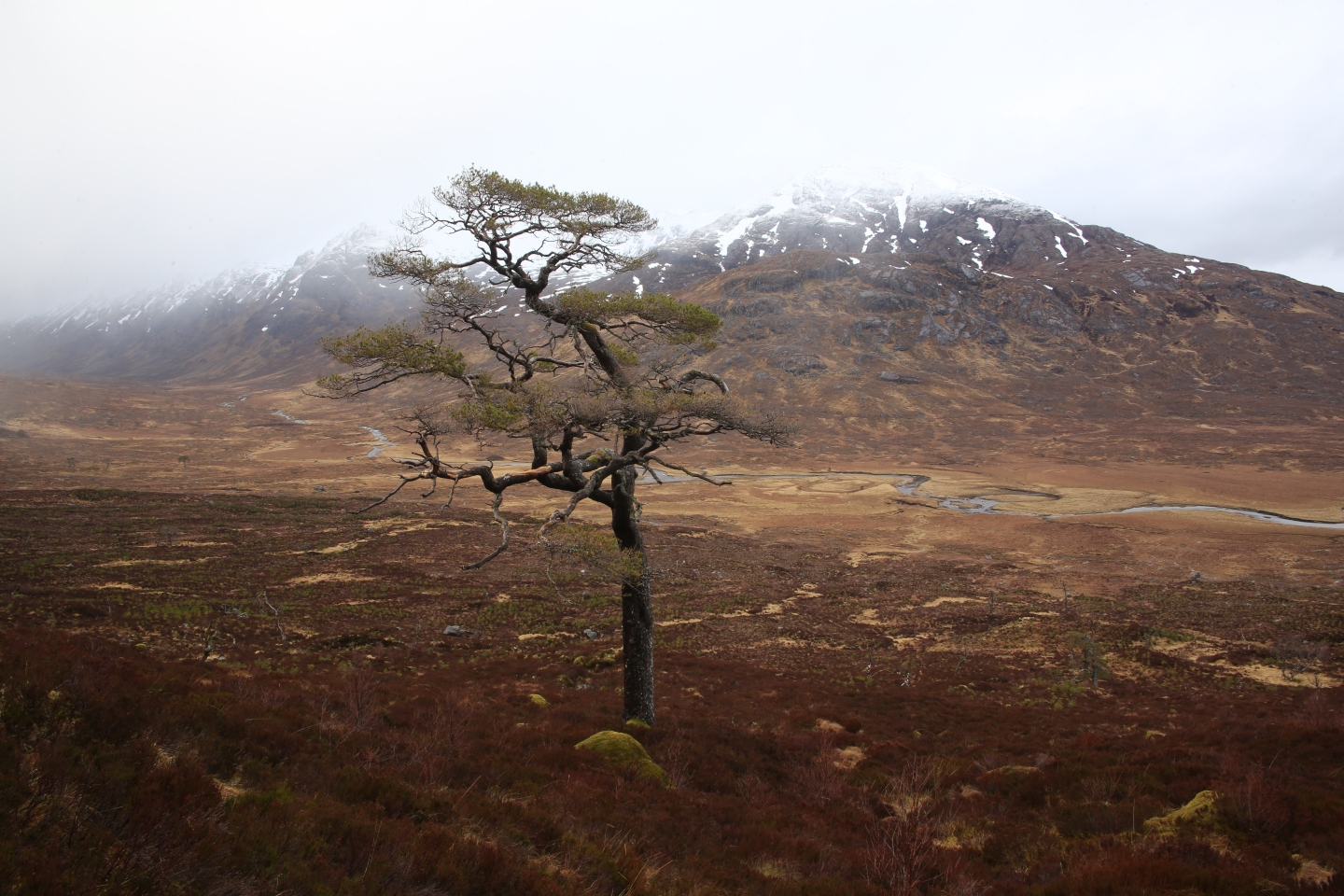
It was quite an emotional experience for me being there, and this was intensified by the extremes of the weather and the strong feeling of remoteness and isolation in this place. At least some new trees were growing, where they had been planted. However, I could see that not all of the old trees were protected inside the two fenced exclosures there, so more could be done to help the pine woodland recover in this area. In my view there’s a small window of opportunity to protect the remaining old trees, to encourage natural regeneration from their seeds before they all die.
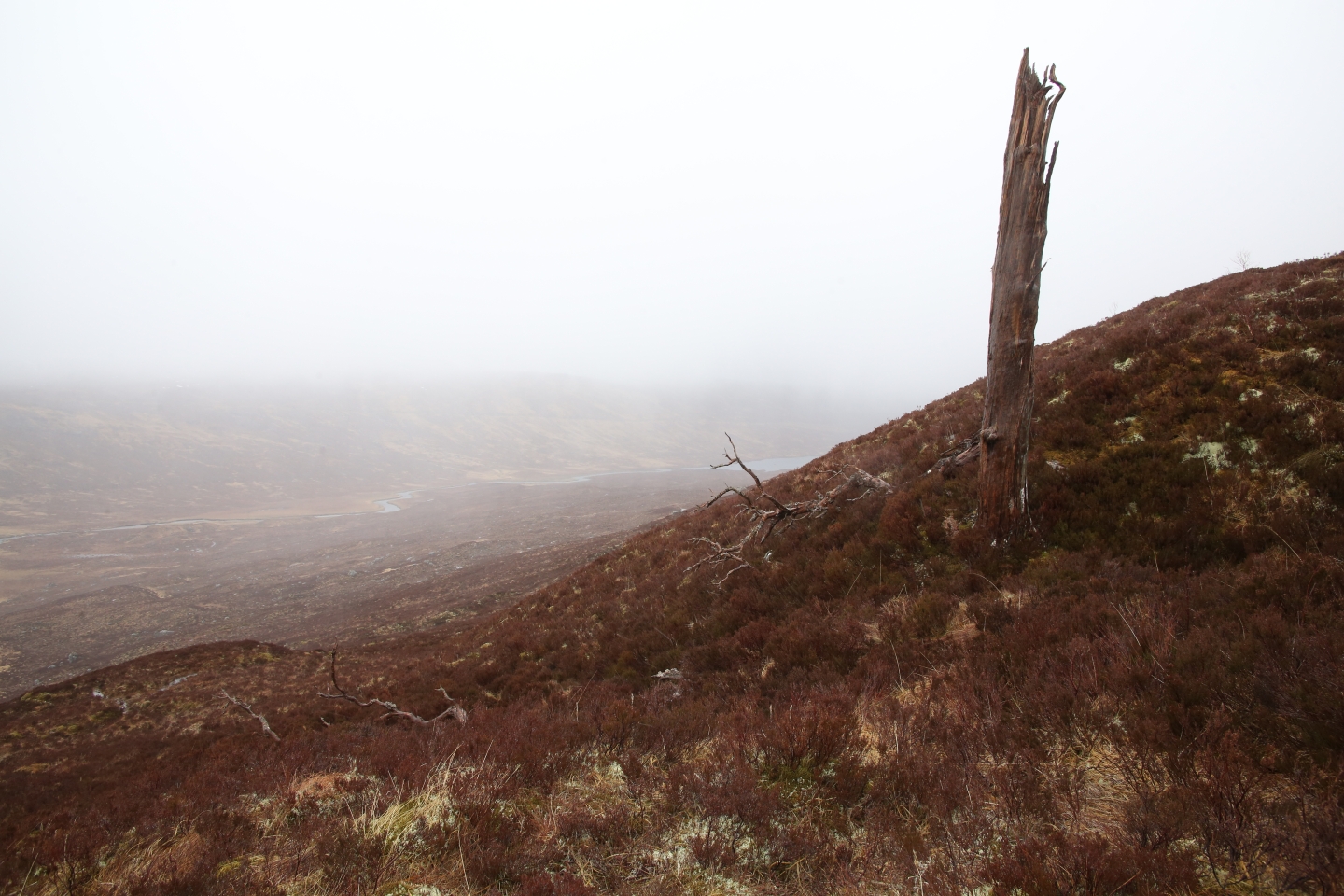
As I turned back and began the walk south again, I took a slightly different route through this exclosure, and this led me past some more dead old pines. It appeared that the healthy pine I’d first encountered upon entering the exclosure was possibly the best surviving tree there – it certainly was amongst those that I managed to get close to. It would have taken a couple more hours to get around all the old trees, because they are so widely scattered, so that will have to wait for another day …
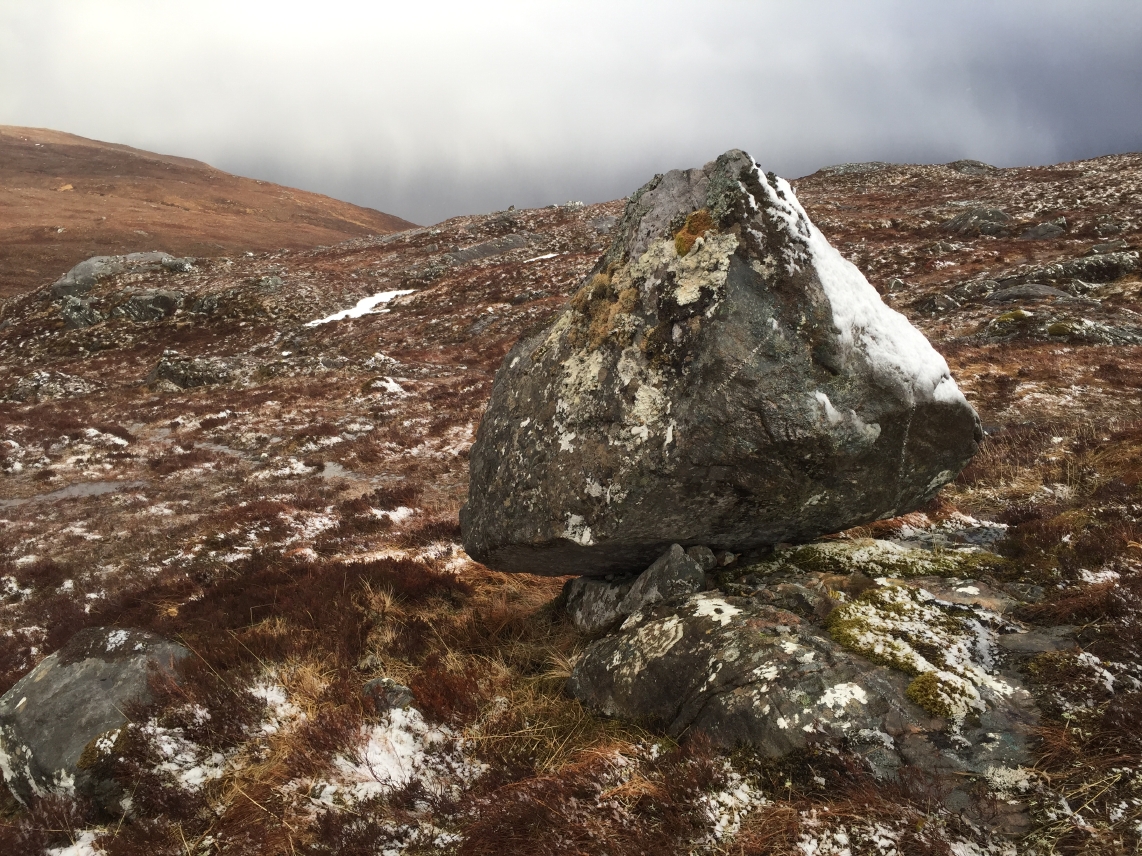
I didn’t stop much on the way back, because I was wet and cold, and also because of the lateness of the afternoon by then. However, when I got back to the high ground separating Glen Loyne from Glen Quoich, the sky cleared briefly, the snow let up, and I came across a large balanced rock on the hillside – what is called a glacial erratic in geological parlance. I paused there for a few minutes, to catch my breath after the steep ascent, and also took the opportunity of the clearer sky to take some more photographs.
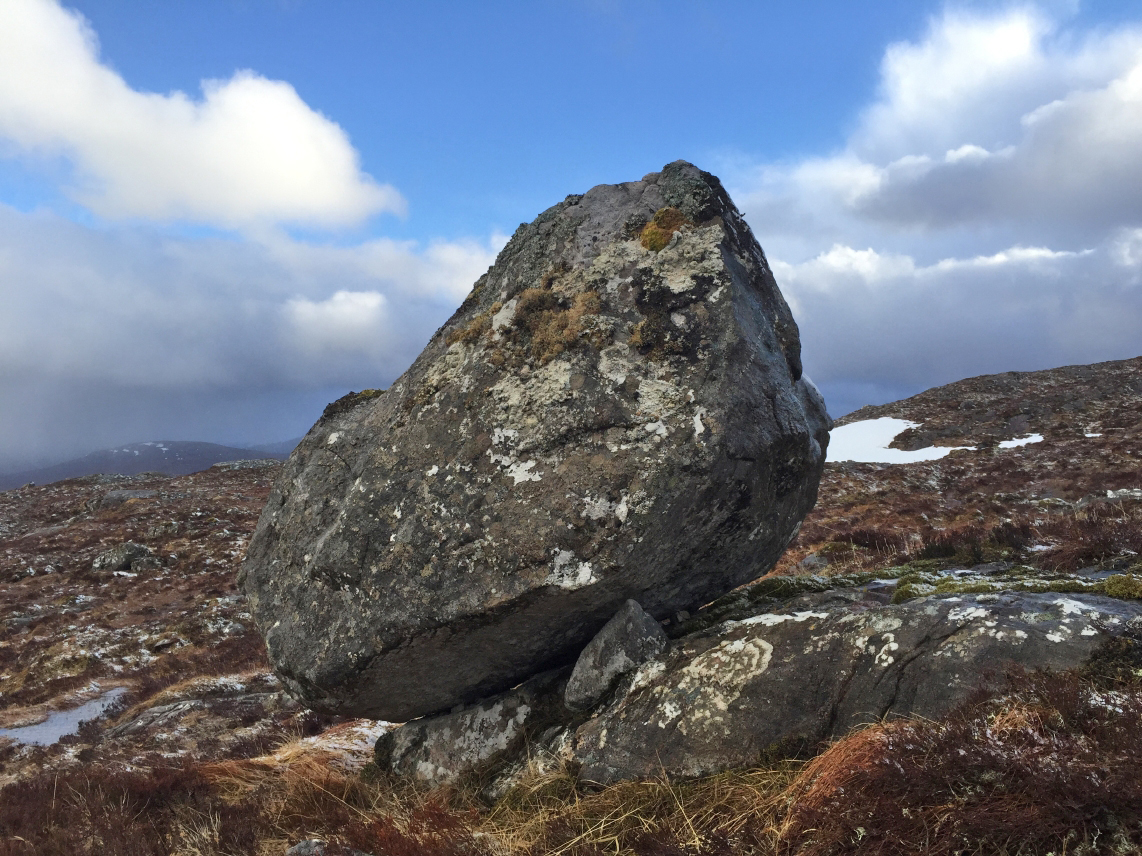
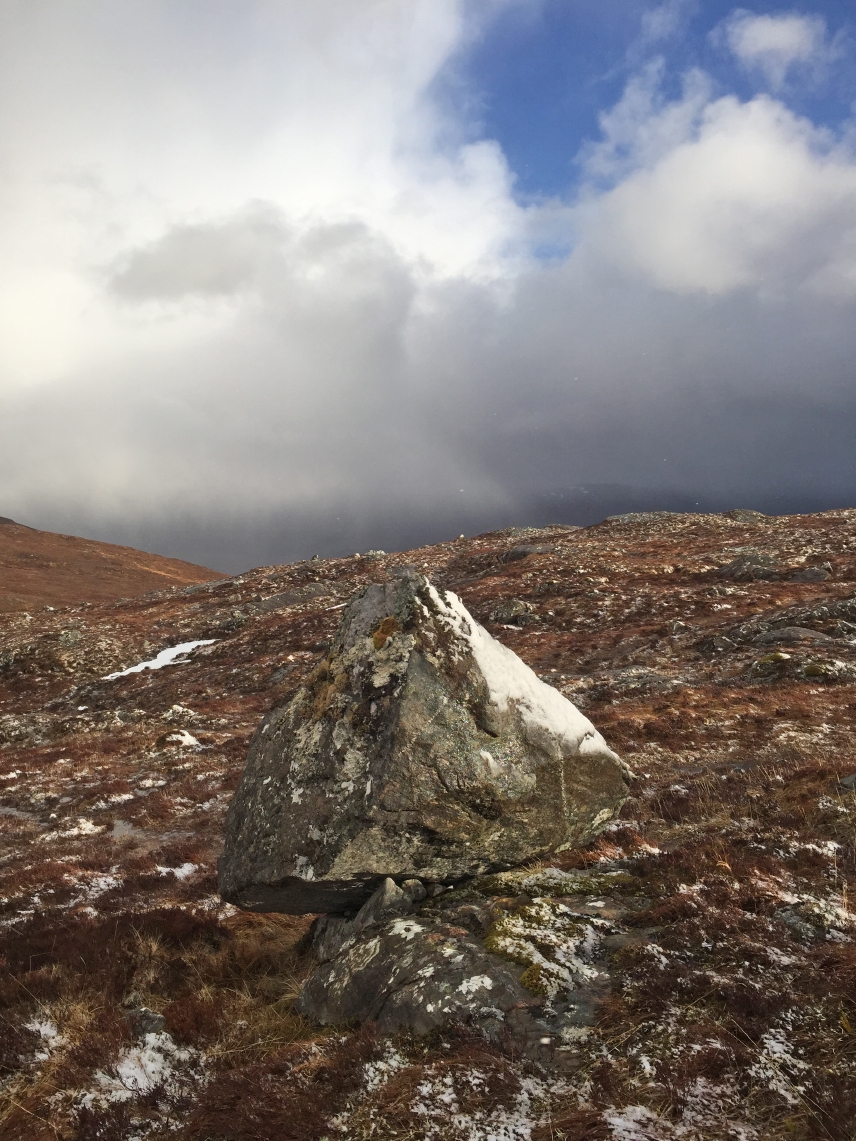
After this brief pause, I continued back to the car without stopping again, and was pleased to get back to the warmth and dryness it represented – when I got home that evening it took me a couple of days to get all my outdoor gear, camera bag, camera body and lenses properly dried out!
I’ll finish this now with a brief compilation of video footage I shot during the day, including some in the middle which illustrate how heavy the snow fall was at one point. The final scenes show the land (and red deer) about a kilometre to the west of the Allt a’ Ghobhainn in Glen Quoich.
https://www.youtube.com/watch?v=M63GGmg5e-4;vq=hd720&rel=0&showinfo=0
Years ago I counted over 400 rings on a pine stump in the Black Wood of Rannoch, which for this first time confirmed for me that they could last over 300 years in Britain. Your trees are sparse and thus fire proofed, but in Rannoch the pines are and have been dense enough for big fires to spread through crowns.
Thanks for that information, George. In 2001 I visited a Scots pine in the north of Norway (much further north than any latitude in Scotland) that had been aged at 720 years some years previously. It was only about 15 feet tall, very stunted and gnarled, and I’m guessing that we may well have had some trees of comparable stature and age in Scotland at some point in the past too.
I have just found this today. My mind was wandering back over the past and I began to think of Loch Loyne. I and three friends crossed the river having left the Road to the Isles heading south from Cluanie. Like your weather, it was sleeting and we had seen a few Snow Buntings along the way. I can’t recall how we crossed the river. This was 1975 and I was young. As we headed over the rough going I noticed the shapes of ancient looking trees in outline. I was born in London but knew in some way I cannot completely understand what I was seeing. I called out to my companions “Caledonian Forest!” It is a memory for life.
I have been back a few times since but not to the coire where most of the surviving pines are for a long time, unfortunately. When I did I think it was still quite impressive but dying away. I saw the enclosure soon after it was put in last century to protect the pines, but I also saw deer inside the fence. From memory, in the years after the removal of sheep, birch regenerated close to the Loch at least as much as breaking the heather cover. I saw no regenerating pines, though I did not walk to the coire. The planted specimens seemed to be holding their own.
I am so grateful to you for this account. It brings back many memories and, like you, long hours of sad reflection on what has been allowed to take place. It could be reversed. I hope so, but not that I shall live to see it. But in my mind’s eye I shall have that sighting of ancient trees against the sleet and a connection to the past.
Hi Barry,
Many thanks for your thoughtful and detailed reply. I’m guessing that most people who visit these old and dying pines will be similarly touched by the loss that has taken place there.
With best wishes,
Alan
Hi Alan,
thanks for this report. It sounds like a fairly hard day out. Your report feels as if you are bearing witness to a long drawn out & sad story. I know some of those places & it must have been hard on you particularly as a man who has & is continuing to contribute so much to change this sad situation. You are not alone but on a day like that it reminds you of the urgency of the task.
If there is any encouragement in the analogy I will be sending your link to both of my kids when I finish this: they are both off at university now but have both been up for work weeks with me in the past where I hope the seed of understanding may have been planted for future involvement in this kind of work. It’s a little like the old pines, you just hope that some of the seeds find a fertile place for germination in the next generation.
But your ongoing commitment & involvement in caring & in educating others is so valued.
It really does help & though it may not be easy to see on such a lonely sounding day, your witness does, I believe, bring lifeblood ever nearer to even the most isolated of these remaining stands & the greater forest to which they should belong.
Best wishes,
That was a wonderful experience to share. I first visited Loch Quoich in 1969 and brought home a spectacular pine root washed up on the shore of the Loch…I have it still. On a more recent visit I was disappointed at the lack of trees. Glen Loyne must deserve attention if only for its isolation…the remnant trees look desolated. FC did a wonderful job grafting Guisichan pines when they were no longer fertile…any chance of something comparable for these last ancient pines? Thanks Alan especially for coping with the weather!
Would it be possible/worthwhile to collect seed from some of these old pines for planting in the nursery, so that the genetic line of these trees can continue even if no natural regeneration occurs in situ? Glad you got home safely Alan
The amount of deforestation must seem discouraging and the enormity of the task of saving the forest daunting at times but it makes me realize even more, just how important the restoration work that Trees for Life is doing is. Every tree planted, every Aspen tree propogated, every person who is made aware of the situation of the pinewood forest, every red squirrel transplanted to a new home, every dollar raised is another step towards the hope that the forest can be saved. I am reminded of a quote from the movie “Shawshank Redemption” — “Hope is a good thing, maybe the best of things, and no good thing ever dies.”
Generally from what I read about dead trees , that usually they are called nurse trees as saplings grow from underneath them,are there no such saplings growing, why not also provide wind breaking walls of some sort of cloth to provide shelter for the young pines growing further up the hills , is the government not involved at all,?Or just the land owners many who probably absent ones.
Landownership is key. We must get directly involved with the landowners themselves. They are personally responsible for this. Until there is large scale land reform, this will continue.
Apparently Lapland and Sweden have a couple of Pinus sylvestris specimens well over 700 years old so hopefully some may hold on a little longer (although I imagine the depleted ecosystem would put the odds against it).
Are the plantings within the exclosure solely of Scots Pine?
Brilliant blog Alan!
Some of those photographs are very moving. One day we’ll see that whole valley covered in the most wonderful forest, I’m sure of it.
I’m interested to know what altitude some of those large pines are growing at?
And of course, any dwarf birch? I assume not, or you might have said!
Feeling educated and depressed all at the same time, Alan.
Thank you so much for sharing your day and your experience with us. I became completely wrapped up in your story, and having been in similar environments while in Scotland could almost smell the air and feel the cold. I found myself imaginging what the same hike would look like in two months time, the bracken and blooming things. It’s also no surprise to me that these ancient trees are gnarled and small. I’ve been to the Bristlecone pines in the White Mountains of California to see the ancient Bristlecone pines https://www.flickr.com/groups/994894@N24/, all of which are gnarled, twisted, half dead, but thriving nevertheless in that high dry habitat. Again thanks for all you and your crew do to help the Highlands, and through that the world.