• Skip to primary navigation
  • Skip to main content
  • Skip to primary sidebar

Alan Watson Featherstone

ECOLOGIST, NATURE PHOTOGRAPHER AND INSPIRATIONAL SPEAKER
FOUNDER OF THE AWARD-WINNING CHARITY TREES FOR LIFE

  • Home
  • Public speaking
  • Writing
  • Photography
  • Events
  • Shop
  • Blog
  • About me
  • Contact

Fabulous fungi and slug-fest at Dundreggan!

Dundreggan: 21 September 2011 3 Comments

Chanterelles beside some cascades on the Red Burn at Dundreggan, which was swollen from all the rain

In the last 10 days I’ve been out twice to Dundreggan, meeting up with some specialist biodiversity surveyors from the British Myriapod and Isopod Group. That rather cumbersome title refers to centipedes and millipedes (Myriapods) and woodlice and pill bugs (Isopods), and the group had chosen to spend a week at Dundreggan, contributing to our biodiversity surveys of the estate, for their annual field trip.

Brown or garden centipede (Lithobius forficatus) found at Dundreggan

As it turned out, the week was mostly wet, and the rain hindered the surveyors in the search for their subjects, although when I was with them we did come across several different millipedes and reasonable numbers of a common centipede (Lithobius forficatus). This latter was particularly active, and whenever we encountered it, either by turning over a stone or searching inside a rotten log, it would run away very quickly back into cover, taking advantage of its 15 pairs of legs (despite their common generic name, few centipede species actually have 100 legs).

Common striped woodlouse (Philoscia muscorum) at Dundreggan

We also found a few different but common species of woodlice, usually inside dead wood, where they feed on dead plant matter, helping to recycle the nutrients back into the ecosystem. Woodlice are the largest terrestrial group of crustaceans, the more familiar members of which are aquatic – crabs, lobsters and shrimps, for example.
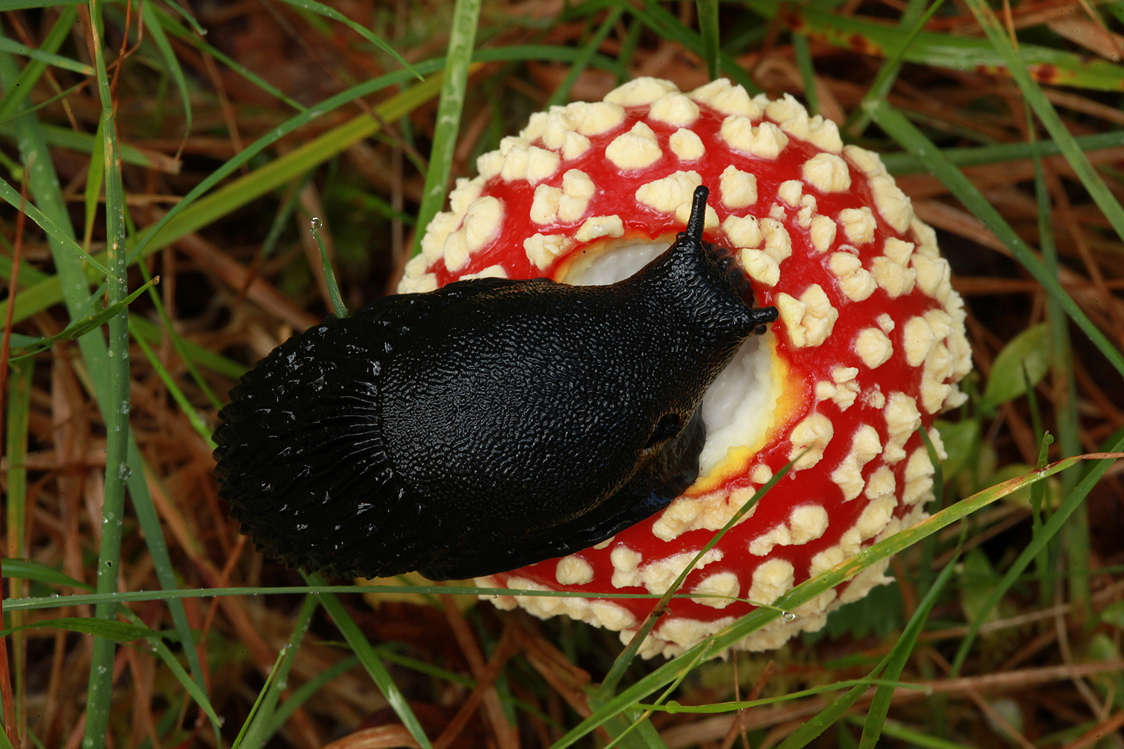
Black slug (Arion ater) eating a fly agaric fungus (Amanita muscaria)

However, the days belonged to a different group of organisms, many of which also play a key role in the recycling of nutrients in the forest – fungi. One benefit of the very wet summer we’ve had this year is that it has produced a fabulous abundance of fungi in the past few weeks, and in some places it was hard to avoid stepping on them, they were so profuse on the forest floor! Amongst the common species were the fly agaric (Amanita muscaria), one of which had attracted the attention of a black slug (Arion ater) – the mollusc was very photogenically positioned on top of the mushroom, eating a circular area in the centre of the cap.

Orange peel fungi (Aleuria aurantia) at Dundreggan

Chanterelles (Cantharellus cibarius) were particularly prolific in the birchwood and both I and the group of surveyors each easily collected enough for several nights’ meals, without making any noticeable dent in the overall abundance of them in the forest.

There were plenty of other fungi fruiting as well, and in the space of a few square metres I came across at least a dozen different species, including some interesting and unusual ones.

Bay cup fungi (Pezizia badia) fruiting on the all-ability footpath at Dundreggan

The new all-ability visitor footpath we’ve created through the birch-juniper woodland in particular provided a habitat for two readily-identifiable and distinctive species – the orange peel fungus (Aleuria aurantia), which as its common name suggests, resembles a piece of orange peel, and the bay cup fungus (Peziza badia), which grows in a characteristic cup-like shape. Both of these were growing at the edge of the path, a habitat where they are often found.

Crested coral fungus (Clavulina coralloides) at Dundreggan

One of the most beautiful species I came across was the crested coral fungus (Clavulina coralloides), which grows in delicate, coral-like branching forms. In a small area there were numerous clumps of this exotic-looking species, poking through the moss and plant debris on the forest floor.

 [jwplayer config=”slug” mediaid=”239″]
Black slug (Arion ater) eating a fungus
In the damp conditions, slugs were out in abundance, taking advantage of the fungal abundance to have a feast – I saw them eating a wide range of different fungi during the day, while many other fruiting bodies bore the evidence of previous feeding by slugs, with distinctively-shaped sections missing from their caps and tell-tale slime trails left behind. I was able to get a close look at one slug gorging itself, with the rasping action of its toothed-tongue (known as a radula) clearly visible.

Black slugs (Arion ater) mating. The white mass in the middle is the exchange of sperm taking place - slugs are hermaphroditic, meaning that each individual has both male and female sex organs.

Just as with human cultures throughout the ages, when times of feasting have often been followed by romantic liaisons and couplings, so too did it seem as though the slugs were making a real party out of it. Whilst walking through the woods I came across a couple of pairs of black slugs mating – the days indeed had turned out to be real slug-fests!


Ascent into the canopy of a Scots pine
Tooth fungi and slime moulds

Reader Interactions

Comments

  1. Anita MacCallum says

    17 March 2014 at 11:22 am

    HI,

    I have been searching the internet for a picture of a centipede for a little trail I am creating at my local city farm. I would be honoured to be able to include the photo of your centipede if possible. I would of course credit you.
    Best wishes
    Anita MacCallum

    Reply
  2. Armando Macatrao says

    26 January 2013 at 9:19 pm

    Very neat and very beautiful pictures.

    Reply
    • alan says

      28 January 2013 at 3:07 pm

      Hi Armando, Thanks for the feedback on my photos. With best wishes, Alan.

      Reply

Leave a Reply Cancel reply

Your email address will not be published. Required fields are marked *

This site uses Akismet to reduce spam. Learn how your comment data is processed.

Primary Sidebar

My TEDx talk – Restoring the ancient Caledonian Forest.

TEDx TEDx – Restoring the Caledonian Forest

Recent posts

  • The abundant life of dead wood, part 3
  • The abundant life of dead wood, part 2
  • The abundant life of dead wood, part 1
  • Gannets galore, part 2
  • Gannets galore, part 1

News

  • Rewilding workshop in Glen Affric 10-17 October 2026
  • Rewilding workshops in 2024
  • ‘A Rewilding Journey’ Workshop 27 May – 3 June
  • 2023 Caledonian Forest Engagement Diary now available
  • Revised dates for our next Rewilding workshop: 15 – 22 October 2022.

I’m speaking at…

  • A Rewilding Journey: Rewilding the World and Ourselves – 10 October 2026–
    17 October 2026
  • Over on X (Twitter)…

    Alan Watson Featherstone Follow

    Ecologist, nature photographer and inspirational speaker. Founder of the award-winning charity Trees for Life that is restoring the Caledonian Forest.

    AlanWatsonFeat1
    Retweet on Twitter Alan Watson Featherstone Retweeted
    richimedhurst Richard Medhurst @richimedhurst ·
    13 Mar

    When Starmer, Von der Leyen and Kallas say we have "shared values" with Israel, do they also mean raping prisoners with knives and bombing primary schools?

    Reply on Twitter 2032292968078381143 Retweet on Twitter 2032292968078381143 2924 Like on Twitter 2032292968078381143 8507 Twitter 2032292968078381143
    Retweet on Twitter Alan Watson Featherstone Retweeted
    mhdksafa Mohamad Safa @mhdksafa ·
    13 Mar

    There is no moral difference between putting people in gas chambers and burning people in safe zones inside tents.

    A holocaust is happening right before our eyes and the world is silent

    Reply on Twitter 2032359436145053854 Retweet on Twitter 2032359436145053854 12637 Like on Twitter 2032359436145053854 24134 Twitter 2032359436145053854
    Retweet on Twitter Alan Watson Featherstone Retweeted
    rainmaker1973 Massimo @rainmaker1973 ·
    13 Mar

    Nestled at the base of Mount Sahand in Iran, Kandovan is a 700-year-old village renowned for its extraordinary inhabited homes known as karaan.

    These multi-level cave dwellings are carved straight into natural volcanic tuff cones, resembling beehives.

    Reply on Twitter 2032252802651558276 Retweet on Twitter 2032252802651558276 1946 Like on Twitter 2032252802651558276 8089 Twitter 2032252802651558276
    Load More...

    Copyright © 2026 Alan Watson Featherstone | Wikipedia | LinkedIn