
It was my first dedicated photography day at Dundreggan for a couple of months last Sunday, so I decided to take a walk along the Red Burn, the main watercourse on the western half of the estate. It’s easy to access, being just a couple of hundred metres west of the buildings at Dundreggan at its nearest point, and as it was an overcast grey day, I thought it would be a good opportunity to do some photography in amongst the trees on the lower section of the burn.


I reached the burn at a place where there’s a bit of an elevation drop, with some nice cascades tumbling over the rocks in the stream bed. This provided me with the first opportunity of the day to get my camera out, and I spent some time photographing the cascades using long exposures, to get the blurred effect of the water in motion that I sometimes liken to ‘angel hair’.


I always find the contrast between the soft flowing fluidity of the water and the seemingly immutable hardness of the rocks to be aesthetically and visually pleasing, and this day was no exception.


While I was photographing the flowing water I noticed a patch of sphagnum moss underneath some of the alder trees (Alnus glutinosa) that were growing beside the burn. They were quite vivid in colour in the damp and overcast conditions, so I changed lenses to take some macro photographs of them.


My original intention for the day had been to head upstream on the burn, but now that I was beside it, I could see some more cascades just downstream from where I was, so I decided to have a look at those first.


As is often the case, this proved to be a decision that determined the rest of my day, as I spent the next few hours in the 100 metres or so downstream from there, and never made it upstream at all! My experience is increasingly that when I spend some time in a small area, I find more and more things of interest, so that I can easily spend a whole day in just a couple of hundred square metres of land! So it was this day, and I find this particularly notable, given that it is winter, and that most of Nature is dormant. There’s nothing like the diversity of life to see that there is in summer, but in fact there was still more than enough to keep me fascinated and engaged for the whole day, as I hope these photographs demonstrate!


Just beside some other cascades, there was a small cluster of hard ferns (Blechnum spicant). This is an evergreen species, and it brings a welcome splash of vibrant green colour to the forest floor in winter.


Hard fern has an unusual ‘interrupted circumboreal’ distribution, as it occurs in Europe and also in the Pacific Northwest of North America, where it is known as deer fern. I’ve photographed it before in Mount Rainier National Park in Washington State in the USA.

There were some more patches of sphagnum moss nearby, but of different species to the one I’d already photographed, so I decided it was going to be a ‘sphagnum day’ in terms of my imagery!


I’m not very good at identifying mosses like these, especially sphagnums, which are hard to tell apart, so I sent these images to Gordon Rothero, a consultant bryologist who carried out a survey of bryophytes (mosses and liverworts) for us at Dundreggan, and he very kindly provided his best guesses for the species – it’s hard even for an expert to be sure about the species of Sphagnum from just a photograph.

In his survey of Dundreggan, Gordon identified 22 different species of Sphagnum, so the three I’ve photographed here just a small sampling of those!
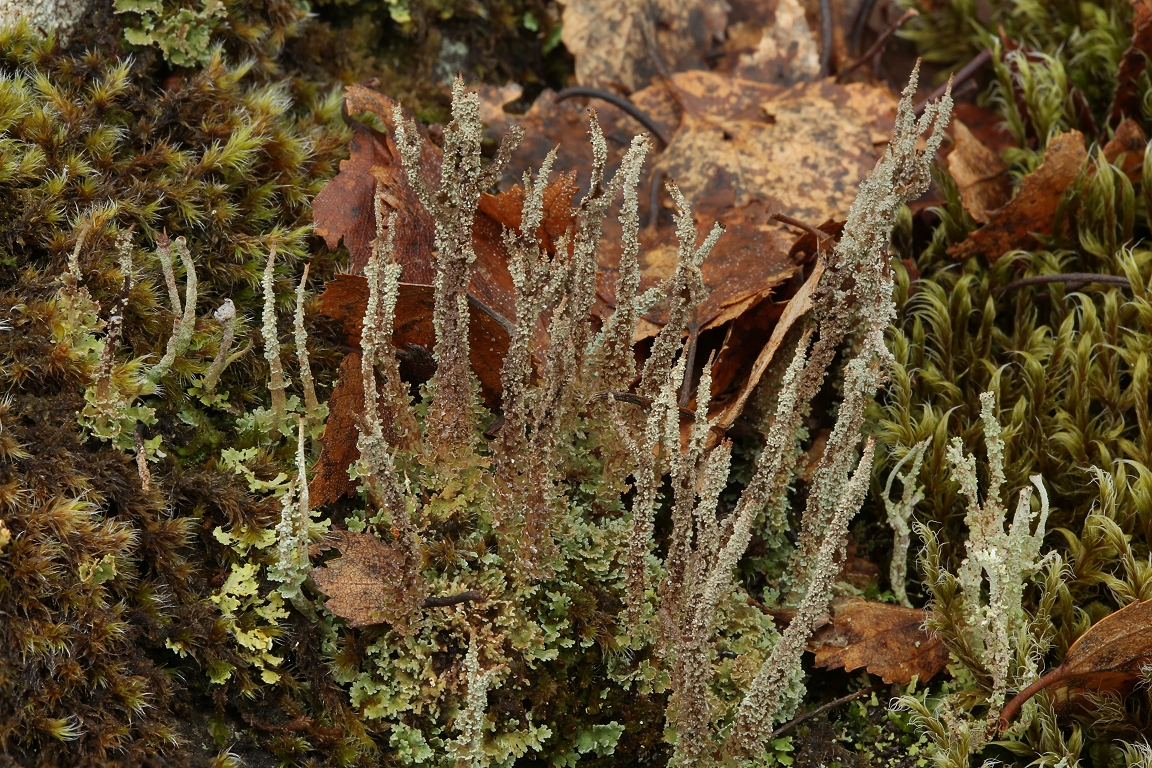
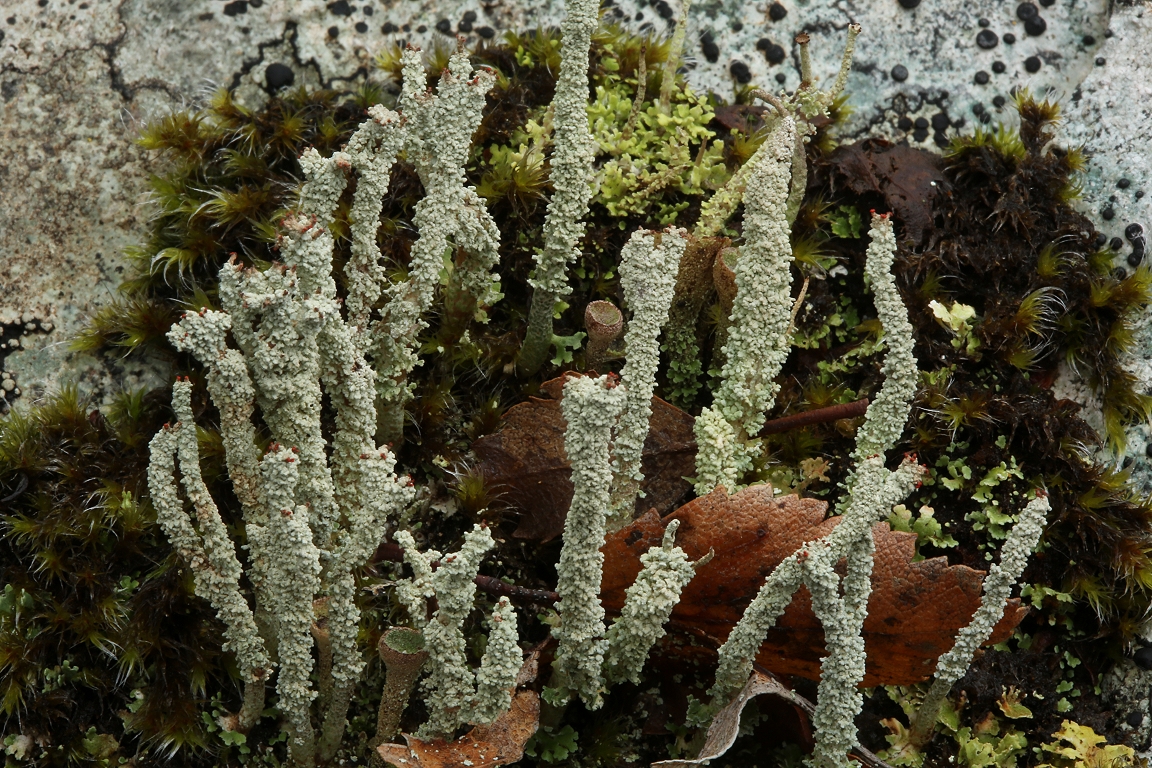
Close to the patch of acute-leaved bog-moss (Sphagnum capillifolium), there was a rock with some interesting lichens growing on it, so I spent some time photographing them too. There were patches of two different species of Cladonia lichen near each other on the same rock, but again I’ll have to get an expert opinion to confirm which species they are. We’ve had a couple of lichen surveys done at Dundreggan as well, and as a result we have records of 30 different species of Cladonia on the estate – it is one of the largest genera of lichens. For these lichens I took a number of photographs, varying the plane of focus slightly, and then ‘stacked’ them together, using the Helicon Focus software that I’ve written about in a previous blog, to get the resulting images here.

Continuing downstream, my eye was caught by the bright green moss-covered trunks of a couple of alder trees (Alnus glutinosa) growing at the edge of the burn, which contrasted with the white cascades and the dark colour of the water.


At this point I was just about 50 metres from where the Red Burn flows south off Dundreggan on to neighbouring land, and I knew there was a tree with an interesting feature on it about 10 metres downstream from me. I’d noted that tree a couple of years ago, but it was before I started this blog, so it seemed like the perfect opportunity now to take some photographs of it, to include them here.
The tree in question is a downy birch (Betula pubescens), and it’s growing in such a way that it leans slightly over the burn. However, that’s not its most notable feature, as it has a distinctive, irregularly-shaped black growth on its trunk. This is the sterile conk of the chaga fungus (Inonotus obliquus) – the black mass is not the fungal fruiting body, but instead is a mass of the fungus’ mycelium, which is coloured black by melanin.


The chaga fungus is another circumboreal species, occurring in the north of North America, in northern and eastern Europe, and in Russia and the Korean peninsula. It has long been utilised for medicinal purposes, and is reputed to be effective in the treatment of some cancers. There are several birches on Dundreggan that have these distinctive sterile conks growing on them.

Near the birch with the chaga fungus there’s a stand of aspen trees (Populus tremula), and some of those are growing by the edge of the burn too. Because the bark of aspen has a different PH to that of birch, there’s a different group of lichens that occur on them, and one of the large aspens in particular was covered by lichens.


One of the most distinctive lichens that was on the aspen (and commonly occurs on aspens in our area) is grey and grows outwards in a radial pattern, with brown disc-shaped apothecia prominent on it. This is Pannaria rubiginosa, and the apothecia are the part of the lichen that release the spores from the fungal partner in the symbiotic partnership between fungus and alga that forms the lichen.


By this stage it was time for me to head for home, so as I mentioned above, I never got an opportunity to walk upstream on the Red Burn – that will have to wait for another day and a different blog. I’ll finish this one now though with some video footage that I shot along the way, which provides a different experience of the flowing water from the still images.
[jwplayer config=”alan29may” file=”http://www.alansblog.org.uk/alan-15-feb.mp4″ html5_file=”http://www.alansblog.org.uk/alan-15-feb.mp4″ image=”http://www.alansblog.org.uk/alan-15-feb-preview.jpg”]
Fantastic photography as always Alan!
I am doing all I can to spread the word of the good work all you folk at TFL and the dedicated volunteers do.
The blogs are great and very inspiring.
All the best,
David
Hi David,
Many thanks for the feedback about my blogs, and for all your promotion of Trees for Life – much appreciated!
With best wishes,
Alan
Hi Alan,
Sometimes I come to your page to see this nice photos. I really really like them they give me a little bit back what I experienced in Scotland. In 2010 and 2011 I joined a workweek at Dundreggan Lodge. It was a very nice time and quite the most peaceful place I’ve ever been so far. Our Group also was honored by your visit. You telled us a lot of things about TFL how you fund it and why.. that was inspiring to me! Thank you for that..
Hi Christopher,
Thanks for your comment, and also the feedback about your work weeks with us. This year’s programme of weeks is starting soon, and there’s still space on many of them, so if you feel like coming back, please sign up for another one!
With best wishes, Alan
G’day Alan
Love your blogs. They give me a unique, beautiful experience of Nature through your aware eyes/Spirit. Is this on a “natural”part of the estate? Also, is the water drinkable or are there pollution sources( chemicals, animals etc) upstream? Lots of love from me & Karen.
Hi Gary,
Thanks for your comment on my blogs, and it’s great to hear from you again after so many years! yes, the Red Burn flows through a part of ancient woodland on Dundreggan, so it is as natural as it gets. I’ve never actually drunk the water from the burn, but there are no pollution sources, although there are some sheep upstream that belong to the man who has crofters’ grazing rights to part of the estate.
With best wishes, Alan