
On Sunday, the day after I’d been up the Allt a Choire Bhuidhe burn on Dundreggan, I went across to the other (south) side of Glen Moriston, where the Allt Phocaichan burn flows down through a native pinewood remnant on Forestry Commission Scotland’s Inverwick site. I don’t know that area as well as Dundreggan, and there’s much of the length of the Allt Phocaichan that I haven’t explored yet, so this was a good chance to see it in its autumn finery.

I started off near the bottom of the burn, where it flows into the River Moriston, in an area that I’d visited briefly during the summer. The woodland there is very different to that on Dundreggan, although the two sites are just across the glen from each other and only about a kilometre apart. Whereas Dundreggan is open birch–juniper woodland with a dense cover of bracken on the forest floor, Inverwick is dominated by Scots pine, with an understorey of blaeberry, heather and glittering wood-moss (Hylocomium splendens), and is much wetter. Even though it wasn’t raining on Sunday, the vegetation everywhere was still wet from the previous day’s rain.

This difference is due in part, I believe, to the different aspects of the two sites. South-facing Dundreggan gets more sun and therefore the ground and vegetation dries out more, whereas north-facing Inverwick stays wetter, and this favours the pines. At Dundreggan the climax woodland, at least at the lower elevations, is likely to have been characterised by hardwood species such as oak, ash, wych elm and hazel – there are still a few of each of those at Dundreggan today.

Much of the pine woodland on the lower reaches of the Allt Phocaichan is relatively young, and it is quite dense in places. There are some birches in the woodland, with more on the edges, where the greater light level is encouraging profilic natural regeneration of them. At the first few places where I stopped to take some photographs, I found that my camera bag quickly had numerous aphids crawling over it.

There were both winged and wingless individuals, and I suspect these were the common birch aphid (Symydobius oblongus) – I’ve sent some specimens off to an expert to get them identified. Aphids have complex life cycles and are not easy to identify. I suspect that there’s much to be learned about them still in the Caledonian Forest, and I’m hoping we can get some surveys and research organised for them in the years ahead.

As I photographed the aphids, I noticed a birch leaf nearby that was covered in small white spots – the first signs of fungi breaking it down. This was a good find, as I was writing a detailed article about decomposition and decay for our members’ magazine, Caledonia Wild!, and an image of this would be very useful to include in it. There were also some partially-decomposed fungi nearby, and I photographed those too, also for potential use in the article.


Because there was so much of interest in the woodland, I was making slow progress in walking up the burn, but I came to a part where there were some larger cascades and interesting rock formations, and I spent quite a while there.
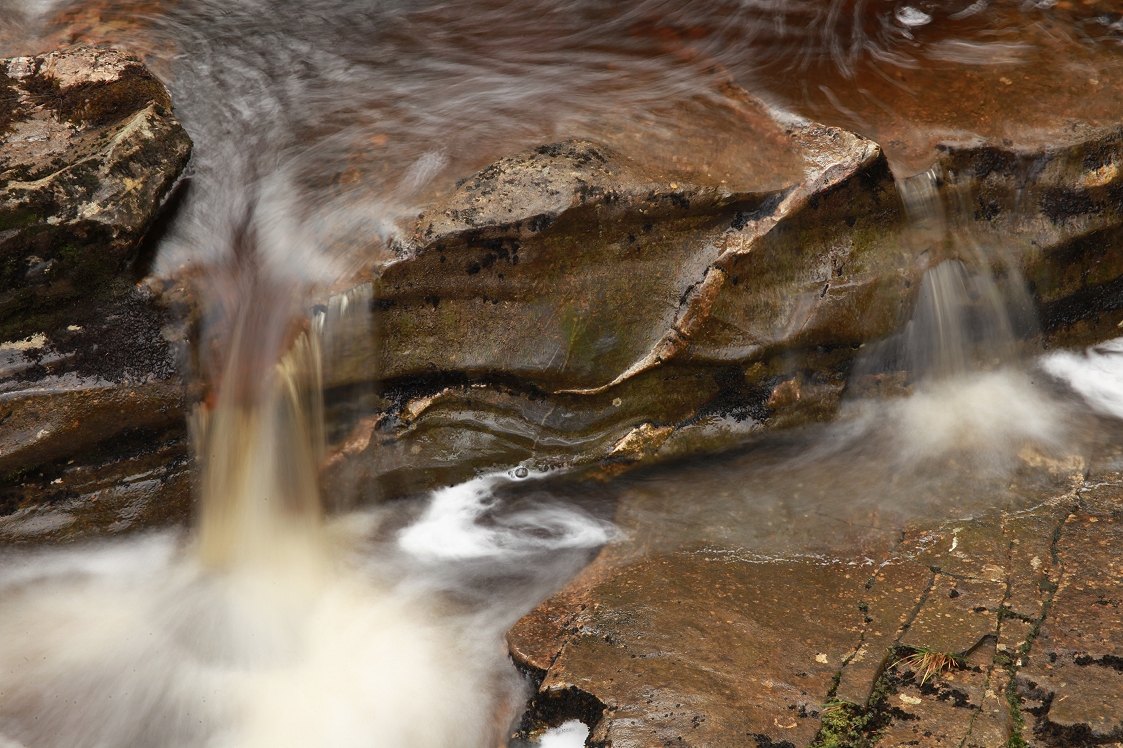
The power of the falling water had eroded the bedrock into some beautiful shapes – natural works of art that speak to my heart and bring aesthetic delight to my eye. The combination of fluid water pouring over hard rock always brings to mind the famous quotation from the ancient Chinese philosopher, Lao Tzu: “What is of all things most yielding can overcome that which is most hard.”
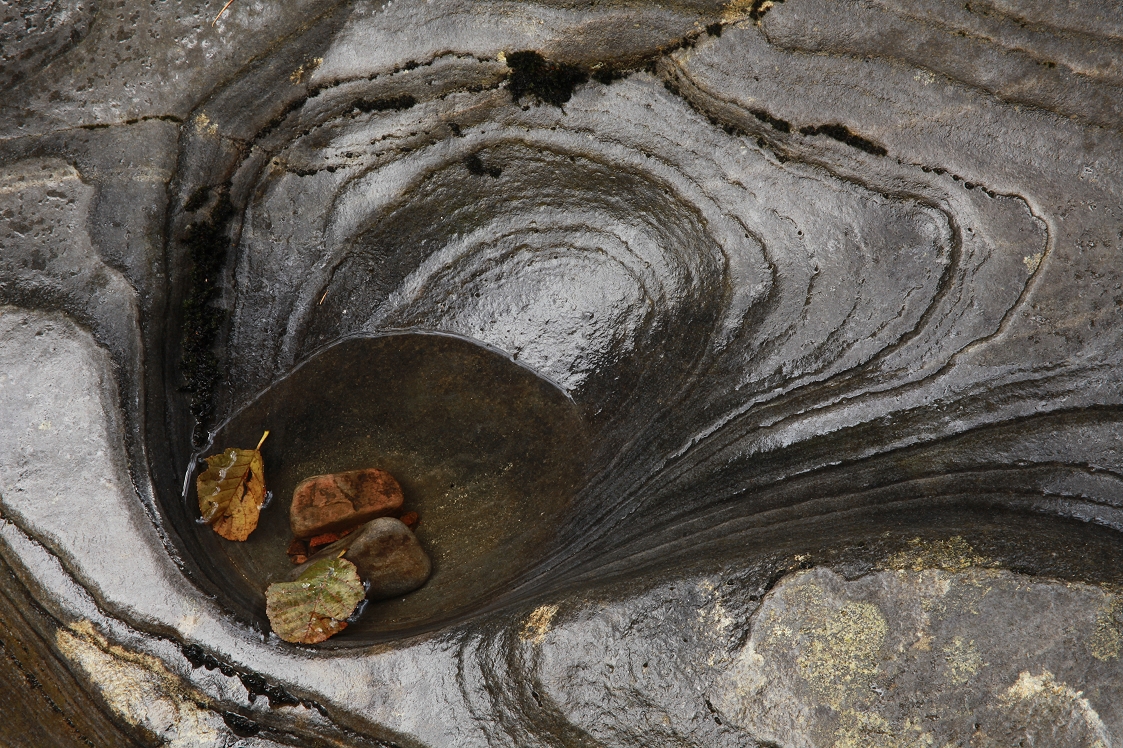
Moving a bit further up the burn, I came across a particularly beautiful example of the power and artistry of flowing water in sculpting beautiful shapes in the rocks. Some stones must have been repeatedly swirled around in a slight depression in the rocks, and over centuries, or millennia perhaps, had deepened that into a larger hollow that exposed the layers of the bedrock itself. The presence of a couple of small rocks in the water indicated that the process is ongoing…

Continuing upstream, there were more cascades as the burn passed through areas of rugged rock formations. The blaeberry and glittering wood-moss understorey is particularly well-developed there, and gives the woodland a similar appearance to that on the south side of Glen Affric. The burn itself was quite full, due to all the rain in the previous days. Like all watercourses, it thrives on the rain, gaining in power and volume the wetter it gets.

A little further up, and I came upon a particularly beautiful alder tree (Alnus glutinosa), growing right beside the burn, as that species likes to do. This one had several trunks, all of them festooned with mosses, ferns and lichens, and one of which was stretching horizontally out over the burn itself, like an arboreal arm, reaching for the other bank.

The sheltered location where the tree was growing, near the bottom of a steep, north-facing slope, meant that little sun reached it. That, together with all the spray and humidity in the air from the cascading water, provides ideal growing conditions for all these epiphytes to thrive on the tree. The more I explore the Caledonian Forest, the more I find there are these little areas with micro-climates and distinguishing features all of their own.

By this time though, it was late afternoon, and I needed to head for home. I hadn’t reached my destination for the day – a stand of aspen trees (Populus tremula) that I’d seen a few years previously, higher up the burn, when I’d approached it from a different direction. Reluctantly, I turned around and headed downstream again, in the knowledge that I probably hadn’t reached the most interesting part of the burn, where there are older Scots pines and the aspens I’d seen before. However, that just provides a good reason to return again soon to continue my explorations! In the meantime, I left that day with a strong impression of the difference between north-facing and south-facing native woodlands in the Highlands, as exemplified by these two burns I’d explored over the week-end.
Leave a Reply