

At the beginning of March I made a trip out to Glen Cannich with Ruth May, a former Trees for Life staff member who had returned to her native Germany about 15 months previously, but was back now for a visit to Scotland again. In the last year I’ve made a couple of visits to the gorge on the River Cannich, where I discovered a large, previously unrecorded stand of aspen trees just over a year ago. I’d been there again last October to photograph the aspens in their autumn colours, but on both those occasions I’d been on the east side of the gorge. This trip therefore I was interested in exploring the west side of the gorge, where I’d seen there were some more aspen trees when I was looking across the gorge in October.

Before walking down into the gorge though, we went further up into Glen Cannich as I was hoping to get some photographs of red deer (Cervus elaphus). The Glen Cannich estate feed deer near the road, so it’s often easy to see them at very close range. However, on this particular day, rather surprisingly, there were no deer to be seen at all. There were several pairs of ducks (Anas platyrhynchos) on a couple of the small lochs in the glen though, so we sat and watched them for a few minutes.

It had been very cold the previous few days, and although it had warmed up now, there were still large patches of ice on much of the water surface. As we watched, the female of one of the pairs clambered up on to the ice, in that somewhat ungainly way that ducks do, and began tentatively walking over the frozen surface. She was obviously unsure of the the ability of the ice to take her weight, so she adopted a particular pose with her wings partly raised and her bill lowered towards the ice as she checked it out – it was an unusual and interesting behaviour to observe.

Leaving the ducks to their exploration of the icy loch surface, we headed back east towards the gorge and began walking in an area of old birchwood there. I wanted to look at some bracket fungi (Phellinus lundellii) that I had seen fruiting on a standing dead birch tree, or snag, when I’d been there last year. The fungi had been on a tree near the road, so they were easy to find again, and, being tough, woody and persistent, they were virtually unchanged from the previous year.

Of particular interest last year had been a white fungus that was growing on the brackets, and Liz Holden, the mycologist who helps me with fungal identifications, had confirmed that this was a species called Cladobotryum varium. It apparently grows on a range of polypore fungi (fungi that produce brackets), but she said there were no records of it growing on Phellinus lundellii. I was very pleased to see that it was here again now, and in fact was larger and more obvious than it had been last year.

I collected some more samples to send to Liz, who has subsequently confirmed its identity again for me.

A little further downstream, beside the River Cannich, I spotted a cluster of common haircap moss (Polytrichum commune) growing in amongst some fallen birch leaves. They caught my eye because the moss stood out against the leaves, and each individual stem has a passing resemblance to a miniature pine tree. This is one of the commonest moss species in the Caledonian Forest, and the star-shaped growth pattern of the leaves, when seen from above, makes for some interesting images.
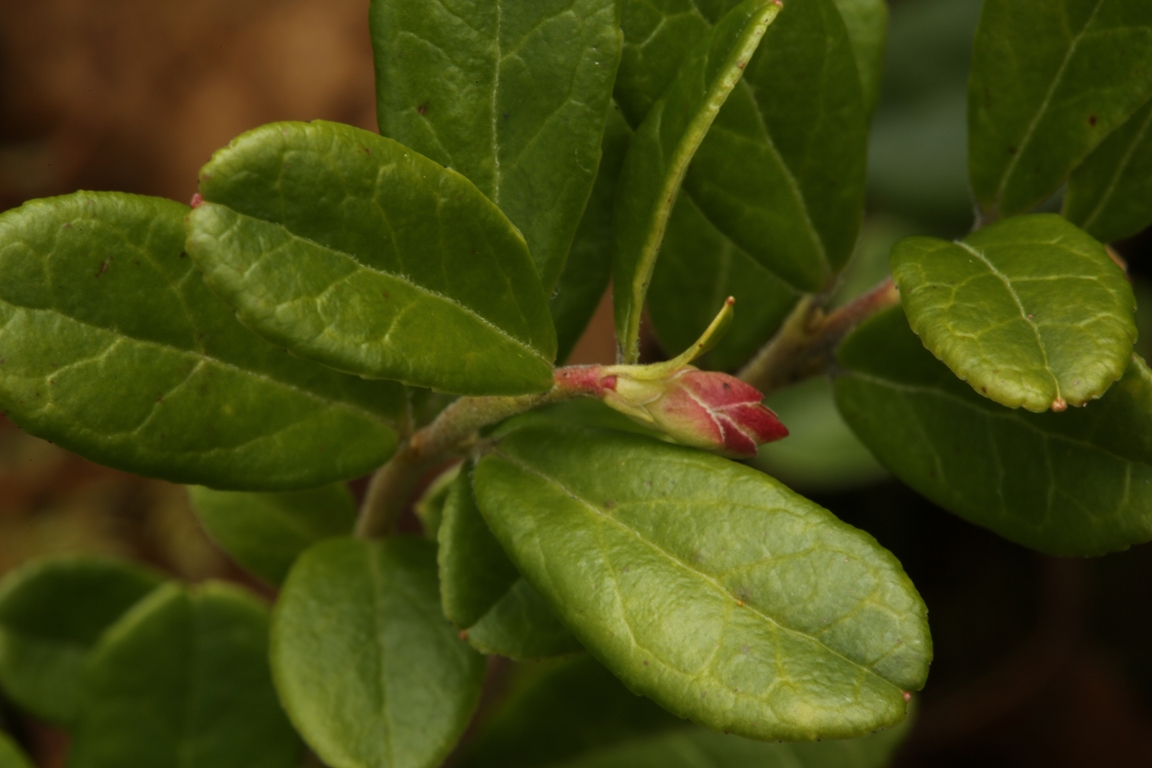
Just beside this patch of moss, there was a hummock with some cowberry (Vaccinium vitis-idaea) growing on it. This is one of the common shrub species in the forest, and I’ve been paying particular attention to it recently, as I’ll soon be writing a species profile about it. I was surprised to see new buds on this particular plant, ready to burst open, as it was only the beginning of March. Cowberry would appear to have a prolonged season of growth, therefore, as I’ve also seen it flowering as late as November before.

By this time we’d reached a small section of rocky gorge on the river, so we stopped to take some photographs and also have our lunch there. The river tumbles through a narrow section of rocks with one main fall where it drops over two metres, and several smaller cascades. It’s a beautiful spot, with a number of Scots pines (Pinus sylvestris) growing right at the edge of the gorge on both sides, where they’ve been able to survive, out of reach of grazing by deer.


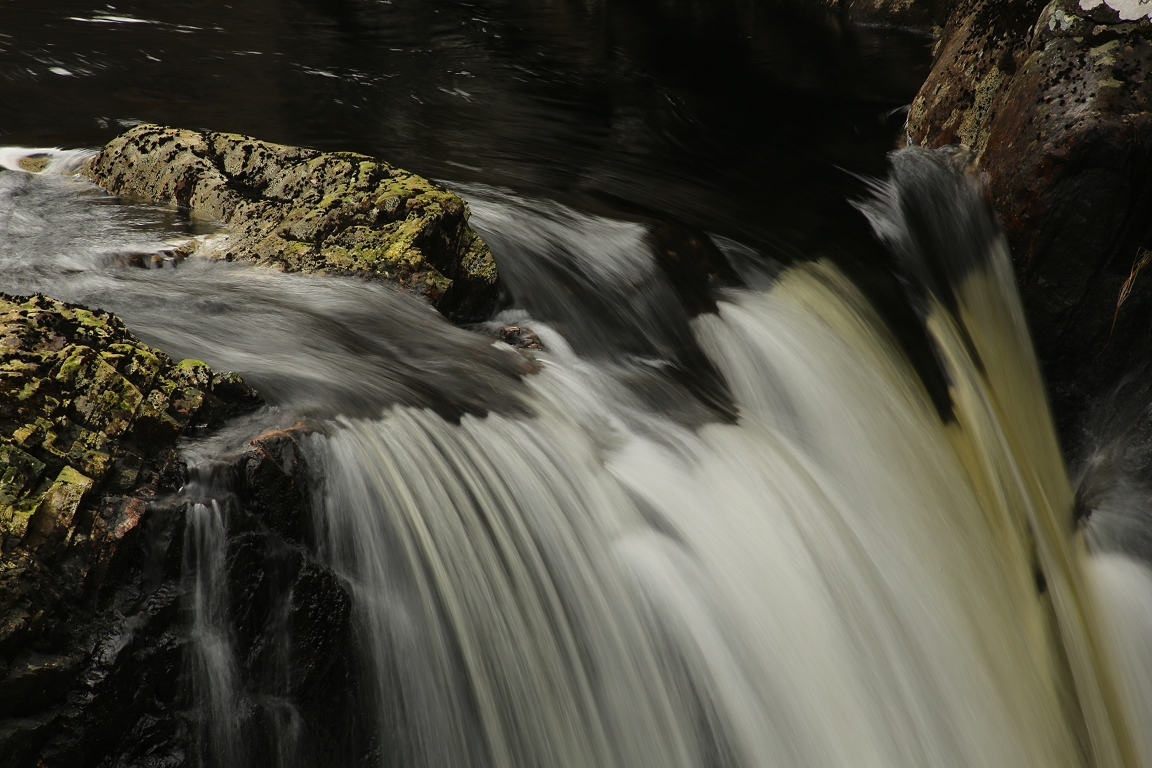
Below the main fall, the river is confined to a narrow section of the gorge little more than a metre in width. The water boils and surges through this part, tumbling over some smaller cascades as it continues its gravity-powered journey towards the still-distant sea.

The river flows into the larger River Glass beside the village of Cannich, and then wends its way northeast, through Strath Glass to Balblair, where it discharges into the sea in the Beauly Firth. That is a long narrow finger of the North Sea that is really more of a sea loch than a firth, and it in turn becomes the Moray Firth, at the narrows where the Kessock Bridge stands.

As I watched the tumbling, cascading water, I thought of its journey to the sea and appreciated how much beauty the river brings along its length, from whitewater sections like this, to the tranquil, slow-moving areas where there is little elevation change.


Walking downstream from the gorge, we followed a flatter section of the river for a while, and in one area there was a group of large rocks near the river. These were covered in moss, as were the trees growing at their base, and it formed a small pocket of temperate rainforest, kept humid by the moisture coming off the river.
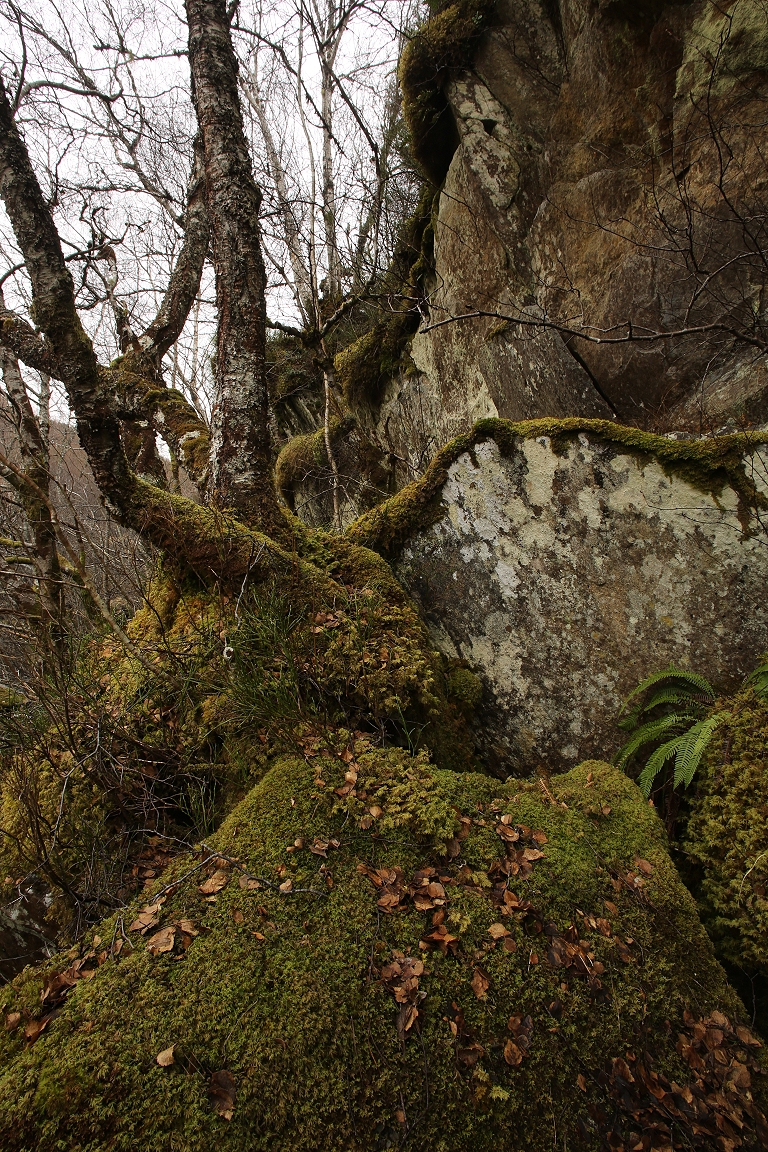


I love these green grottoes, where ferns and mosses abound, even though there are only tiny pockets of them in the glens where we work. Near the west coast of Scotland, there are larger fragments of temperate rainforest, and I’d like to spend more time in them.
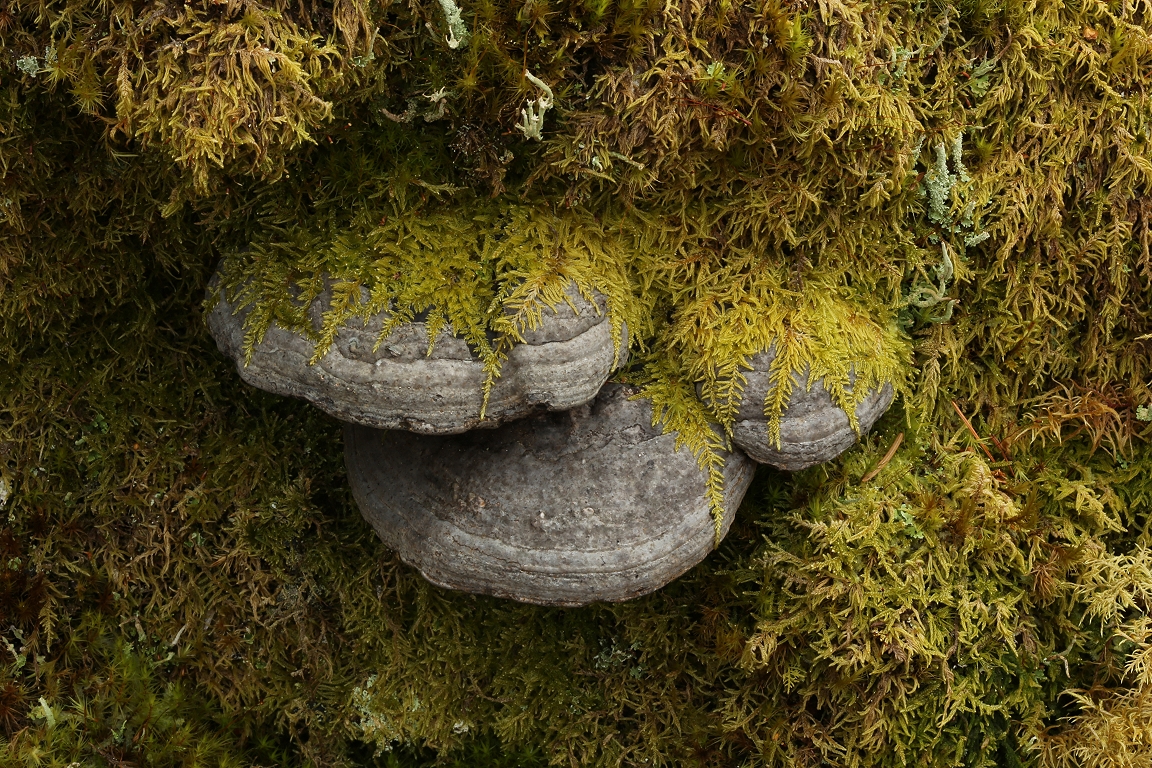
A short distance away, we came across a moss-covered fallen birch tree (Betula sp.), and there were quite a few brackets of the tinder fungus (Fomes fomentarius) growing on it. One cluster of three fruiting bodies growing together was particularly photogenic, as the brackets were partially covered in moss. I could imagine that in another few months, after the moss has had another growing season, the brackets might be completely inconspicuous as they will be fully overgrown by the moss.

Another birch log a little further downstream also had some tinder fungi growing on it, and one of those consisted of three brackets, which had grown in two different planes, at right angles to each other. This indicated that the larger one had grown while the dead birch was still standing, with its main surface in a horizontal plane. When the tree fell over, this bracket ended up in a vertical plane, and the smaller ones beside it grew with their main surfaces horizontal, so that they were rotated at 90 degrees relative to the larger one.

By this time we had reached my main destination for the day – the larger gorge further downstream, directly across from the very large aspen stand I had discovered last year.


During my previous visit to the gorge, back in October, I’d seen there were a few aspen trees here on the western side of the gorge, so it was good to see them close up now.


One of the aspens had an unusual, large burl on its upper branches – it’s rare to see burls like this on aspen trees. At Dundreggan we have a stand of aspens where there are a lot of burls on the trees, but we’ve not yet been able to find out what has caused there to be so many there.
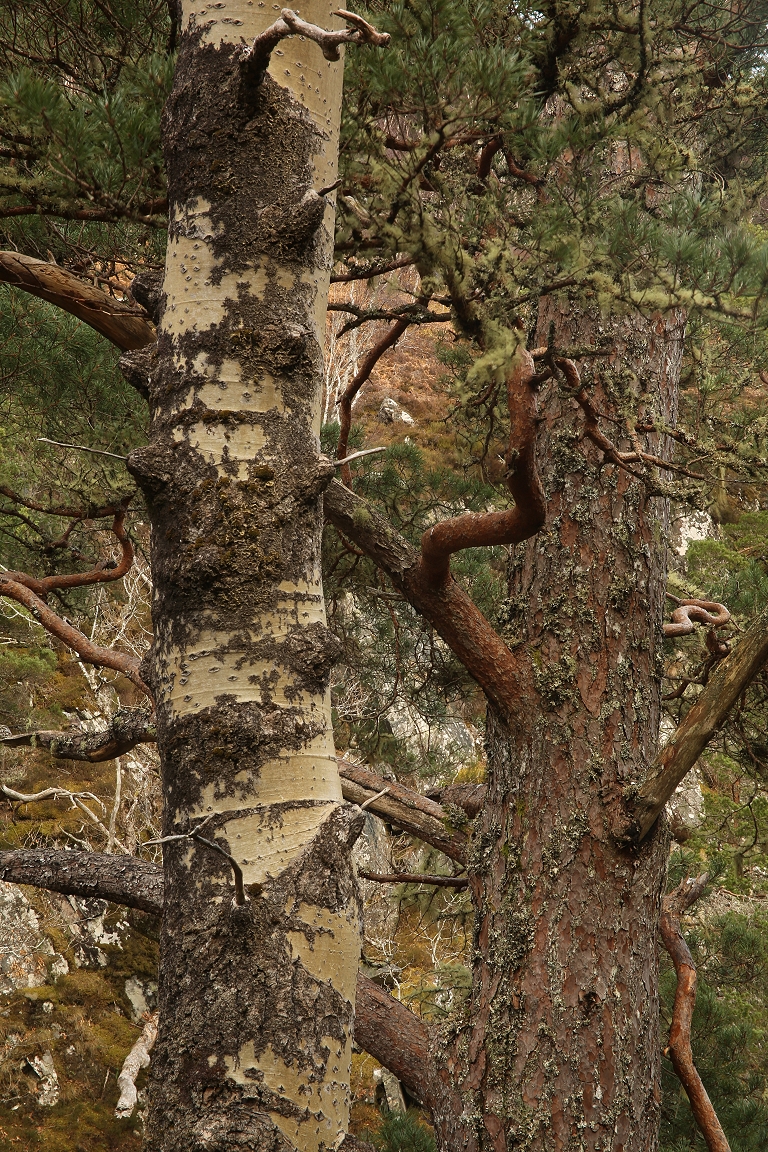
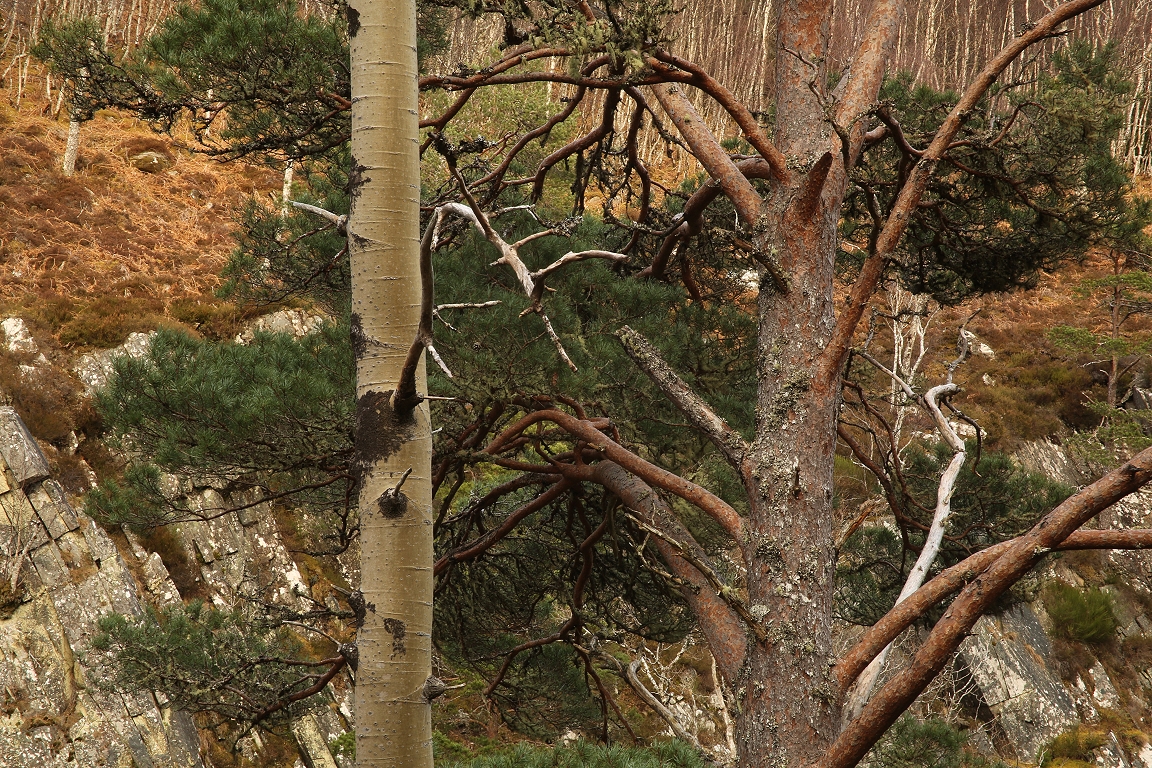


I particularly liked the combination of aspen trees and Scots pine growing together here, as the contrast between the two tree species seemed to help both of them stand out, with their distinctive features. On the other, easterm side of the gorge there’s a very steep rock slope, and that, combined with the aspens and pines, gave the area a very similar feel to places I’ve been in the Rocky Mountains in western Canada.

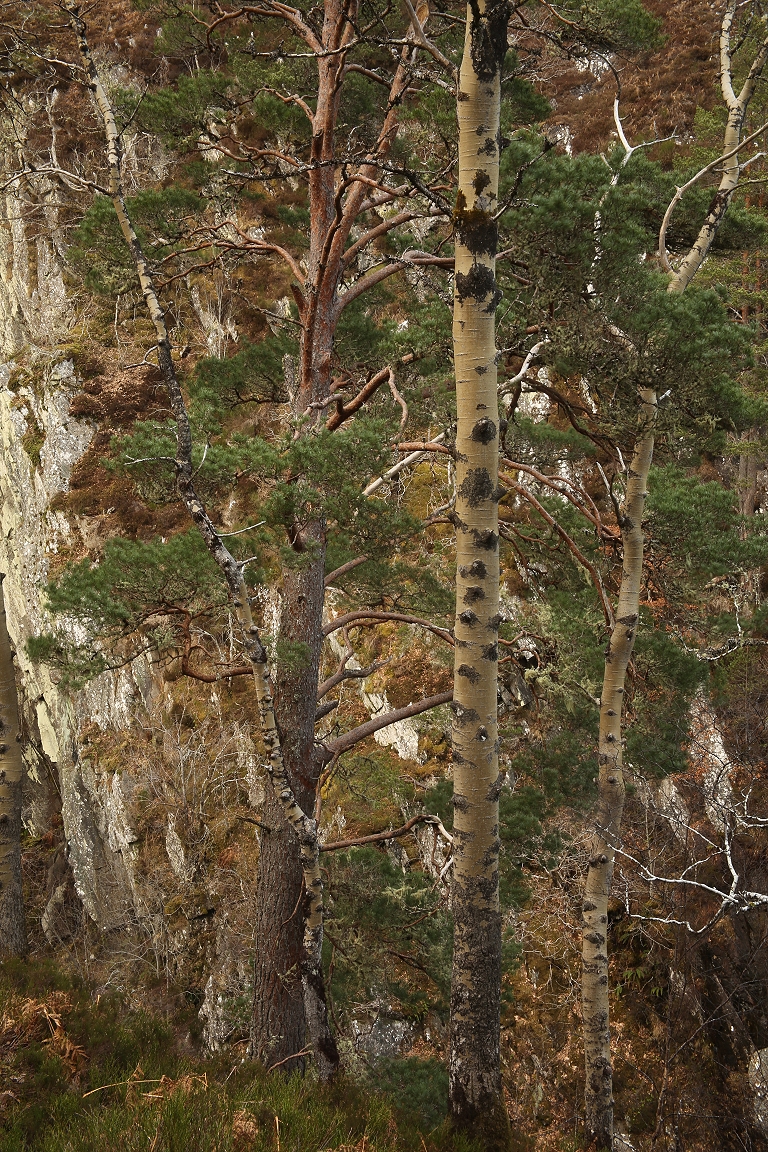

We spent a while appreciating the special qualities of this place, with the pines and aspen fringing the very steep drop off into the gorge, and the precipitous rocky slope on the other side of the river.

Soon enough, though, it was time to head back to the car, and we walked fairly quickly back upstream in the fading light. We only stopped once, where I spotted an unusual, multi-stemmed rowan tree (Sorbus aucuparia) growing near the river.


I found the parallel, lichen-covered trunks of the rowan tree particularly photogenic, so I spent a few minutes taking a range of photographs of them. The prominent horizontal bands of lichen on some of the trunks seemed to make a natural counterpoint to the vertical lines of the trunks, and also made it very easy to distinguish the rowan trunks from those of the adjacent birches.
Once again, I’d been shooting some footage throughout the day, so here’s a short compilation to finish this blog entry with:
[jwplayer config=”alan29may” file=”http://www.alansblog.org.uk/alan-11-mar13-2.mp4″ html5_file=”http://www.alansblog.org.uk/alan-11-mar13-2.mp4″ image=”http://www.alansblog.org.uk/11mar-preview2.jpg”]
I too like the combination of aspen +scots pines growing together. They are so different from each other that both types of tree can be seen clearly +in their natural environment The blogs are always very interesting. (I have signed up to do the work week on Skye at the end of March so am hoping for some good weather?? !! but will enjoy the week regardless I’m sure.)
best wishes Frances
Hi Frances,
Thanks for the positive comments about my blogs – I’m glad you like them. Have a great week on Skye – I’m hoping to get over there myself at some point this year, as I have some friends who’ve bought a croft on the island, and they’ve asked me to come and look at the native woodland on their land.
With best wishes, Alan
Thanks Alan. Wonderful images once again. I really feel that I’d now be able to recognise an Aspen tree without the iconic leaves.
The still photos are great but the video clips you include are very special and instantly transport me to the forest. Today’s was no exception. It was breathtaking, gentle and timeless and made me feel very secure.
Thank you.
Jim Kieran
Hi Jim,
Thanks for the feedback. I’m especially glad you’re enjoying the videos. I bought a new still camera just before with Christmas with much improved video capabilities, and I’m really enjoying using it to share the magic and qualities of the landscapes I visit.
With best wishes,
Alan
Beautiful words and images. Thanks for sharing these Alan.
Thanks Nicki. There’s so much beauty out there in the forest, every time I go out I’m deeply touched by it all.
With best wishes, Alan
Wonderful story as always; your photos are beautiful, and the videos are a nice touch. Thanks for sharing!
Hi Julie,
Many thanks for the feedback.
With best wishes, Alan