
For my first trip out to the Caledonian Forest in 2017 I decided to visit Glen Cannich as it had been some time since I was last there. It was another mild day in this unseasonably warm winter when I went out in early January, and I was hoping to be able to photograph some red deer (Cervus elaphus) while I was there. One of the estates in the glen feeds deer near the road in the winter, so it’s often possible to see the animals at close proximity.

When I arrived in the glen it was a very atmospheric morning. Because of the mild weather there was no snow visible at all, which is very unusual for January, but there were numerous ribbons of mist drifting along the slopes of the hillsides, which made the landscape just as beautiful as if there had been a more normal blanket of wintry white covering everything. In fact, the views were much more dynamic, because of the movement of the mist, whereby the vistas changed from minute to minute.


Much of the north side of Glen Cannich is virtually tree-less, and whereas it normally appears very bleak and desolate, the mist covered the hillsides in undulating drapes and folds, in much the same way that snow would have camouflaged the degraded slopes, and brought an unexpected but very welcome beauty to the landscape.

Near the Mullardoch dam, which dominates the section of the glen it is sited in, there are a few scattered old Scots pines (Pinus sylvestris) on the north side. Some of these were intermittently visible through the mist, appearing almost like ancient trees dating back from the mists of time, when the forest must have filled this part of Glen Cannich. Sadly only a handful of them survive in this area now, standing as lonely sentinels to their lost companions, and all the other life they must have formerly supported.
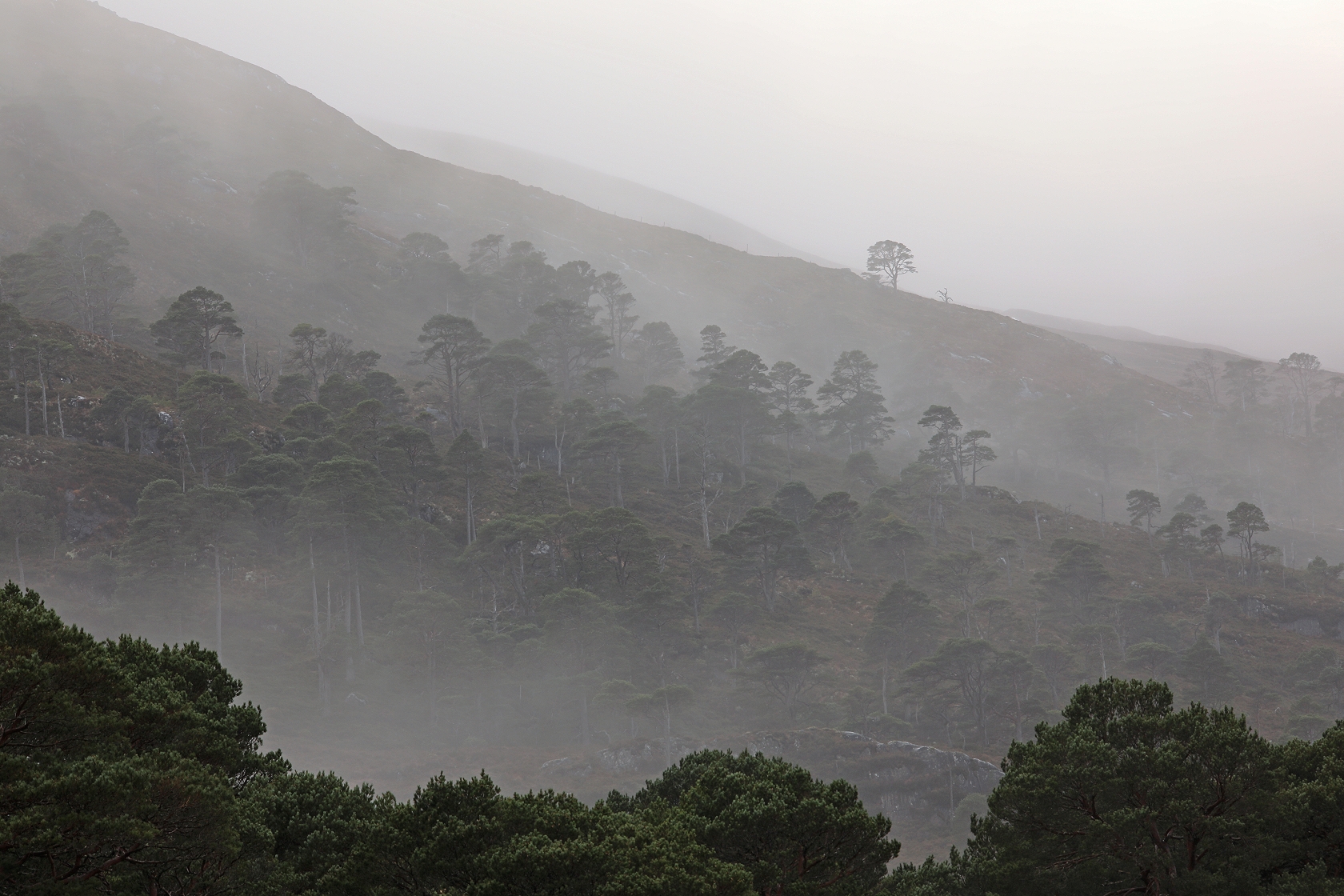
By contrast, there are extensive areas of Scots pines on the south side of the glen, on both the land managed by Forest Enterprise Scotland as the northern-most part of the Glen Affric National Nature Reserve, and the privately-owned land to the west. The pinewoods in this area were badly damaged by a fire in the 1950s, but regeneration measures from the 1980s onwards, in which Trees for Life has played a part, have led to the successful growth of young trees amongst the old pines.


Misty days like this seem to accentuate the primeval and ancient quality of the pinewoods, and these are some of my favourite times to be out in the Caledonian Forest. Because of the reduced visibility, it’s almost possible to imagine that the forest still covers huge areas of the Highlands, and contains lots of mysteries and unexplored regions. Hopefully, as a result of the work of Trees for Life and others today, it will become possible to have an actual experience like that again in the decades ahead, as the forest reclaims significant parts of its former area.

While the mist was the dramatic feature in the landscape that captured my attention initially, the red deer I’d been hoping to see were also there, in an area of relatively flat and open ground beside Loch a’ Bhana, not far below the dam.

There were a group of stags in close proximity to each other, clustered near some straw that had been put out as feed for them.

It’s a sad reflection on the depleted state of the land here that the deer need to be fed artificially like this. Due to past deforestation and the geriatric condition of the surviving woodland patches in the area (a result of the overgrazing that has prevented the growth of any young trees for perhaps two centuries) there simply aren’t enough nutrients available to support the numbers of deer that some landowners seek to maintain. The low, heavily-cropped vegetation on the open hills is inadequate for forest-dwelling animals such as red deer.

One of the stags had a malformed antler, and I wondered what might have caused that. Sometimes such deformities result from an injury when the antler is at an early stage of growth. This could be caused as a result of fighting with another stag, or from a collision with a fence, if the animal is panicked and running. Other reports indicate that misshapen antlers can be a sign of disease or malnutrition as well, and this stag didn’t look in the best of condition to me.
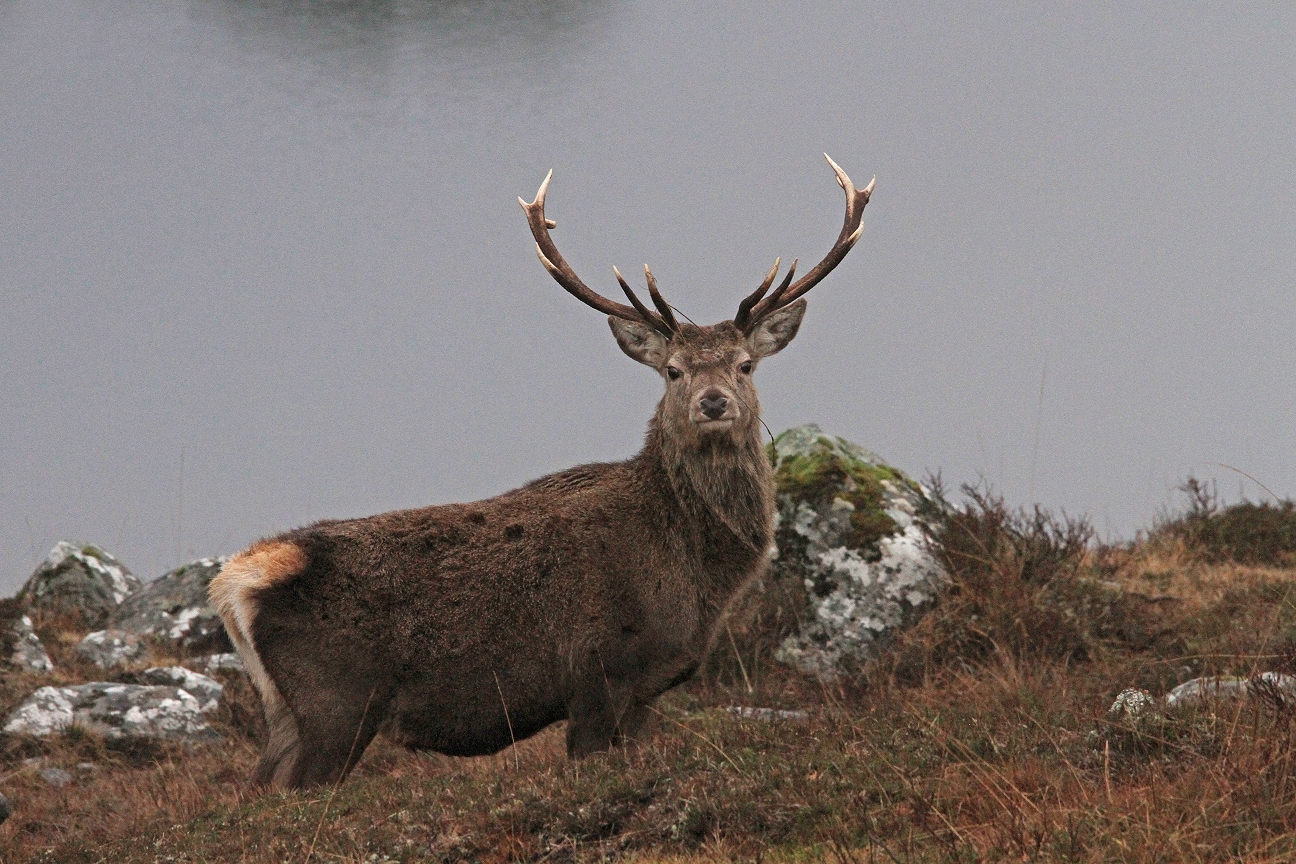
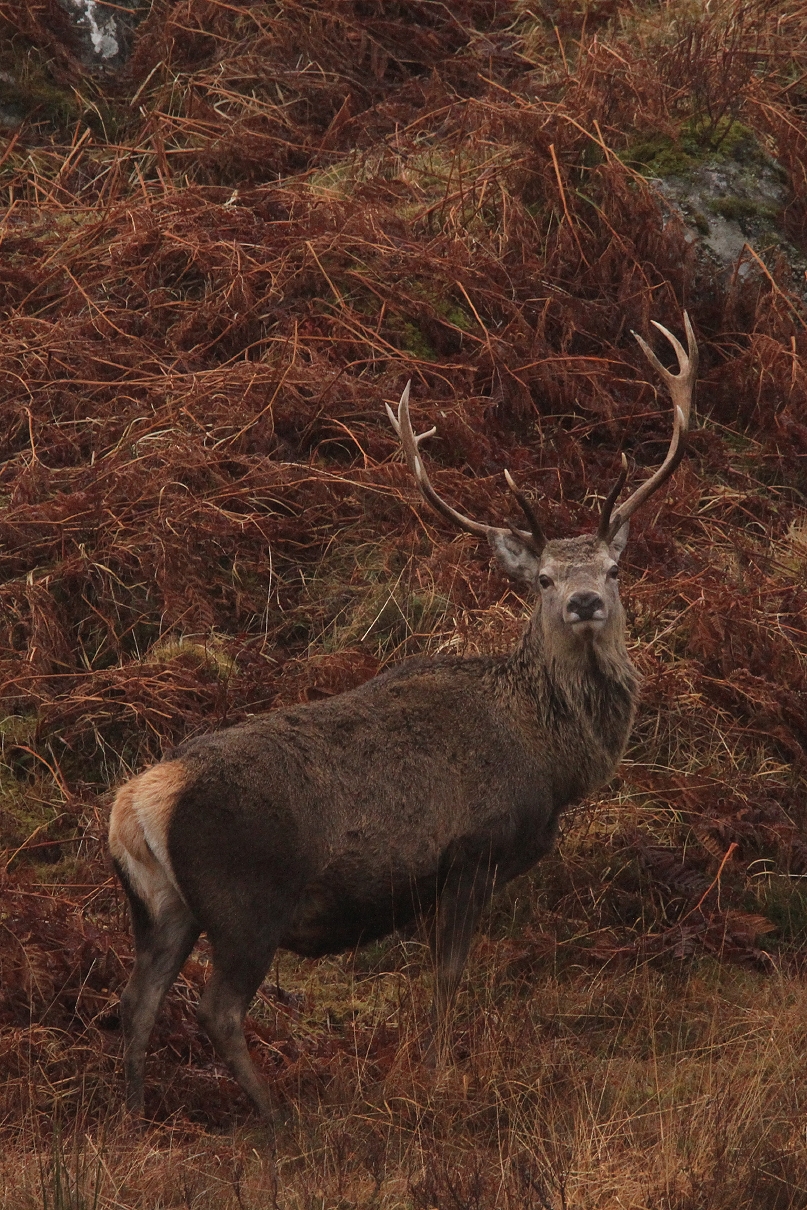
Red deer are beautiful animals, and there is a certain majesty about the stags in particular, which has led to the well-known monicker of ‘Monarch of the Glens’ being used to describe them. However, they should be even more regal in their size and health than at present.

Deer in Scotland have been forced to adapt to the loss of their forest habitat, and one of the consequences of this is a reduction in their size. Red deer in continental countries such as Germany are significantly larger than in those in Scotland because they have a proper forest habitat to live in. Recent data from southwest Norway produced a telling indication of this contrast. There, in an area of comparable latitude, rainfall, temperatures and windspeed, and similar soils, the stags were measured as 45% heavier than those in Scotland. The difference of course is that in southwest Norway (which at the beginning of the 20th century was as treeless as the Scottish Highlands are today) there are now extensive tracts of natural forest to provide a good habitat for the deer. Forest recovery occurred spontaneously in southwest Norway, after most of the population left voluntarily by the early part of the last century, to go to Wisconsin and Minnesota in the USA, where they were offered land.

After the people left, and unlike the Highlands after the Clearances of the late 18th and early 19th centuries, there was no large scale introduction of sheep, nor any increase in deer numbers by large landowners. With the land virtually empty, both of people and large herbivores, tree regeneration began from the surviving woodland remnants and spread continuously outwards from them. When I and some colleagues visited southwest Norway in 2015, we were told that the process of natural forest re-establishment was still accelerating.

This same process would occur spontaneously in Scotland, if the numbers of deer and sheep were to be significantly reduced. However, that’s unlikely in the near future in many areas. In the interim, therefore, Trees for Life and others are involved in fencing off areas of land for either natural regeneration of the trees, or for planting if there is no seed source nearby. The young forests that are growing in these exclosures will form the nucleii for an expanded natural regeneration in the decades ahead, when hopefully the herbivore numbers have been reduced to levels at which some tree seedlings will survive the grazing pressure, without the need for protection.
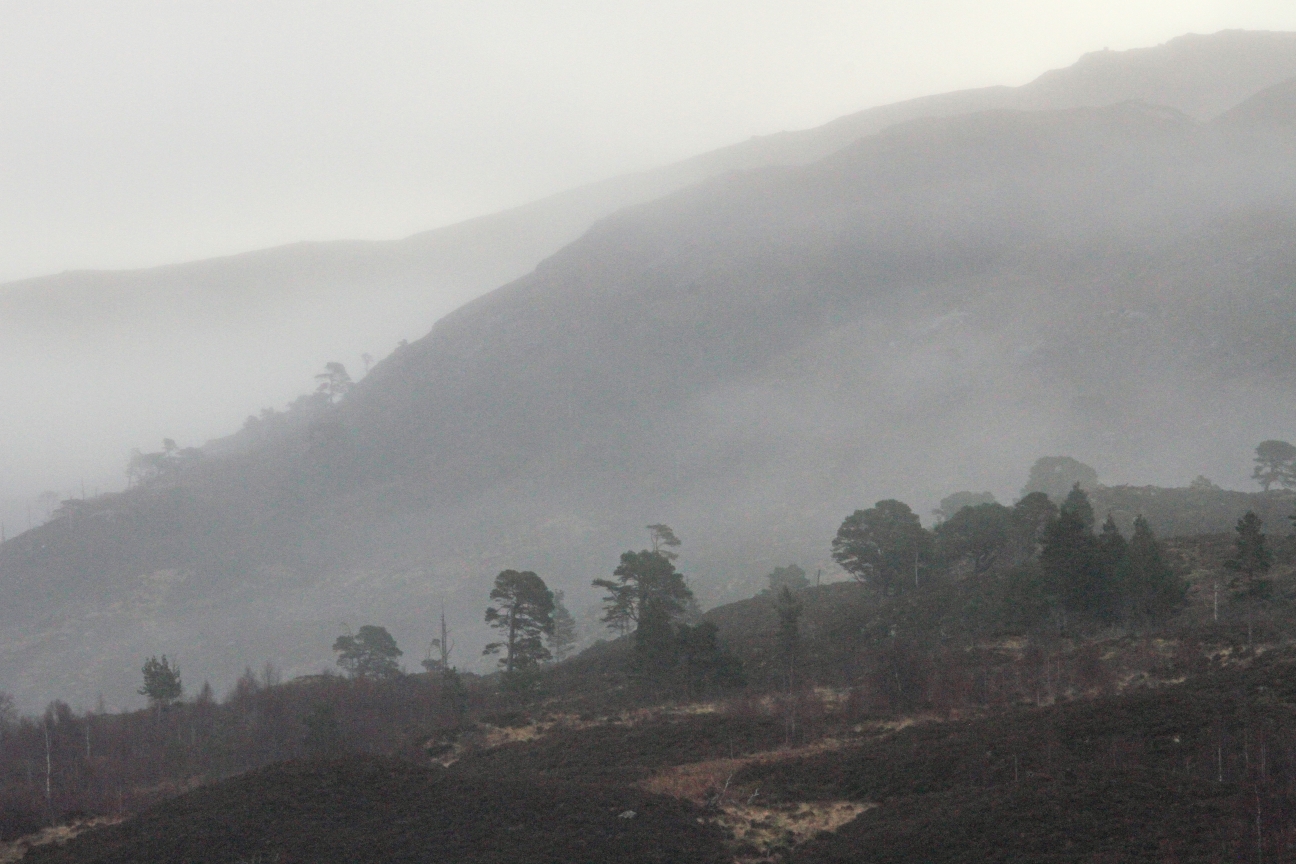
After a while, and due in part to my presence I suspect, the deer began to move away from the feeding site, on to the hillsides on the north side of the glen. By this time, the mist had also begun to lift, because the day had warmed up slightly and a slight breeze had come from the east. The views of the glen opened up significantly, and with the deer gone, my attention turned to some other features of the landscape. This provided a very different focus for my afternoon, so I’m going to make that the subject of a separate blog. To finish this one though, here’s some video footage of the misty morning:
https://www.youtube.com/watch?v=NwOGIkFB6TU;vq=hd720&rel=0&showinfo=0
and also if the government lifted the blanket ban on, no planting of native pine trees on native pine sites, which has been in place for the last six years…..
Thanks again for taking us with you!
Alan — thanks again for another enjoyable blog. Here in Canada we are also in the midst of our winter — I just spent a day in what we call the Highlands of Algonquin Park, where the snowfall, coming slowly down in large fluffy snowflakes, created much the same effect as mist — quite beautiful. Enjoyed seeing Gray Jays, Chickadees, Blue Jays and White Breasted Nuthatches. Nature never disappoints! Keep up the good work
John Lowry
Thank you, Alan. Your comments about the lack of trees makes me feel very sad but hopefully we’ll get there and bring the forest alive again. I very much enjoy your blogs and your beautiful photos. Will be in Glen Affric myself in March 🙂