
In late June I heard that my colleague Jill Hodge and local Glen Moriston resident and keen naturalist Jane Bowman had found a rare orchid, the Lapland marsh-orchid (Dactylorhiza traunsteinerioides ssp. francis-drucei) on Dundreggan, that we hadn’t previously had any records of there. As I was already scheduled to go out to Dundreggan in the next couple of days, I took the opportunity of going to see these orchids myself.
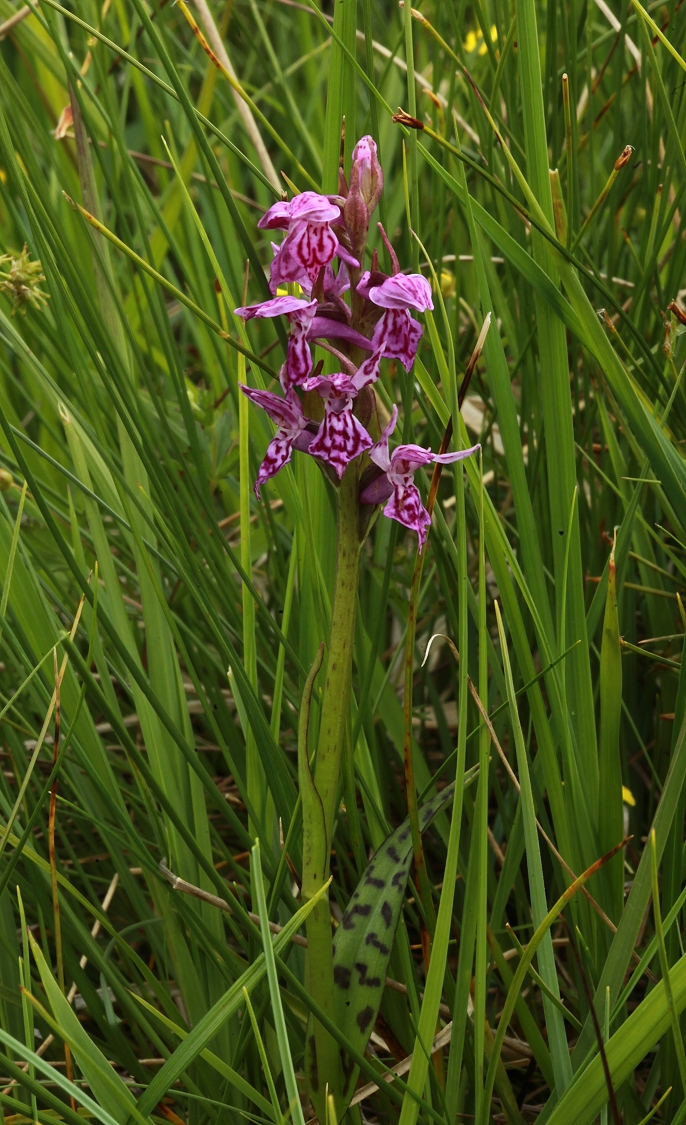
After spending some time with a visiting group of staff and students from Plymouth University, who were continuing the forest canopy research work that they started last year, I headed off uphill with Jill and a couple of the students towards the site where the orchids had been seen. That is above the existing native woodland, in the upper valley of the Allt a Choire Bhuidhe burn, between the peaks of Binnilidh Bheag and Binnilidh Mhor. There, in an area of flushed base-rich soil, a range of different orchids flourish, as well as some other special plants, such as Scottish asphodel (Tofieldia pusilla) and globe flower (Trollius europaeus). I’d last been up there looking at the orchids two years previously, and had photographed an orchid then that a colleague had identified as being the northern marsh-orchid (Dactylorhiza purpurella). I now suspected that it had actually been the Lapland marsh-orchid that I’d seen and photographed then, but that it hadn’t been identified correctly.

Arriving at the site, Jill pointed out some of the Lapland marsh-orchids she and Jane had seen a couple of days previously, when they noted at least a hundred of them, and this confirmed in my mind that they were indeed those I’d photographed in 2010. The flowers of this orchid are very intensely-coloured, being a deep magenta-purple to magenta-red, and the leaves have prominent dark brown spots on them. As with many orchids, it can be hard to make a definitive identification of this species, and Jane had needed to consult with a specialist to get this confirmed as being the Lapland marsh-orchid. In fact, there has been considerable taxonomic confusion about this species in the past, and it has been known by a variety of different scientific names. It is only relatively recently that the current name has been accepted as correct.

There were plenty of the orchids in flower, and they seemed to be at the peak of their blossoming the day we were there. After a short while Jill and the two students headed back down the hill, but I stayed for longer to enjoy the beauty of the orchids, and to take a series of photographs of them. Orchids are not easy to photograph, and I had to wait both for the even lighting that overhead cloud (rather than bright sunlight) produces, and for the wind to stop, so that the images wouldn’t be blurred.
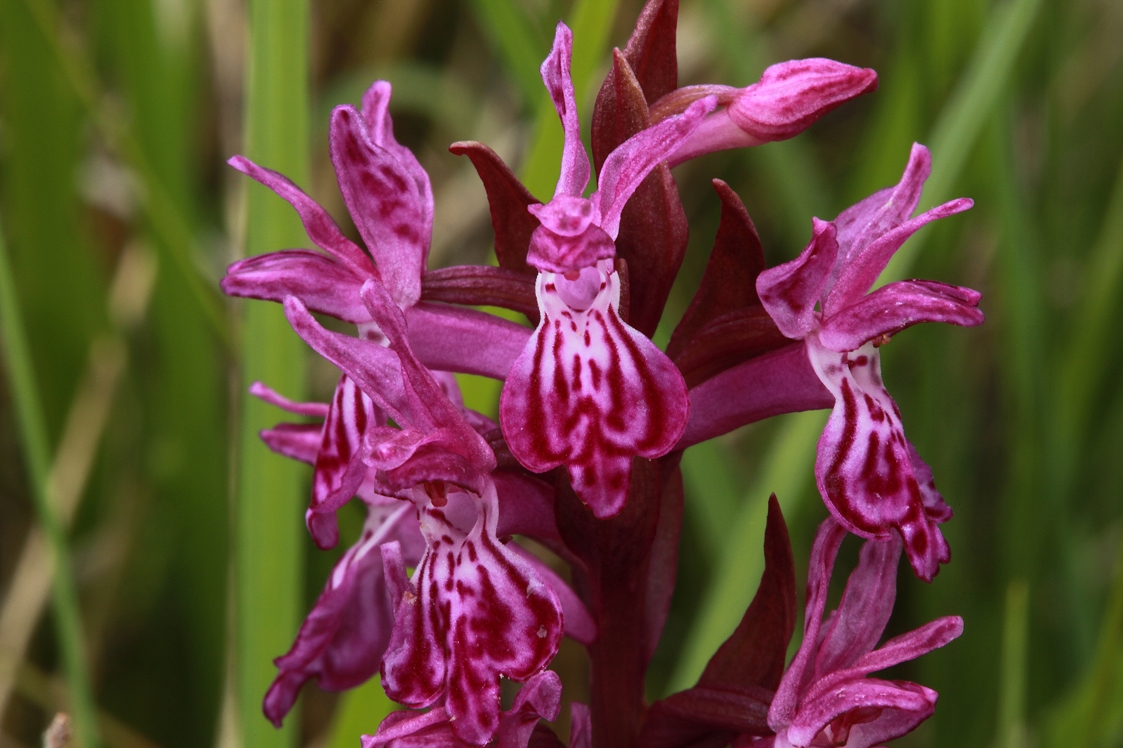
This gave me the opportunity to study the orchids close up, and it was a real joy to spend time in the company of such vividly brilliant flowers, with their complex petal structure so brightly-coloured. The colour of each individual orchid was slightly different, with some being more intensely-hued than others. I suppose this is a natural variation, in much the same way as different people have hair that varies in colour.
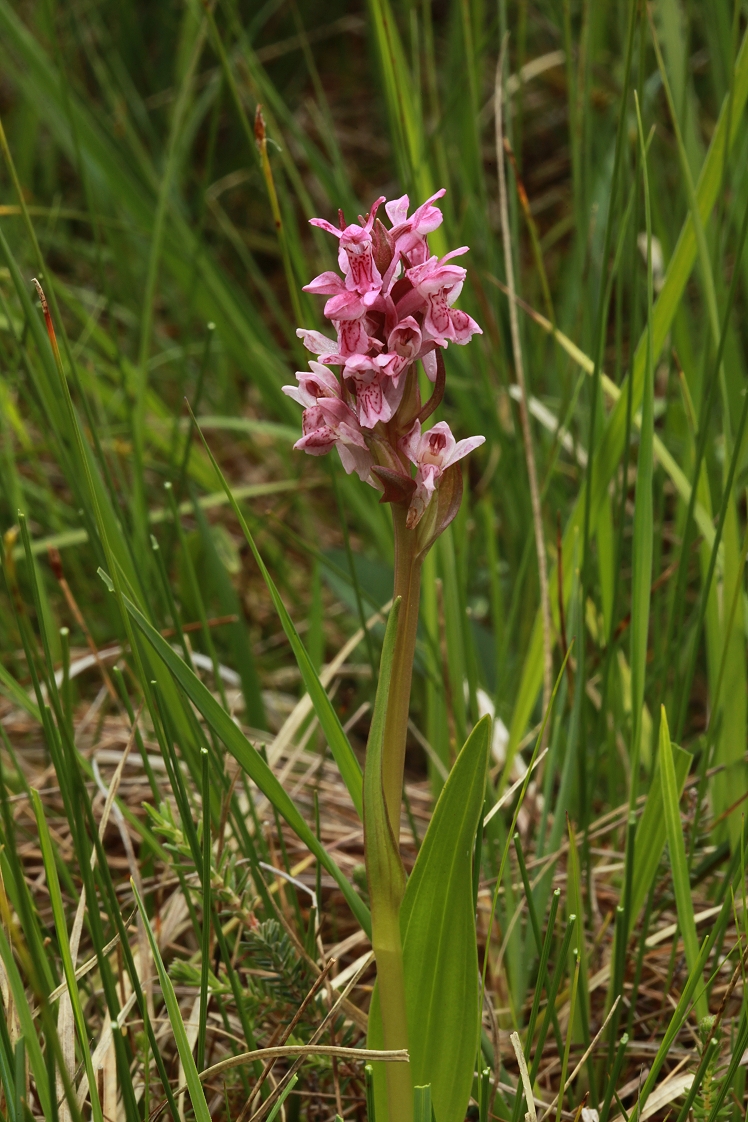
There were other orchid species growing in the same area, including the related early march-orchid (Dactylorhiza incarnata). This has a more flesh-pink colour to its flowers, and the leaves have no spots on them.

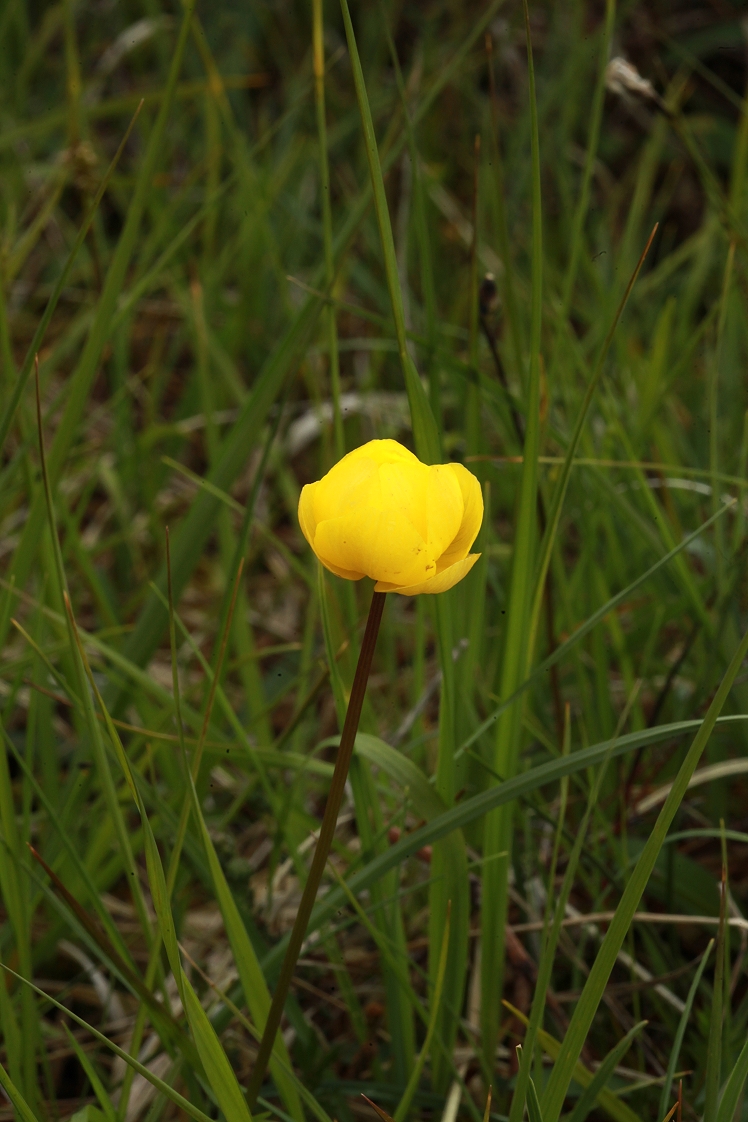
Nearby, Jill had spotted some globe flowers (Trollius europaeus), so I took a few minutes to photograph one of those too. The bright yellow-gold colour provided a dramatic contrast to the purples and pinks of the orchids.

Last year, Guy Knight, the sawfly surveyor from Liverpool Museum who’s been doing surveys for us at Dundreggan, found evidence of a rare sawfly (Pseudodineura enslini) on a globe flower not far from this area. The larvae of this sawfly make mines in the leaves of globe flower, and as the species features on the UK’s Red Data Book, it was another good record for Dundreggan. I didn’t see any evidence of mines on the leaves of this one though.
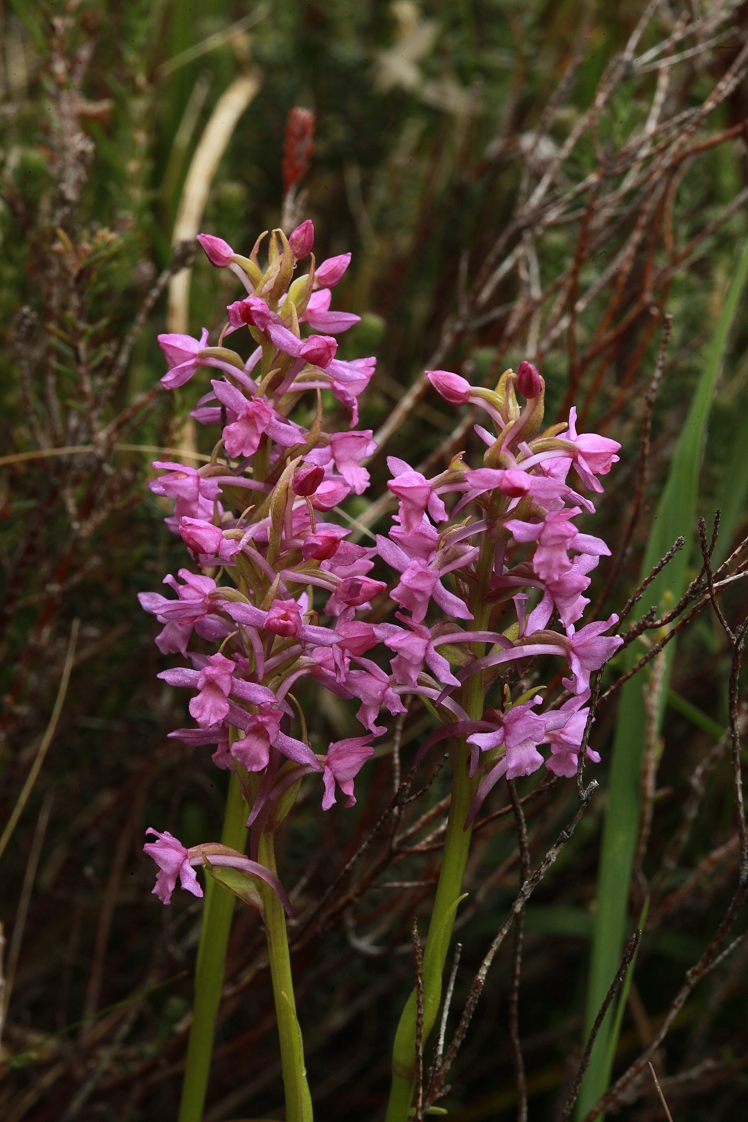
Walking downhill again, I stopped to photograph a cluster of fragrant orchids (Gymnadaenia conopsea) that were growing beside each other. This is one of the most abundant orchids at Dundreggan, and its common name is derived from its characteristic fragrant scent.


Usually the fragrant orchid occurs as isolated individual plants, and although they can grow near each other, I’d not previously seen them growing so close together that their flower spikes overlapped with each other like this. It provided a good opportunity to get some photographs of the dense concentration of flowers close together – this is one of easiest orchid species to identify in Scotland.
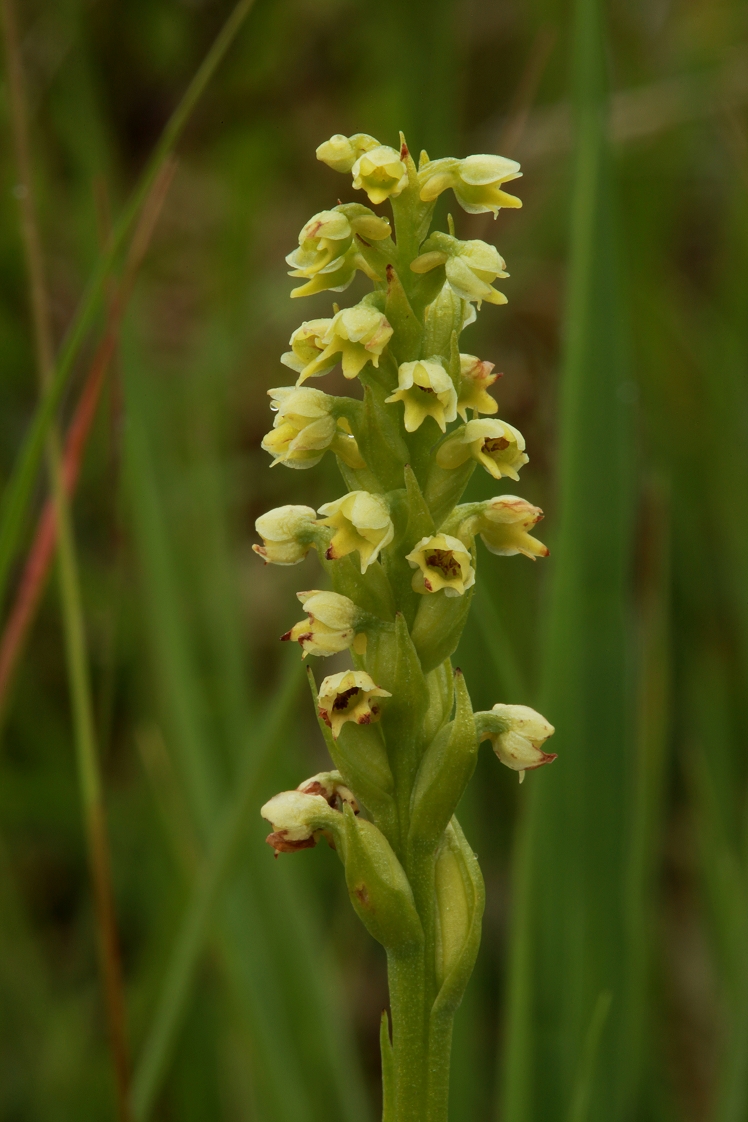
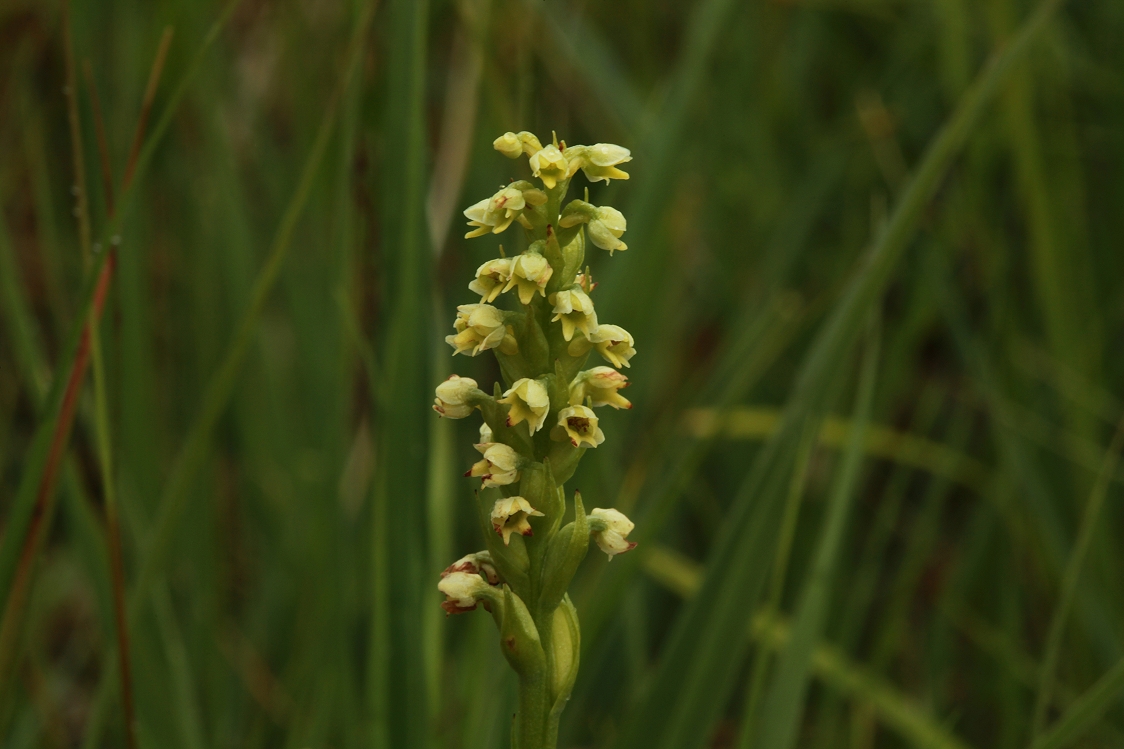
Continuing downhill for another 200 metres or so, I stopped to photograph another easily distinguished orchid that we’d seen earlier, on our way up hill. This was the small-white orchid (Pseudorchis albida), and it is less conspicuous, with its smaller size and pale colouration, than the marsh-orchids.
By this time it was late in the day and I had to return to the lodge for dinner, so I didn’t have time to photograph any of the numerous heath spotted-orchids (Dactylorhiza maculata) that were flowering in profusion that day. That’s the most abundant orchid on Dundreggan, and I’ve photographed it on plenty of other occasions, so I was content to finish the day having documented some of the less common species.
So jealous that you’ve saw a Small White Orchid Alan!! I live in Northern Ireland, and there are old records for Small White across the road. It’s gotten really rare here, but the level of land “re”clamation and drainage for agriculture makes it easy to see why. Your photos are beautiful, and your blog is a goldmine of information and inspiration! I’m headed for uni over the water, so will definately be up at Dundreggan to help out at some point. Amazing project you’re pushing! I want to set up an ecological restoration project in NI someday!
I think it’s strange that orchids don’t seem to be used as insect larvae foodplants. Some species are very common in unimproved areas, so must’ve been very frequent in the past, and yet few insects have evolved to take advantage of the foliage…
Hi James, thanks for your comment, and I’m pleased you find my blogs useful. Your point about orchids not being used as a foodplant by many insect larvae is an interesting one, which I wasn’t aware of. I just checked the UK fly mines website, and found some information about mines in orchid species here. I’m sure you’ll find a visit to Dundreggan useful, if you can fit in a visit while you’re at uni.
With best wishes,
Alan
Dear Alan,
The beauty of the Marsh orchid is breathtaking. I have printed it off and ask your permission to do a wee painting of it please?
Here in the I.o.M we have some wild orchids growing by the roadside in special places but i have never seen any as colourful as your Marsh orchid. I am a bit house bound following shoulder surgery so sketching is a way of taking my mind off things.
I have passed your blog on to Dr John K. Wardle who is the Natural history Co- ordinator for the newly formed U3A. I think he will enjoy it so if you get a response from him you will know why. I told him how you came to the IOM and inspired The Woodland Trust !
best wishes
Midge
Hi Midge, thanks for your comment, and no problem about doing a painting based on one of my photographs. I’d be interested in seeing what you create…
Interesting that you mention the Isle of Man U3A, as I’m giving a talk to the Inverness U3A later this month!
With best wishes,
Alan
I love your orchid photographs! My partner Alison Leishman and I are keen hill-walkers and one of the joys of being up a mountain is looking out for the orchids, both in the sense of seeing them and avoiding them! I’m going to start photographing them on my little digital camera, so that I can identify them later. As you noted, to get good shots of them takes some skill and patience, especially if the midgies are out!
I sold a few more paintings recently so my Trees for Life grove is growing!
Keep up the good work!
Brian
Hi Brian, thanks for your feedback about the orchids, and good luck with photographing them – it’s very satisfying when you get some quality images of challenging subjects like that. Thanks also for supporting us with your grove when you sell some paintings – that’s great.
With best wishes,
Alan