
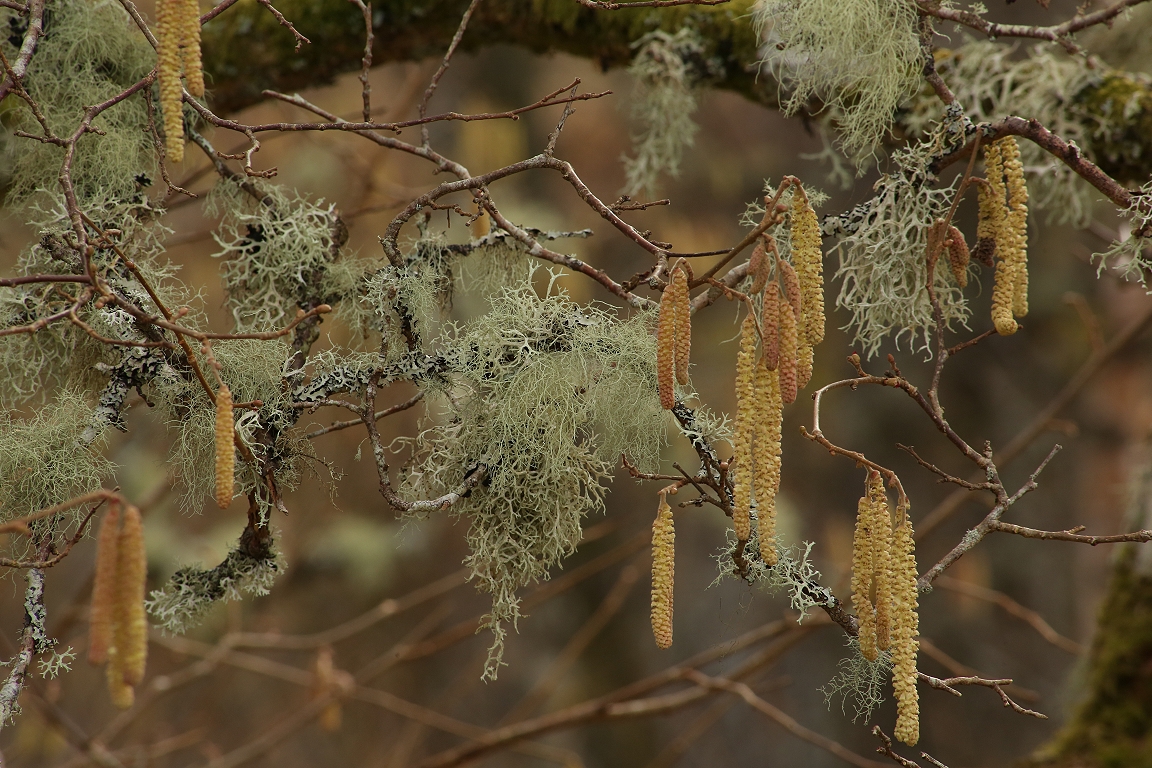
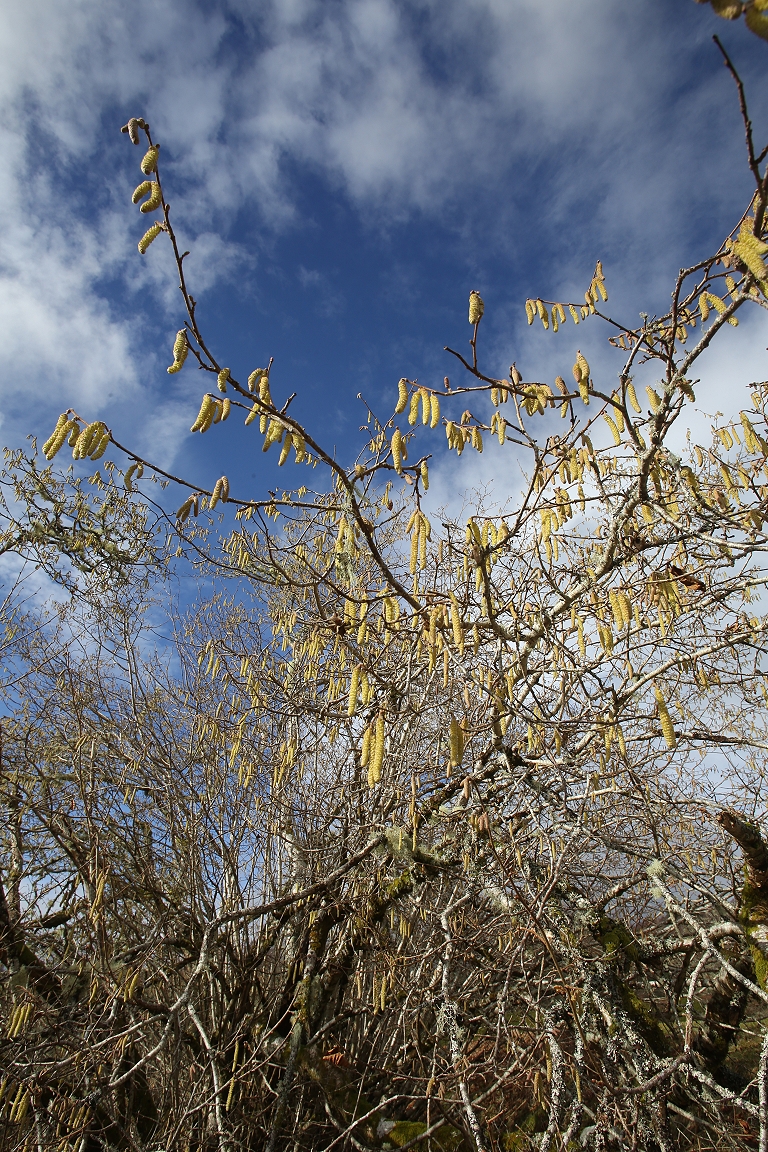
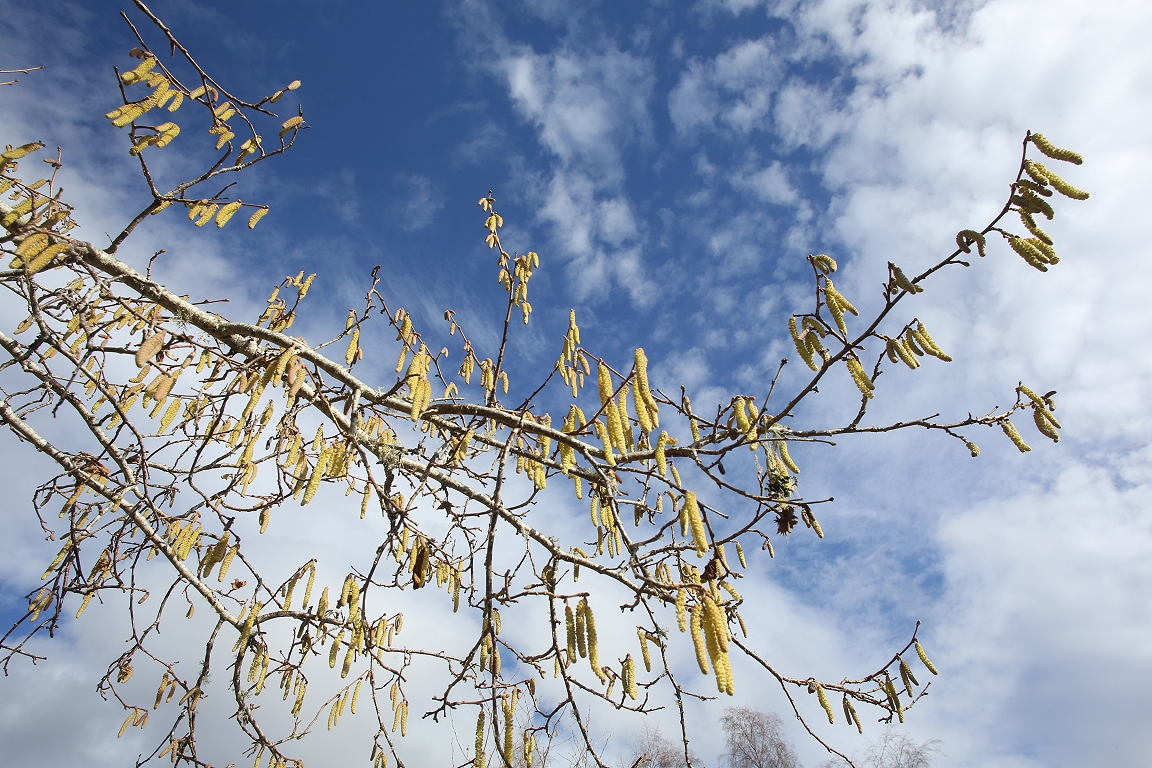
This is a remarkable year for hazel catkins. I don’t recall ever seeing quite as many in the area where we work as there are out at the moment. The hazels (Corylus avellana) are completely loaded with them, making them stand out very visibly from the other broadleaved trees in our forests in the Highlands. Some trees are utterly bedecked in hanging tassels, with the catkins crowded together, like sardines in a can.
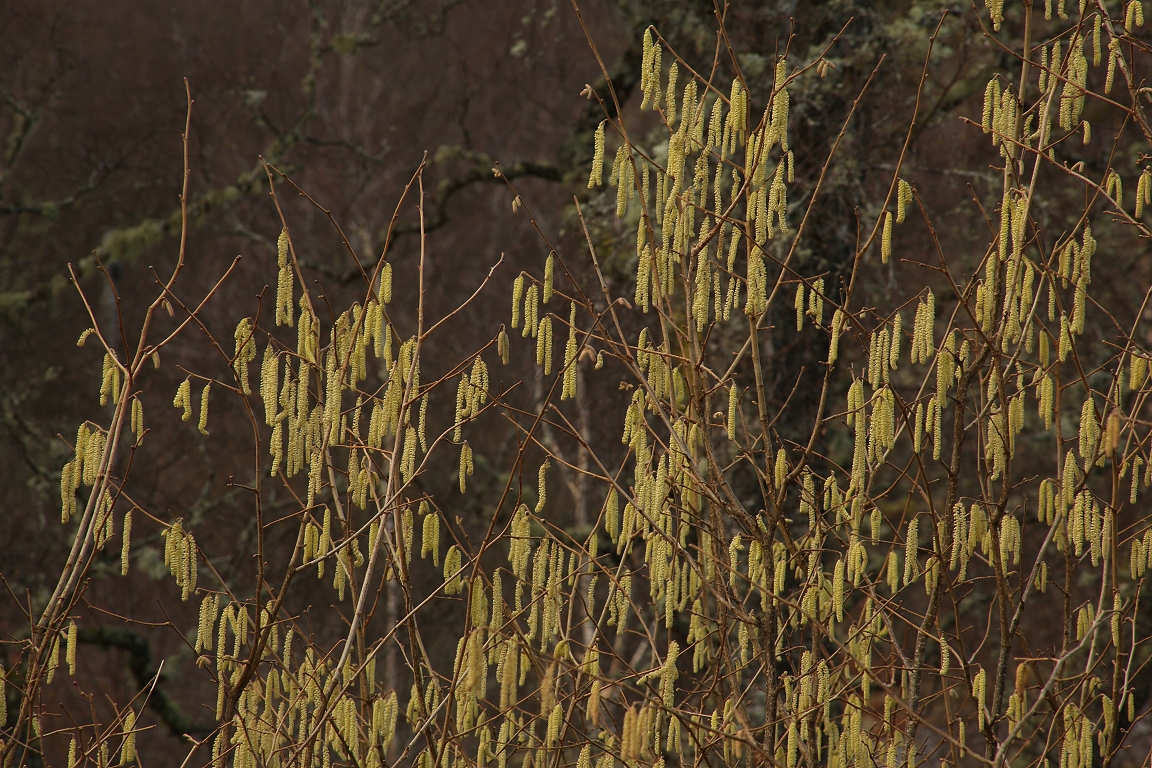
I first noticed hazel catkins this year at the north end of Loch Ness on 8th January, which seemed extraordinarily early, as it’s usually mid- to late-February when the first ones appear. We haven’t had any real winter weather at all – there have been very few days with frosts, and there’s been very little snow either – so everything in Nature is ahead of its usual timing, and the hazel catkins are a clear sign of this. It could almost be the ‘year without a winter’, given the conditions we’ve had so far, but I suspect we may yet see some colder weather before spring is fully here.
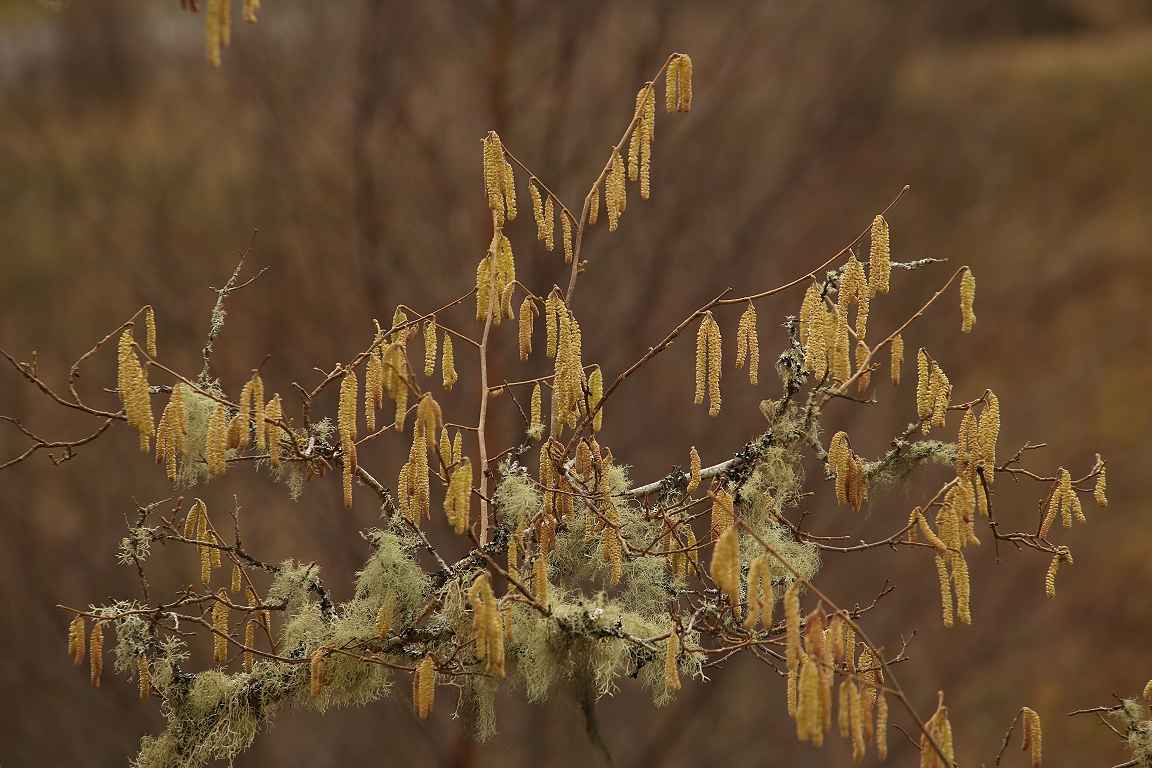
However, while the mild weather may account for the early emergence of the catkins, their sheer abundance is due to a different factor – the warm summer we had in 2013. The buds from which all of these catkins are bursting out just now were formed during the summer last year, and the relatively hot weather we experienced in the Highlands enabled the trees to be much more productive than usual in terms of how many catkin buds developed.
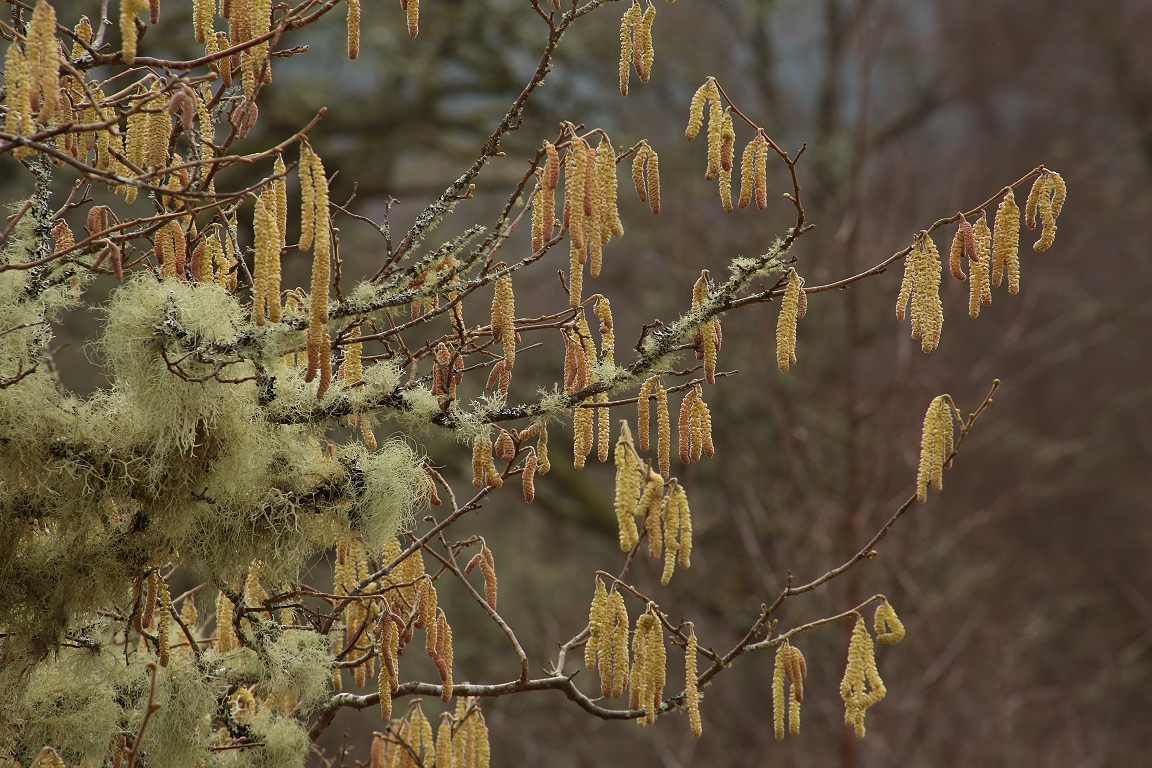
It is this combination, of a warm summer followed by a mild winter, which has produced this extraordinarily abundant and early display of catkins, the like of which I can’t recall from any recent year. It’s a veritable phenomenon of phenology – the study of periodic seasonal events in nature, such as the timing of leaf emergence in spring, the beginning of annual migrations of birds etc.
Although I’d seen the first catkins out beside Loch Ness in early January, none had been visible on Dundreggan then. Because of its large volume of water, Loch Ness has a gigantic moderating effect on the local climate, and it never gets as cold there in winter as it does at Dundreggan, which is about 7 miles west of the loch. This means that spring is always more advanced along the lochside than it is at Dundreggan, so it was only in the middle of February that catkins appeared on the hazels there.
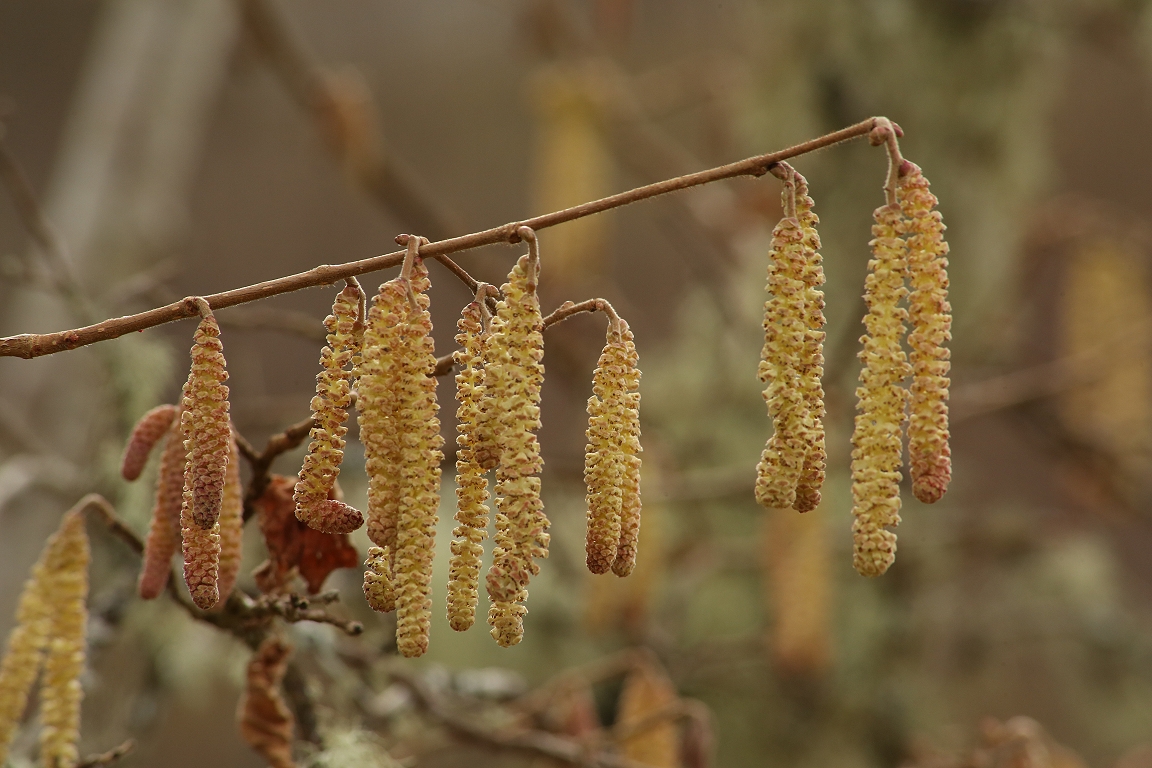
By the time of my visit there this day, at the beginning of March, the catkins were just about at their peak, with many of them fully extended and open, but others still to lengthen a bit more, as they stretch out from their buds. One hazel in particular, which had a lot of lichens growing on its branches, was festooned with masses of catkins, in a density and abundance that was almost overwhelming in its sheer profligacy.
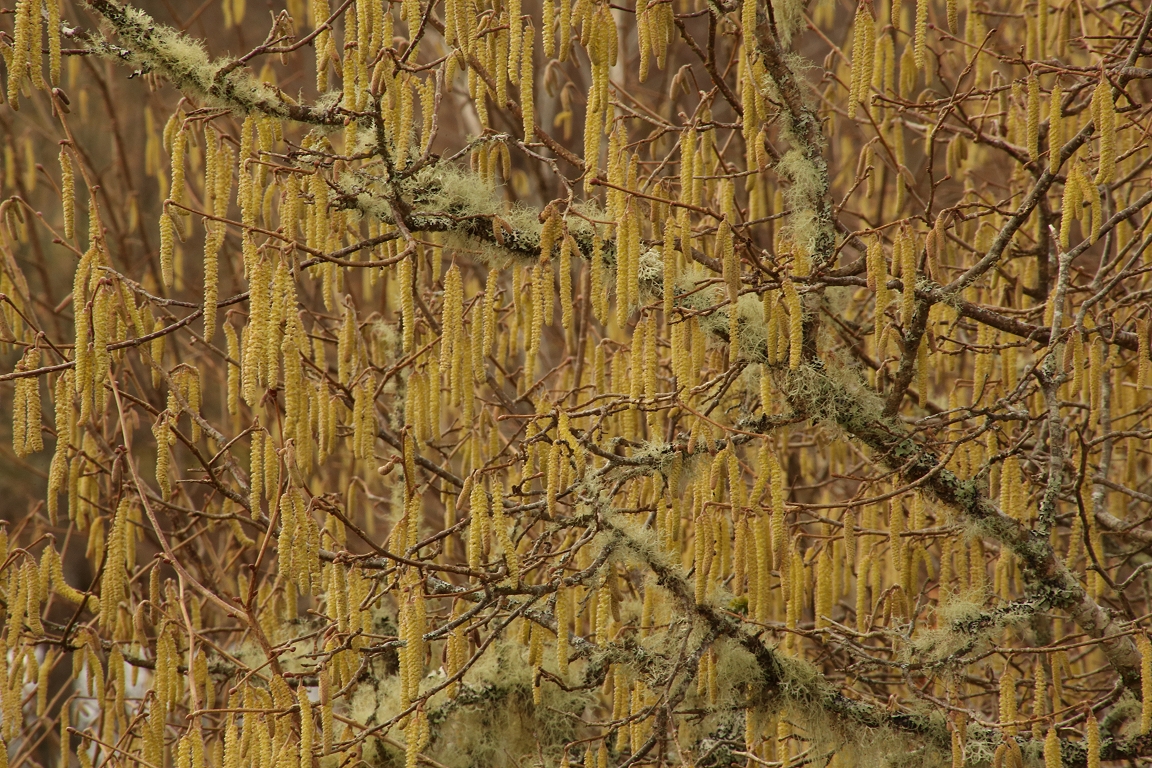
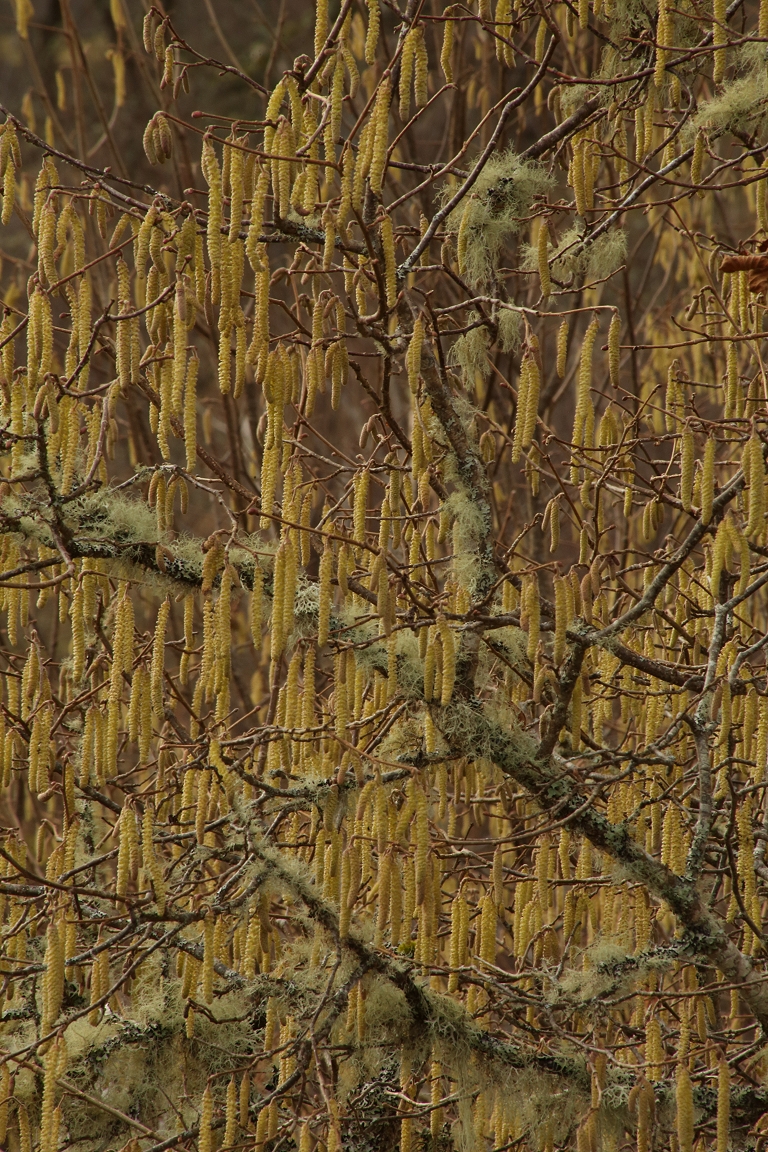
The huge number of catkins on the hazels this year will produce a bumper crop of hazelnuts in the autumn.
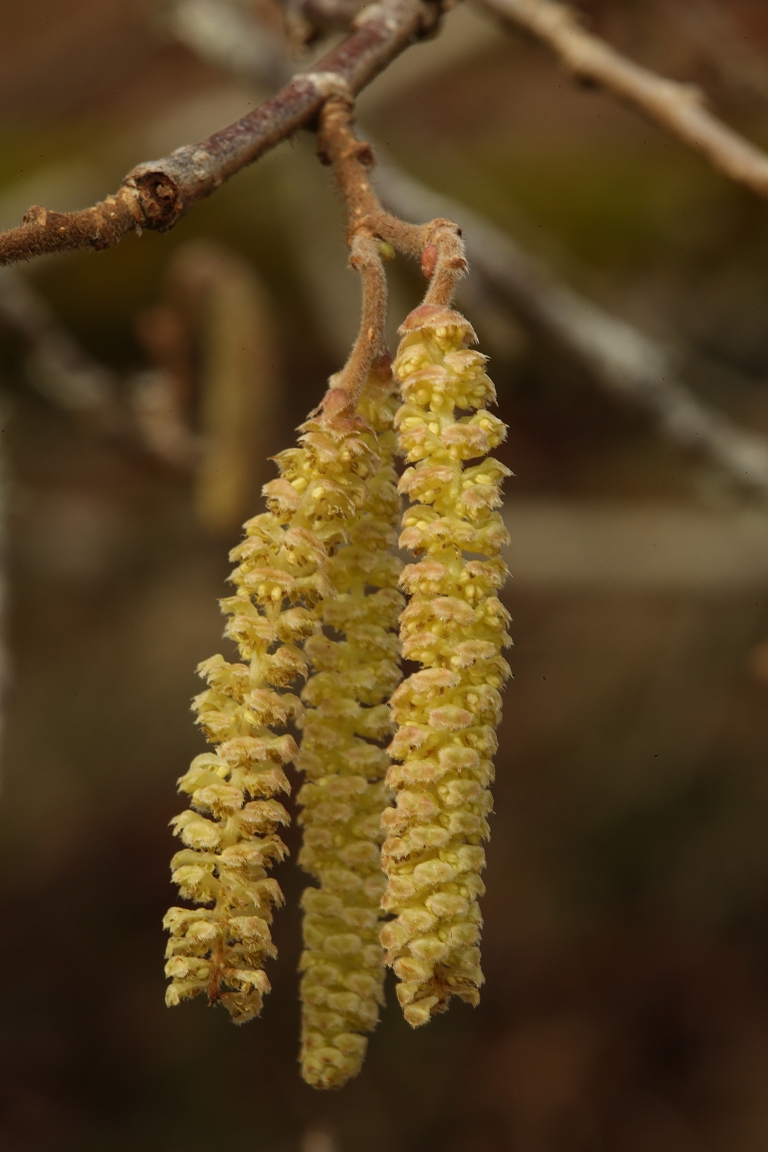
As a result this will be a so-called ‘mast’ year, in which the production of nuts vastly exceeds the normal productivity of the trees in most years. It will be followed by several years of relatively few nuts, before another mast year occurs, and this irregular cycle of mast years occurs in a number of tree species, including hazel, oak and many large-seeded trees in the tropical rainforests. A theory called the ‘predator satiation hypothesis’ has been developed to account for this phenomenon in the rainforests. The rationale is that the huge seed production of a mast year enables nuts to survive the attentions of seed eating birds and mammals, so that some germinate and grow, to produce a new generation of trees. The seed-eaters cannot reproduce quickly enough to take advantage of the abundance, and the lower productivity of the trees in subsequent years prevents the seed eaters’ numbers from building up to levels that would consume all the nuts produced in a mast year. The theory makes intuitive sense to me, but whether it is an accurate explanation for the phenomenon, and also if it is applicable to mast fruiting in temperate forests, is still an open question.
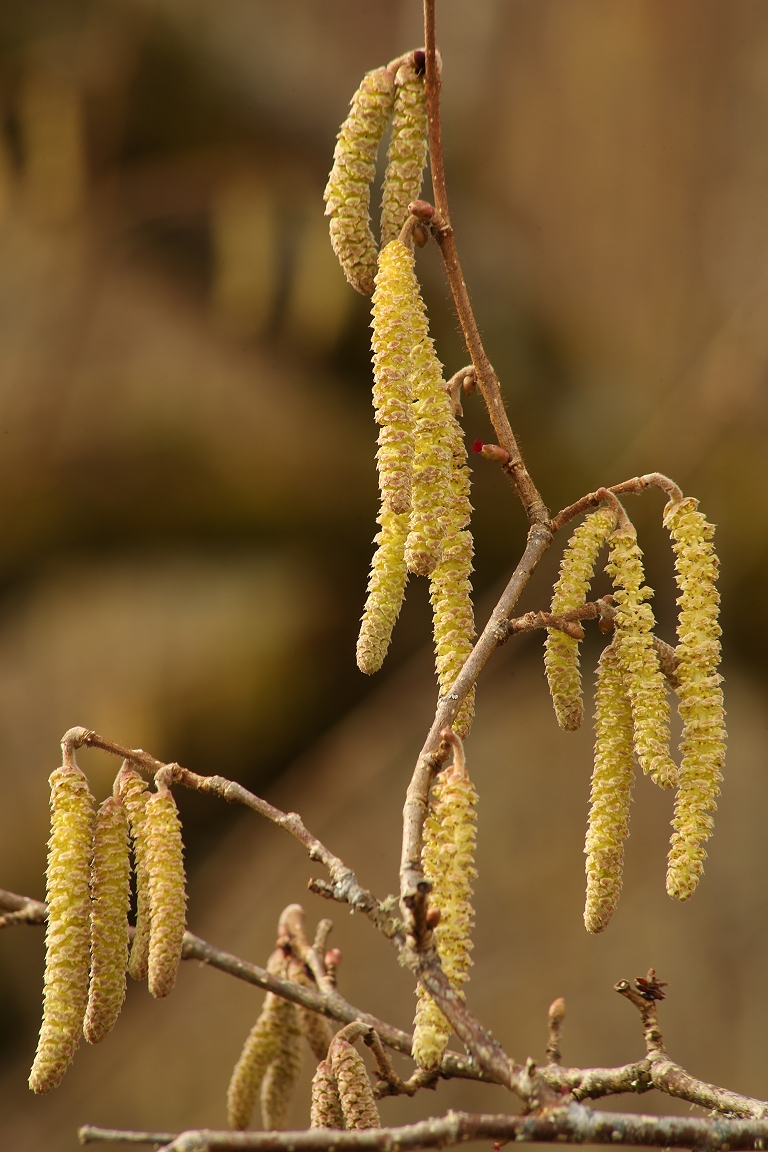
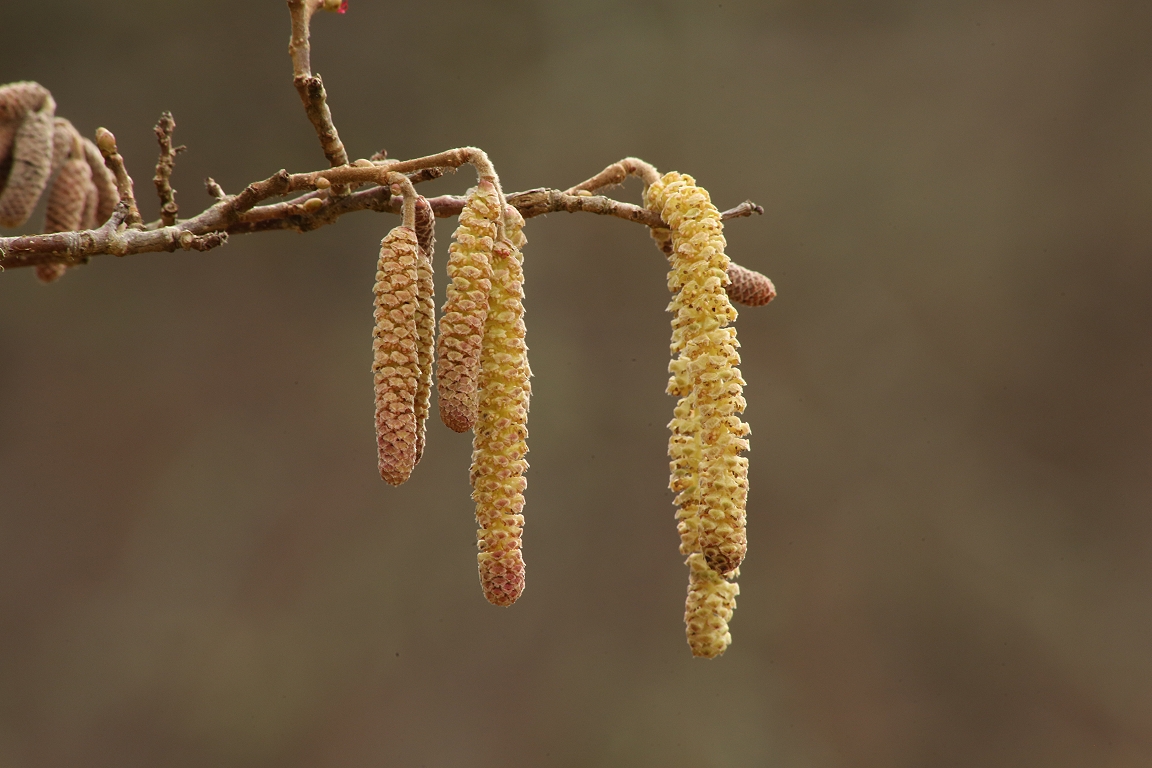
Hazel catkins are the tree’s male flowers. In contrast to their abundance and showiness, the female flowers are few in number, small in size and almost inconspicuous. They are tiny red tufts that emerge from the tip of some leaf buds, and one can be seen in the photo here on the right. They rely on the wind to blow pollen on to them when it is released by the male catkins.
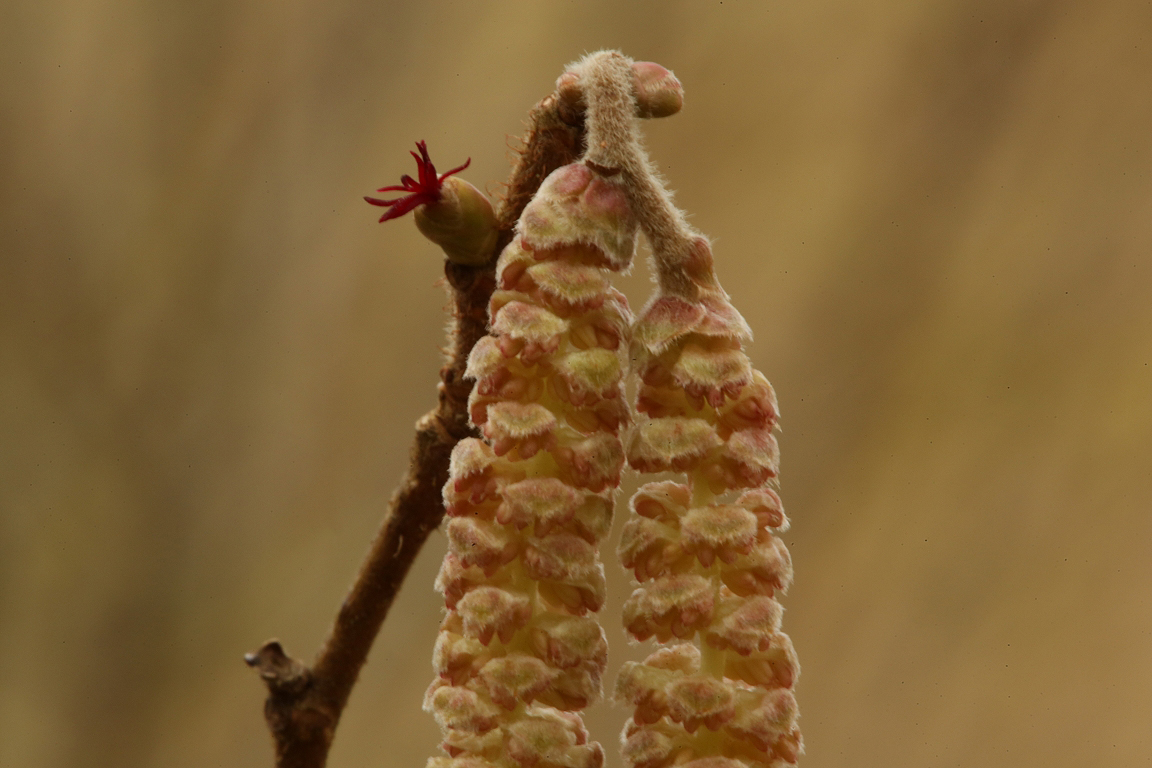
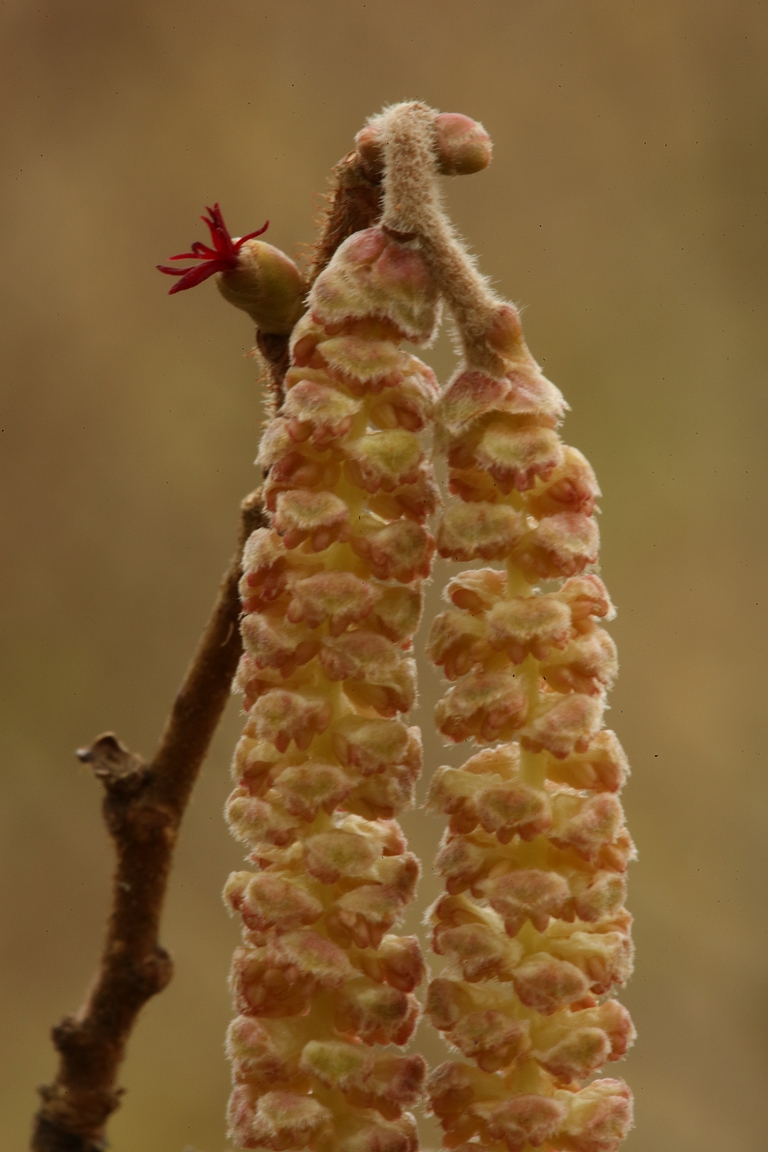
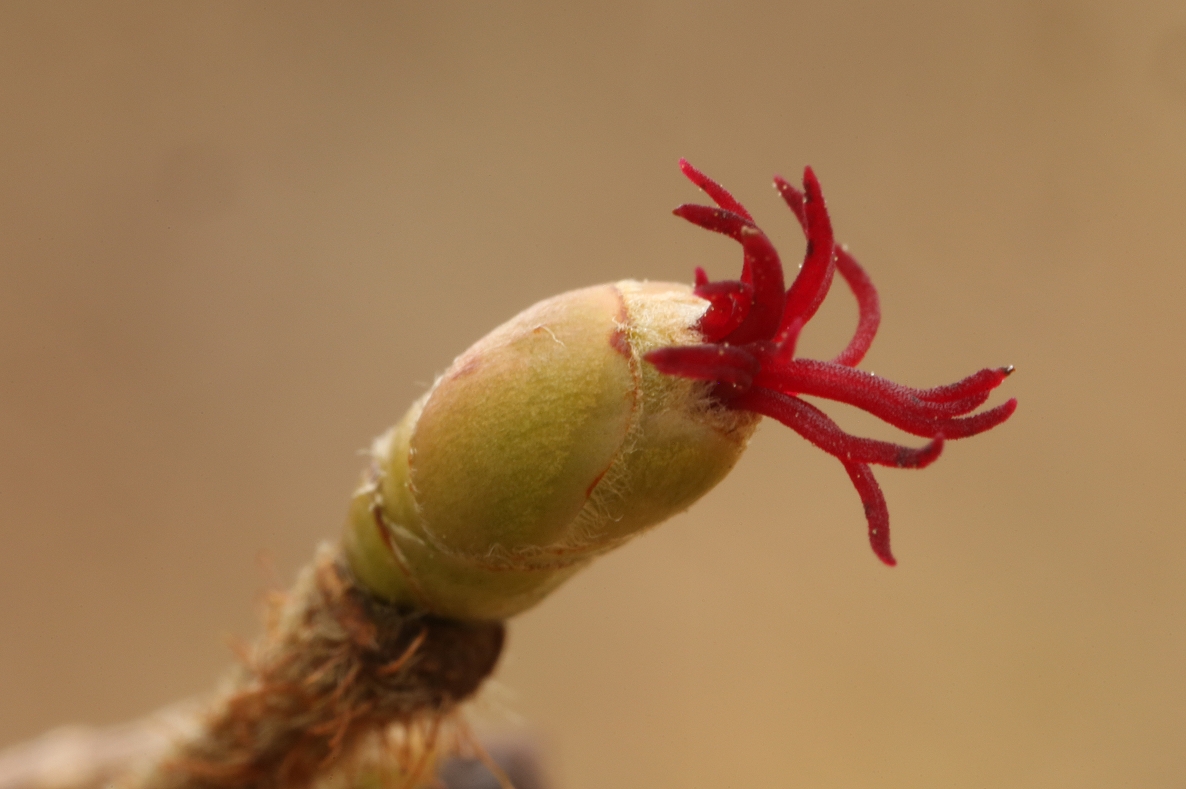
I took a number of photographs of the female flowers using my standard macro lens, and then, finding a particularly accessible one, I spent a while with my 5x life size, high magnification macro lens, eventually managing to take the photograph on the left above. I had a wait for quite a while for the wind to stop completely, as long exposures are required with that lens, in order to get a good depth of field (or planes of focus) in the image.
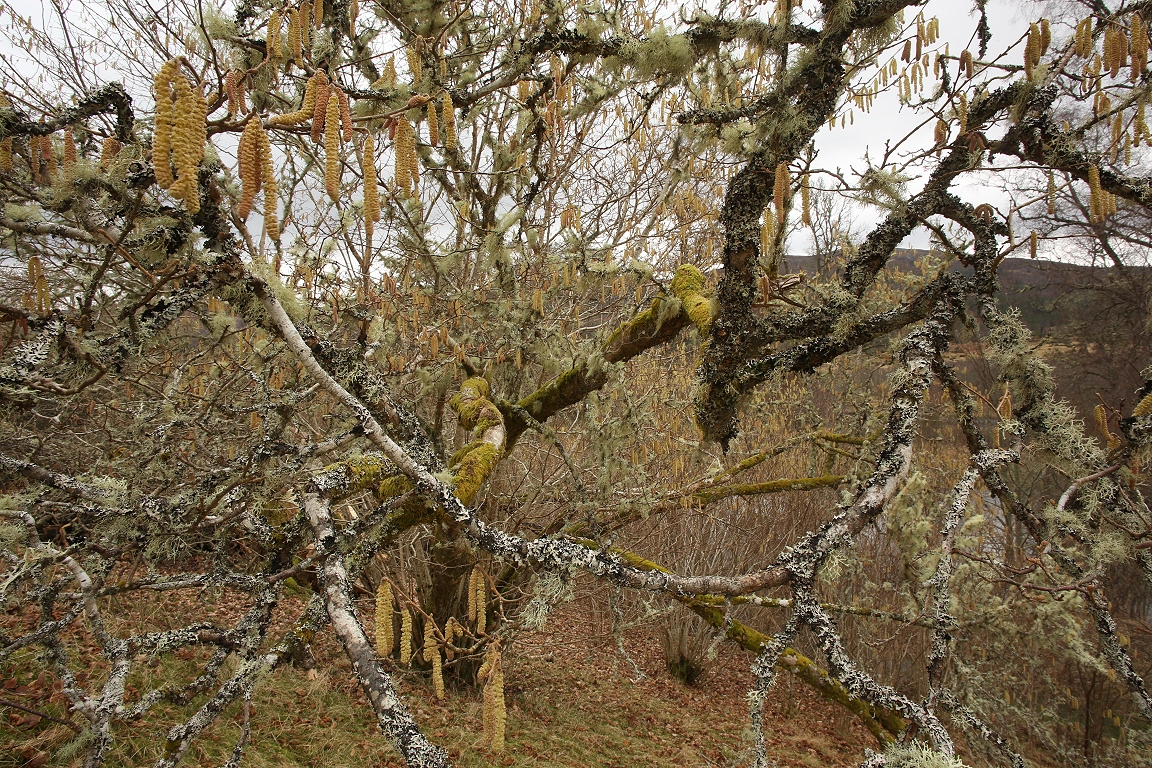
By this time, I’d moved about 20 metres from the hazel I originally stopped to photograph, and had turned my attention and camera to another tree nearby. It had a more sprawling branch structure, and was even more heavily-laden with lichens than the first one. While it still had large numbers of catkins on it, they didn’t seem quite as prolific as on the other tree. It looked like it was an older hazel, particularly given its growth form, so it may be that it was past its reproductive prime and therefore less profligate with its flowering.
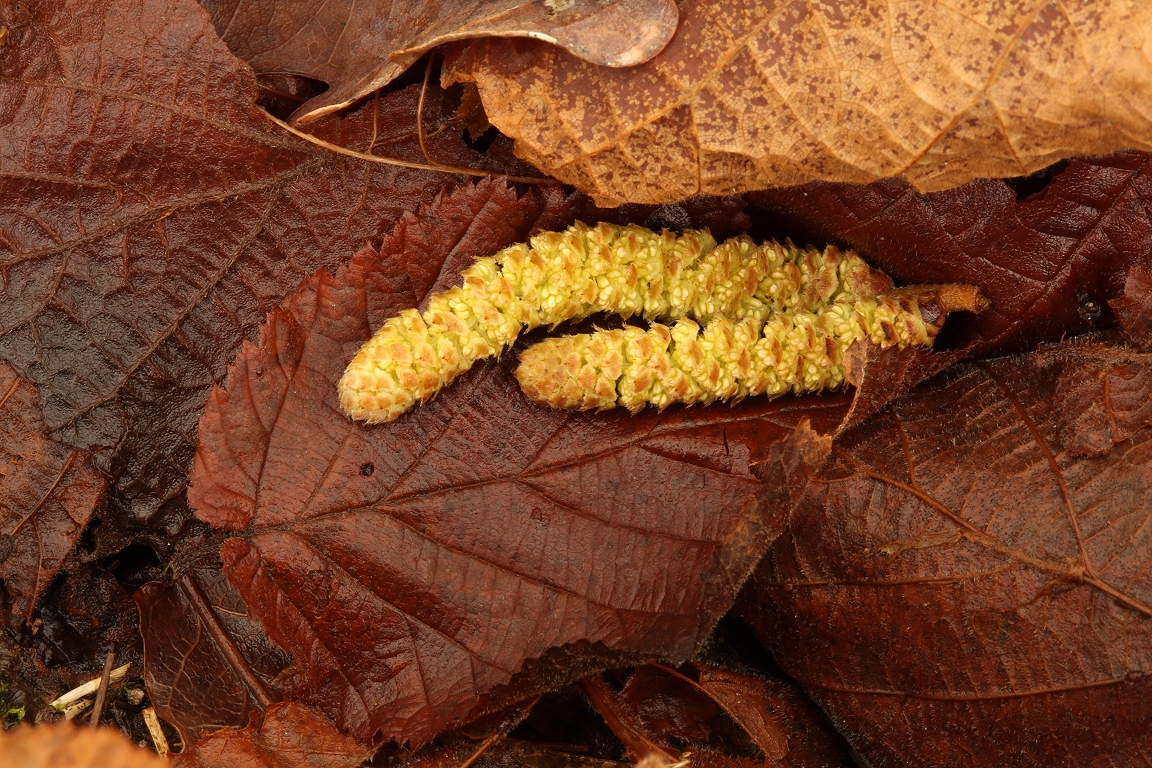
As I walked around this tree, I noticed that there were quite a few catkins lying on the ground in amongst the litter formed by last year’s fallen leaves. When I bent down to look more closely I saw that the catkins were just at the peak of their ripeness, so I surmised that they must have been blown down by a strong wind in the night. Usually they only fall off the tree of their own accord when they have released their pollen and have begun to wither – these however had not reached that stage.
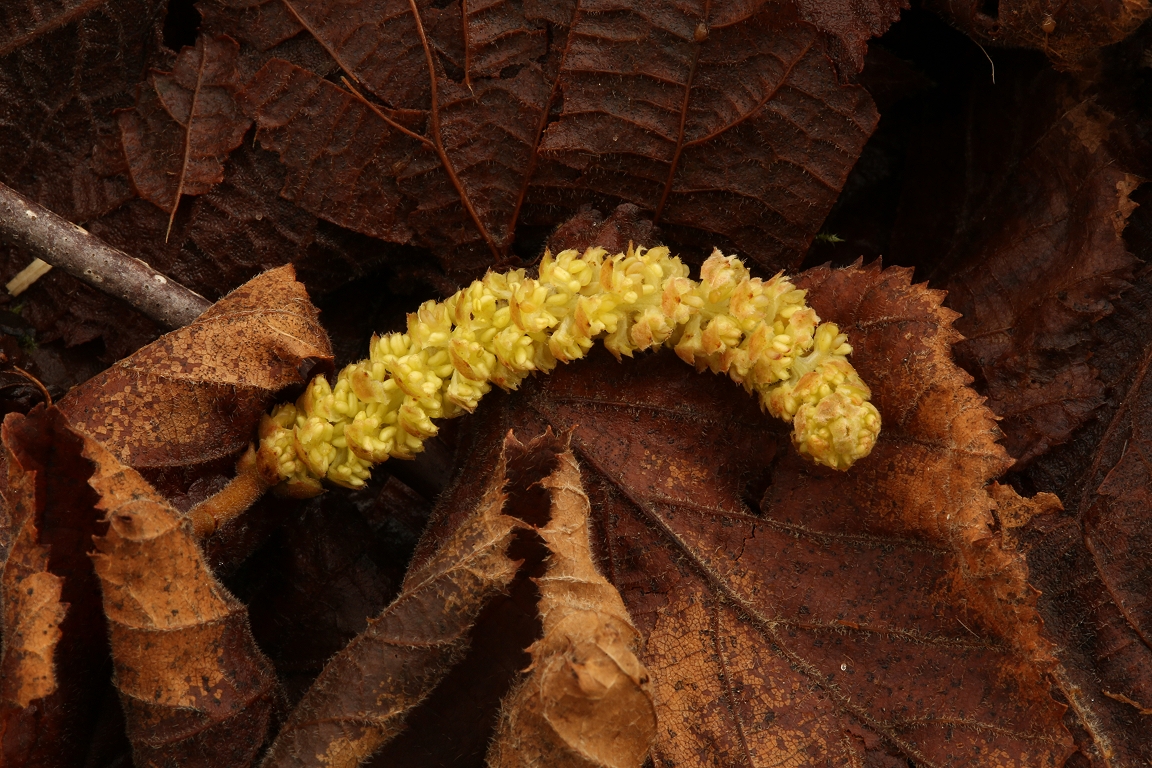
As I looked around, I saw quite a few catkins on the ground, scattered here and there. However, the total number that had been lost to the wind like this was a tiny proportion of the catkins still on the tree itself, so their loss would have had a negligible effect on the hazel’s reproductive prospects. One of the fallen catkins looked for all the world like a motionless green caterpillar, resting on a fallen hazel leaf.
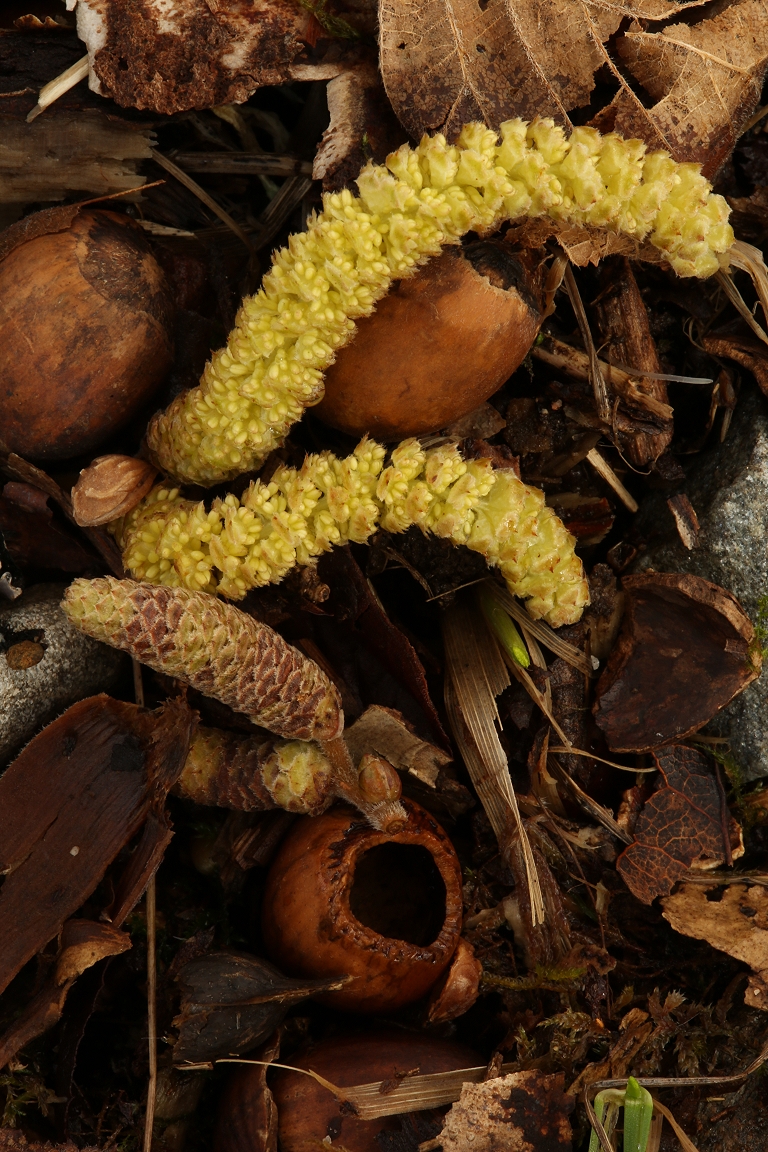
Some of the fallen catkins had ended up on the ground in amongst some of last year’s hazelnuts. Those had been broken open, probably by wood mice (Apodemus sylvaticus), and the nuts eaten, leaving the hollow shells with tell tale holes in them.
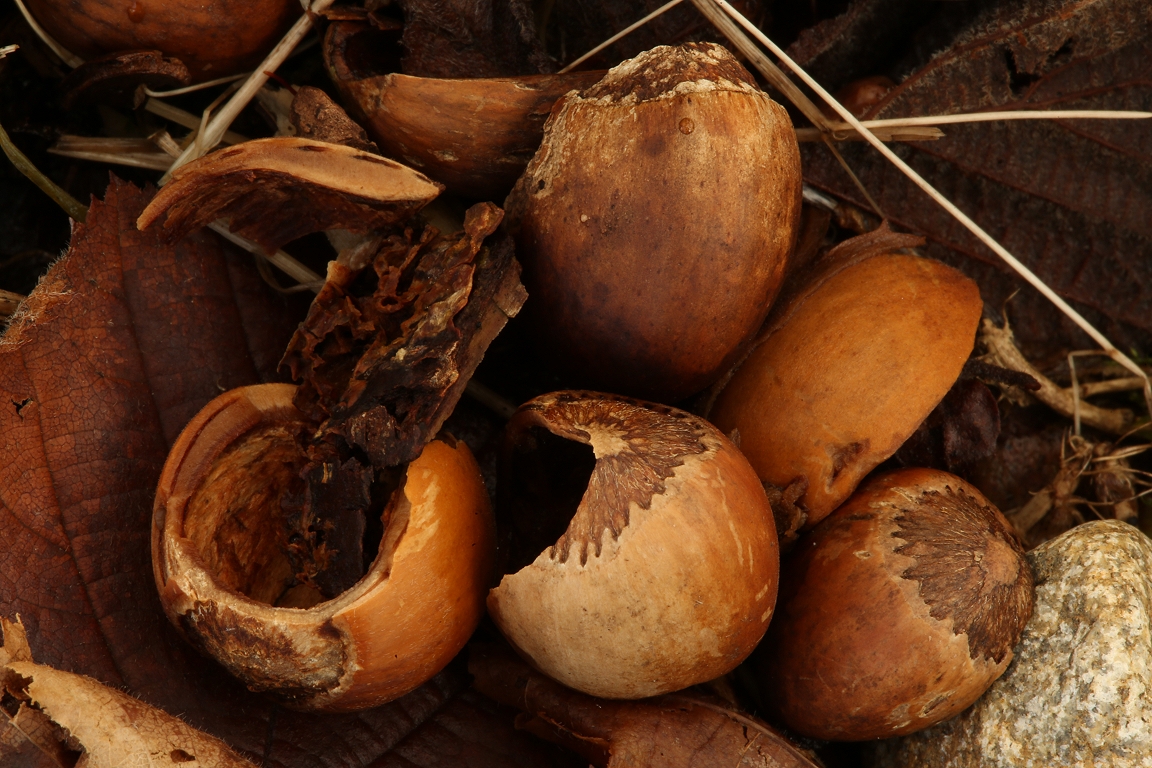
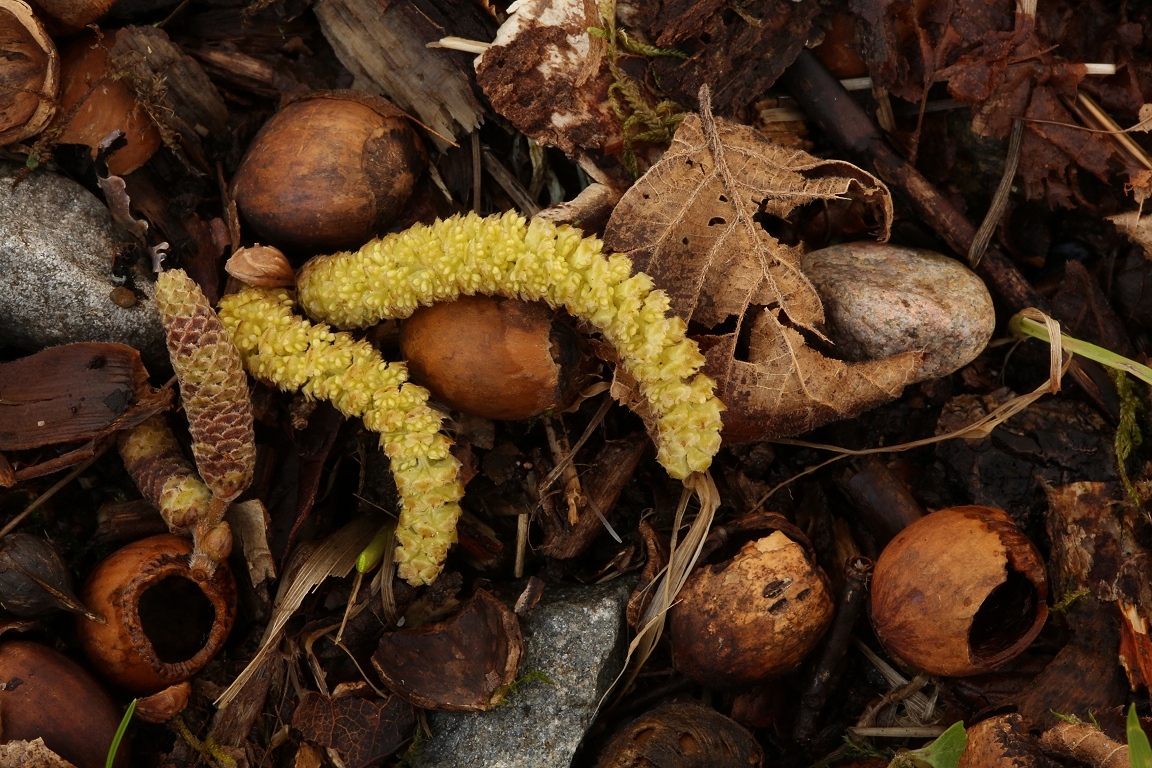
I searched on the ground for quite a while, looking for hazelnuts that hadn’t been eaten, and eventually I found about half a dozen in total. This was a very small proportion of the total number of nuts I saw there, but I suspected it will be a very different story next winter. Then there should be a much, much greater quantity of nuts being produced, as a result of the mass flowering taking place just now, and if the predator satiation theory is correct, then substantially greater numbers of them should survive the attentions of the wood mice.
It was a generally overcast day, and relatively windstill, which I was very pleased about, as it enabled me to take close up photographs of the catkins, without them becoming blurred by moving while the camera’s shutter was open. Then, for a brief period the sun came out, and I was able to take a few very different images.
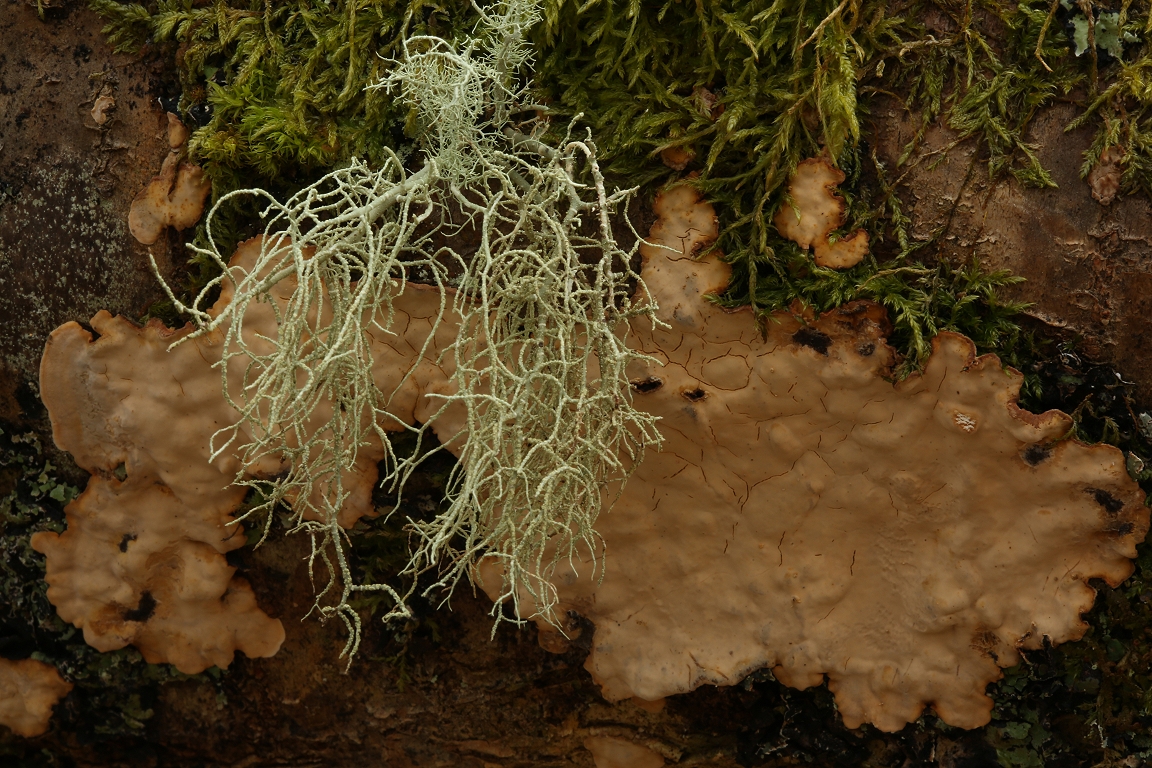
When the clouds came over again a few minutes later, I returned my attention to the hazel with the spreading, sprawling branches, and I noticed that it had some fungal fruiting bodies growing flush on the underside of one of the largest branches. These were from the fungus called bleeding broadleaf crust (Stereum rugosum) – so called because if the surface of the fungus is scratched, it turns a bright red colour that is reminiscent of blood.

By this time the light was beginning to dwindle, and I realised I’d spent most of the day with these two hazel trees, photographing their veritable cornucopia of catkins. I packed up and set off in the car for home, but only got a mile or so down the road, before I spotted some more hazel catkins, on a tree beside a large Scots pine (Pinus sylvestris), growing by the River Moriston, downstream from the dam. The combination of dangling catkins and spreading reddish-coloured branches of the pine drew my eye, so I took one last photo for the day before leaving the glen.
I believe I increased the number of male catkins considerably by fertilizing with Phosphorous, hopefully the same will happen with the female flowers.
Alan, I loved your photo of the female hazel flower. They are so tiny and insignificant-looking. Our allotment is growing a small plat of cobnuts. The flowers are similarly very small and bright pinky-red. I found them hard to find at first. I have made a drawing from your photo which I hope to make into a wood-engraving on a course I am doing next week. I shall be trying this spring to take a similar photo of oe of our cobnut flowers, following your experience. Many thanks, Mary
Hi Mary,
Thanks for your positive feedback, and I’m glad that my photo of the female flower is acting as an inspiration to you.
With best wishes,
Alan
HI Alan, very informative about hazels, I had never thought about the female flowers – is it the same with other trees with catkins? is alder one of them? and does willow have catkins or is that my imagination?
Hi Jiva,
Thanks for your comment on this blog. Yes, alder has catkins too – there’s information and photos on our alder species profile.
Willows also have catkins, and there’s information and photos about eared willow here.
With best wishes,
Alan